

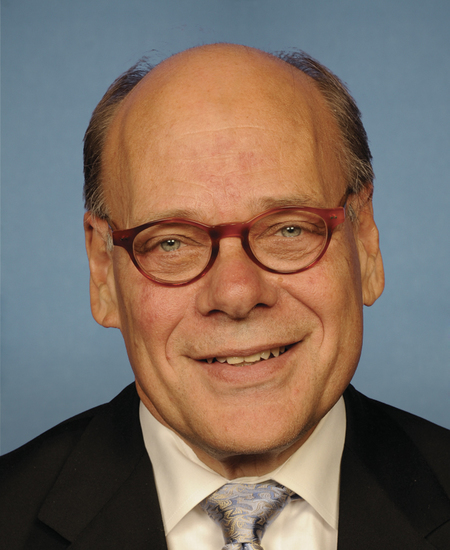
Photo of Steve Cohen
D United States House · District 9 · Tennessee

Rep. Steve Cohen

Compare
Total votes
2,837
all sessions
Attendance
97%
97 missed
Lower than 82% of chamber peers
With party
98%
of cast votes
Near the chamber average
Bipartisan score
1%
crosses aisle rarely
Near the chamber average
Sponsored
2,770
bills & resolutions
Higher than 96% of chamber peers
Committees
7
assignments
2,770 bills and resolutions

Sponsored bills

Total
2,770
Primary
198
Co-sponsor
2,572
This page
2,770
matching current filters
Co-sponsor HR 4769
In committee · United States House · Co-sponsor
PFAS Alternatives Act

Maddy summaryHR 4769, the PFAS Alternatives Act, funds research and training to develop PFAS-free turnout gear for firefighters. It authorizes $25 million annually (2024-2028) for grants to eligible organizations to research, develop, and test next-generation gear without per- and polyfluoroalkyl substances (PFAS), which are linked to firefighter cancer risks. The bill requires partnerships with firefighting organizations to ensure research translates into practical training and gear care guidance, including decontamination protocols. It also allocates $2 million yearly for training programs on proper gear use and maintenance, aiming to reduce exposure to hazardous chemicals during fire operations.

In committee Jul 21, 2023 1 co-sponsor
Co-sponsor HR 4785
In committee · United States House · Co-sponsor
Fracturing Responsibility and Awareness of Chemicals Act of 2023

Maddy summaryHR 4785, the Fracturing Responsibility and Awareness of Chemicals Act of 2023, requires oil and gas companies conducting hydraulic fracturing operations to disclose detailed chemical information to state agencies or the EPA. Specifically, companies must provide a pre-operation list of chemicals (including CAS numbers and volumes) and a post-operation report of chemicals actually used, which states must then make publicly available online. The bill also mandates immediate disclosure of proprietary chemical formulas to medical personnel during emergencies, without requiring prior written consent. It explicitly excludes natural gas storage from the definition of hydraulic fracturing. This bill directly affects oil and gas operators and state environmental agencies managing disclosure requirements.

In committee Jul 21, 2023 1 co-sponsor
Co-sponsor HR 4782
In committee · United States House · Co-sponsor
CLOSE Act

Maddy summaryThis bill, the CLOSE Act (HR 4782), removes a loophole that allowed oil and gas facilities to aggregate emissions from multiple sources when calculating pollution levels under federal law. It requires the EPA to add hydrogen sulfide - a pollutant linked to health harm - directly to the list of hazardous air pollutants within 180 days of the bill becoming law. The EPA must then, within a year, define specific categories of oil and gas wells and other sources that emit hydrogen sulfide. This change directly affects oil and gas operators by subjecting hydrogen sulfide emissions from their facilities to stricter federal pollution controls.

In committee Jul 21, 2023 1 co-sponsor
Co-sponsor HR 4775
In committee · United States House · Co-sponsor
Helping Tobacco Users Quit Act

Helping Tobacco Users Quit Act This bill provides for Medicaid and Children's Health Insurance Program (CHIP) coverage of certain tobacco cessation services. Specifically, the bill provides for coverage, without cost-sharing, of diagnostic, therapy, and counseling services and pharmacotherapy, including prescription and nonprescription tobacco cessation agents, that are provided under medical supervision and in accordance with specified guidelines. It also applies a 90% Federal Medical Assistance Percentage (i.e., federal matching rate) for such items and services for five years.

In committee Jul 21, 2023 1 co-sponsor
Co-sponsor HR 4778
In committee · United States House · Co-sponsor
FRESHER Act of 2023

Maddy summaryThe FRESHER Act of 2023 requires the Secretary of the Interior to study stormwater runoff impacts from oil and gas operations on environmental contamination and groundwater resources. The study must analyze measurable contamination levels, groundwater conditions, and aquifer vulnerability to contamination in affected areas. The Secretary must complete the study and submit a report to Congress within one year of the bill’s enactment. This bill does not impose new regulations on the oil and gas industry but mandates a federal review to inform future environmental policy decisions.

In committee Jul 21, 2023 1 co-sponsor
Co-sponsor HR 4777
In committee · United States House · Co-sponsor
CLEANER Act of 2023

Maddy summaryThe CLEANER Act of 2023 requires the Environmental Protection Agency (EPA) to evaluate within one year of enactment whether waste from oil, gas, and geothermal energy production - such as drilling fluids and produced waters - is hazardous. If determined hazardous, these wastes must be listed and regulated under existing hazardous waste rules, with potential modifications to address their unique properties while ensuring health and environmental protection. For non-hazardous waste from these sources, the EPA must establish new facility requirements, including groundwater monitoring, location standards, and financial assurance for cleanup. This bill directly affects oil, gas, and geothermal energy producers and facilities handling such waste.

In committee Jul 21, 2023 1 co-sponsor
Co-sponsor HR 4811
In committee · United States House · Co-sponsor
Safe Hydration is an American Right in Energy Development Act of 2023

Maddy summaryHR 4811 requires oil, gas, and geothermal companies conducting hydraulic fracturing (fracking) operations to test nearby underground drinking water sources before, during, and after activities. It mandates testing at specific intervals (e.g., before starting operations, every 6 months during operations, and annually for five years post-operation) and submitting results to the EPA within two weeks. Companies must test using EPA-certified labs for contaminants linked to fracking, with results stored in a public, searchable EPA database by ZIP code. The requirement does not apply if no accessible drinking water source exists within one mile of the site. The bill amends the Safe Drinking Water Act to establish these testing and reporting obligations.

In committee Jul 21, 2023 1 co-sponsor
Co-sponsor HR 4796
In committee · United States House · Co-sponsor
Reproductive Health Patient Navigator Act of 2023

Maddy summaryHR 4796, the Reproductive Health Patient Navigator Act of 2023, establishes a federal grant program to fund organizations that help individuals access abortion services. Eligible entities - such as abortion funds, community groups, or local governments - would receive grants to provide services like connecting people to providers, coordinating travel/financing costs, offering culturally appropriate information, and ensuring data confidentiality. The bill includes strong legal protections, prohibiting states from restricting or penalizing navigators for assisting people seeking abortion services, even in states where abortion is illegal. It also allows affected navigators to sue states that violate these protections. The program is funded for fiscal years 2023 through 2027.

In committee Jul 21, 2023 1 co-sponsor
Co-sponsor HR 4663
In committee · United States House · Co-sponsor
Federal Mechanical Insulation Act

Maddy summaryHR 4663, the Federal Mechanical Insulation Act, defines "mechanical insulation" (insulation around pipes and equipment in federal buildings) as an eligible energy efficiency measure. It requires federal agencies to include mechanical insulation in their required energy and water evaluations, specifically mandating that evaluations identify this insulation as a potential efficiency measure. The bill specifies that such insulation must meet minimum standards under Reference Standard 90.1 to qualify. This change directly affects federal building managers and contractors by formally recognizing mechanical insulation as a standard efficiency option in compliance with existing energy conservation laws.

In committee Jul 21, 2023 1 co-sponsor
Co-sponsor HRES 608
In committee · United States House · Co-sponsor
Recognizing the importance of diversity, equity, and inclusion efforts in higher education.

Maddy summaryHRES 608 is a non-binding House resolution recognizing the value of diversity, equity, and inclusion (DEI) efforts at colleges and universities. It affirms that DEI initiatives help create supportive learning environments where all students, faculty, and staff thrive, and specifically supports programs like implicit bias training and cultural competence resources. The resolution emphasizes that DEI efforts strengthen institutions’ ability to recruit diverse talent and align with academic freedom principles. It also notes concerns about state-level efforts to restrict DEI programs and states that such restrictions threaten campus inclusivity. As a symbolic resolution, it does not create new laws or funding but expresses congressional support for DEI work in higher education.

In committee Jul 20, 2023 1 co-sponsor
Showing 1,191 to 1,200 of 2,770 bills