

Protecting Family and Small Business Tax Cuts Act of 2022 This bill makes permanent provisions affecting individual and business taxpayers that were enacted in 2017 by the Tax Cuts and Jobs Act and are scheduled to expire at the end of 2025. The bill makes permanent provisions that reduce individual and capital gain tax rates. The bill increases the standard tax deduction for individual taxpayers. It also increases and modifies the child tax credit and raises the contribution base for the tax deduction of charitable contributions. The bill allows additional contributions to ABLE accounts (tax-exempt accounts designed to enable individuals with disabilities to save and pay for disability-related expenses). It exempts from taxation combat zone benefits of members of the Armed Forces serving in the Sinai Peninsula of Egypt and the moving expenses of servicemembers. Additionally, the bill lowers to $750,000 the amount of mortgage debt eligible for an interest expense tax deduction; excludes from the gross income of student borrowers income attributable to the discharge after 2025 of loan debt due to death or disability; makes permanent the limitation on the tax deduction for state and local taxes and denies a deduction for foreign real property taxes; makes permanent the tax deduction of the income of certain pass-through business entities; repeals the tax deduction for personal tax exemptions and the exclusion of employer-provided bicycle commuter fringe benefits; terminates certain miscellaneous itemized tax deductions; doubles the estate and gift tax exemption amount; and makes permanent the increase of the alternative minimum tax exemption amount for individual taxpayers.
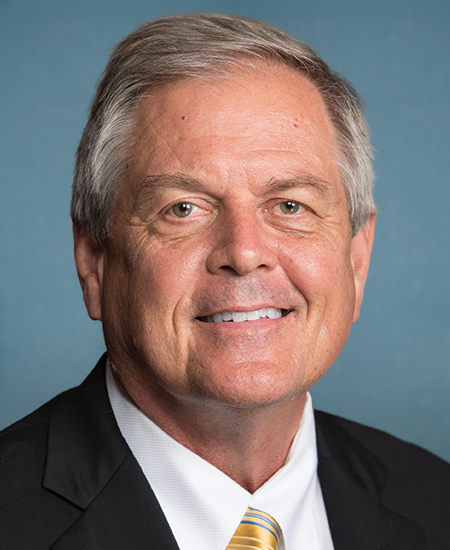
Rep. Ralph Norman
Sponsored bills
Secure America's Borders First Act This bill prohibits using federal funds to provide certain military assistance to Ukraine until a border wall system along the U.S.-Mexico border is completed and operation control of such border is achieved. Specifically, this prohibition shall apply to funds made available to the Department of Defense and funds made available for security assistance or security cooperation.
Service Restoration Act This bill prohibits the use of federal funds to require a member of the Armed Forces to receive a COVID-19 vaccination. The bill also prohibits adverse action (e.g., punishment) being taken against a member of the Armed Forces solely on the basis that the member refuses to receive a COVID-19 vaccination. Individuals who were involuntarily separated from the Armed Forces solely on the basis of their refusal to receive a COVID-19 vaccination must be reinstated in the grade they held prior to the separation. In computing retired or retainer pay, the military department concerned must include the time between the involuntary separation and reinstatement of the individual. The military department concerned must expunge adverse actions or references to involuntary separation related to the refusal to receive a COVID-19 vaccination from an individual's service record.
Close Biden's Open Border Act This bill provides $15 billion for the Department of Homeland Security to construct a border wall along the southern border of the United States. It also imposes a two-year moratorium on funding for U.S. contributions to the United Nations (U.N.). During the two-year period, funds may not be authorized or otherwise made available for contributions to the U.N.
Strengthening Enforcement and Criminalizing Unlawful Records Enabling Flights Act or the SECURE Flights Act This bill prohibits the use of warrants and other documents issued by U.S. Immigration and Customs Enforcement (ICE) as proof of identification at airport security checkpoints unless the individual is leaving the United States pursuant to immigration laws. If an individual uses prohibited documents as a proof of identification, the Transportation Security Administration (TSA) must (1) inform ICE and local law enforcement to determine whether the individual is in violation of any term of release, and (2) collect the individual's biometric information unless the TSA can verify the individual is a U.S. national. The TSA must also submit the biometric information to a national biometric identification system.
Blockchain Solutions for Small Businesses Act This bill requires the Small Business Administration to study the current and potential uses of blockchain technology (i.e., the technology that supports digital currencies such as Bitcoin) in making loans to qualified small businesses.
Senior Citizens Tax Elimination Act This bill repeals the inclusion of any Social Security or tier I railroad retirement benefits in gross income for income tax purposes. The bill also (1) appropriates funds to cover reductions in transfers to the Social Security and Railroad Retirement Trust Funds resulting from the enactment of this bill, and (2) expresses the sense of Congress against using tax increases to provide revenue necessary to carry out this bill.
Teamwork for Employees and Managers Act of 2022 This bill authorizes employers and employees to establish voluntary employee involvement organizations to address matters of mutual interest within the workplace (e.g., productivity, compensation, benefits, recruitment, and retention). Employee involvement organizations are not considered labor organizations under federal labor laws, and they do not constitute an unfair labor practice by an employer provided the employees are not already represented by a labor organization.
TSA Security Threat Assessment Application Modernization Act This bill requires the Transportation Security Administration (TSA) to standardize the enrollment and renewal system for individuals applying for or renewing multiple TSA Security Threat Assessment programs, including the Transportation Worker Identification Credential, Hazardous Materials Endorsement, and TSA PreCheck programs. The standardization shall permit an individual to (1) enroll at a TSA-designated universal enrollment center once and use the application for one of such programs to enroll in two or more of such programs,with specified exceptions for those applying for or renewing enrollment in more than one program at different times; (2) apply successful, valid clearance results from a TSA Security Threat Assessment to satisfy vetting requirements for participation in any related program without additional cost; and (3) undergo a streamlined and expeditious renewal process. Additionally, the TSA must publish on its website information relating to the standardization of the enrollment system.
Respecting the Rights of Organ Donor Recipients Act of 2022 This bill prohibits limiting access to organ transplants based on an individual's COVID-19 vaccination status. Specifically, the Organ Procurement and Transplantation Network may not (1) request an individual's COVID-19 vaccination status when considering whether to place the individual on an organ transplant waitlist, or (2) require the vaccination in order for an individual to receive an organ transplant. This network is a public-private partnership that links organizations (e.g., transplantation centers and laboratories) in the organ donation and transplantation system.