

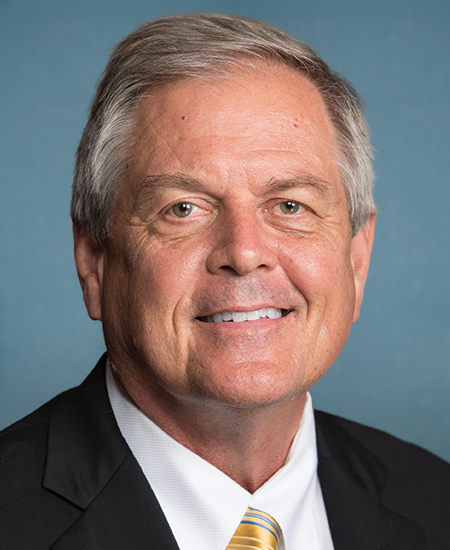
Photo of Ralph Norman
R United States House · District 5 · South Carolina

Rep. Ralph Norman

Compare
Total votes
2,837
all sessions
Attendance
95%
142 missed
Lower than 95% of chamber peers
With party
81%
of cast votes
Lower than 97% of chamber peers
Bipartisan score
10%
crosses aisle rarely
Higher than 96% of chamber peers
Sponsored
1,403
bills & resolutions
Near the chamber average
Committees
6
assignments
1,403 bills and resolutions

Sponsored bills

Total
1,403
Primary
78
Co-sponsor
1,325
This page
1,403
matching current filters
Co-sponsor HR 1228
In committee · United States House · Co-sponsor
Combating Racist Training in the Military Act of 2023

Maddy summaryHR 1228 prohibits the U.S. military and Department of Defense-operated academic institutions from promoting specific anti-American or racist theories in training. It bans military programs that teach ideas such as "the U.S. is fundamentally racist," "the Constitution is fundamentally racist," or that "an individual’s worth is determined by race." The bill explicitly states it does not restrict protected speech, research access, or educational contexts that clearly disavow military endorsement of such theories. This directly affects military training curricula, workshops, and educational materials within the armed forces.

In committee Feb 28, 2023 1 co-sponsor
Co-sponsor HRES 132
Passed · United States House · Co-sponsor
Responding to the earthquakes in Türkiye and Syria on February 6, 2023.

Maddy summaryHRES 132 is a non-binding House resolution expressing condolences for the over 36,000 earthquake victims in Türkiye and Syria and commending humanitarian response efforts. It specifically condemns the Assad regime for obstructing aid delivery and exploiting the disaster, urging the Biden administration to open all UN border crossings for aid and prevent U.S.-funded assistance from being diverted to Syria’s government. The resolution also calls for continued enforcement of the Caesar Syria Civilian Protection Act to protect Syrian civilians. As a symbolic resolution, it does not create new law but formally directs the administration’s diplomatic approach to the crisis.

Passed Feb 27, 2023 1 co-sponsor
Co-sponsor HR 1206
In committee · United States House · Co-sponsor
Federal Agency Sunset Commission Act of 2023

Maddy summaryThe Federal Agency Sunset Commission Act of 2023 would establish a 13-member commission to review all federal agencies every 12 years (or less) to determine if they should be abolished, reorganized, or continued. The commission would evaluate agencies based on specific criteria including efficiency, cost-effectiveness, duplication with other agencies, and whether the agency has achieved its original purpose. Agencies would be scheduled for review and potentially abolished unless Congress reauthorizes them, with a supermajority vote allowing up to a 2-year extension. This bill directly affects all federal agencies and would require Congress to periodically assess the necessity of government programs. The commission would also monitor new legislation to prevent unnecessary creation of new agencies or programs.

In committee Feb 27, 2023 1 co-sponsor
Co-sponsor HR 1200
In committee · United States House · Co-sponsor
National Right-to-Work Act

Maddy summaryHR 1200, the National Right-to-Work Act, prohibits requiring workers to join a union or pay dues as a condition of employment in both private-sector workplaces (covered by the National Labor Relations Act) and railroad industries (covered by the Railway Labor Act). The bill amends key sections of these laws to eliminate provisions that allowed union security agreements, meaning workers in unionized settings would no longer be forced to pay dues to retain their jobs. This directly affects employees in unionized workplaces across the U.S., particularly those in industries with existing union contracts that included mandatory dues. The law changes the legal framework to ensure union membership and dues payment remain voluntary for all workers.

In committee Feb 27, 2023 1 co-sponsor
Co-sponsor HR 597
In committee · United States House · Co-sponsor
Stop the Cartels Act

Maddy summaryThe Stop the Cartels Act (HR 597) aims to disrupt drug trafficking organizations and related criminal activities by requiring enhanced intelligence gathering on cartels in Mexico and Central American countries, mandating improved U.S.-Mexico law enforcement cooperation, and cutting federal funding from jurisdictions that restrict immigration enforcement. The bill creates a "Special Transnational Criminal Organization" designation for major cartels like the Sinaloa Cartel and Jalisco New Generation Cartel, requires monthly reports on migrant encounters at the border, and establishes refugee processing centers in Mexico and Central America. It also increases staffing for immigration courts by 500 judges, prohibits asylum applications from nationals of countries with refugee processing centers, and reauthorizes substance abuse prevention funding at higher levels while repealing several existing drug programs. These provisions directly affect U.S. intelligence and law enforcement agencies, Mexican and Central American governments, local jurisdictions receiving federal funds, and migrants seeking asylum or refugee status.

In committee Feb 27, 2023 1 co-sponsor
Co-sponsor HR 1122
In committee · United States House · Co-sponsor
CBDC Anti-Surveillance State Act

CBDC Anti-Surveillance State Act This bill limits the ability of the Federal Reserve to (1) provide direct services to individuals, and (2) use a central bank digital currency. A central bank digital currency is a digital currency (e.g., Bitcoin or Ether) issued by a government-backed central bank. Specifically, the bill prohibits the Federal Reserve and the Federal Open Market Committee from using any central bank digital currency to implement monetary policy. In addition, a Federal Reserve bank is prohibited from offering products or services directly to an individual, maintaining an account on behalf of an individual, or issuing a central bank digital currency directly to an individual. The Federal Reserve must (1) consult with each Federal Reserve bank with respect to any central bank digital currency study or pilot program, and (2) issue quarterly reports on the findings and determinations of any such study or program.

In committee Feb 21, 2023 1 co-sponsor
Co-sponsor HR 150
In committee · United States House · Co-sponsor
Protecting American Energy Production Act

Maddy summaryHR 150, the Protecting American Energy Production Act, gives states primary authority to regulate hydraulic fracturing (fracking) for oil and gas on state and private lands, directly affecting state governments and energy producers. The bill requires states to maintain this regulatory role and blocks the President from imposing a fracking moratorium without explicit congressional approval. Key provisions include a Congressional "sense" statement affirming state primacy and a direct prohibition on presidential moratoriums unless authorized by a new law. This bill focuses on shifting regulatory power to states and limiting federal executive action on fracking, without specifying financial impacts or environmental standards.

In committee Feb 21, 2023 1 co-sponsor
Co-sponsor HRES 118
In committee · United States House · Co-sponsor
Maintaining Medicare.

This resolution expresses the sense of the House of Representatives that Medicare should be strengthened and should not be used to finance Democrats' policies.

In committee Feb 17, 2023 1 co-sponsor
Co-sponsor HR 1102
In committee · United States House · Co-sponsor
UNRWA Accountability and Transparency Act

Maddy summaryThis bill would require the U.S. to withhold funding for the UNRWA (United Nations refugee agency for Palestinians) unless the State Department certifies UNRWA staff, materials, and facilities comply with specific conditions. Key conditions include confirming no ties to terrorism or anti-Israel rhetoric (like denying Israel's right to exist or promoting BDS), no misuse of UNRWA resources for terrorist activities, and adherence to international financial audits. It also caps U.S. contributions to UNRWA at levels comparable to Arab League countries and mandates annual reports to Congress on phasing out UNRWA support. These changes directly affect U.S. foreign aid decisions for Palestinian refugees in Jordan, Lebanon, Syria, Gaza, and the West Bank.

In committee Feb 17, 2023 1 co-sponsor
Co-sponsor HR 997
In committee · United States House · Co-sponsor
English Language Unity Act of 2023

Maddy summaryHR 997, the English Language Unity Act of 2023, would establish English as the official language of the United States government. It requires all federal government functions, including laws, regulations, and public communications, to be conducted in English, with exceptions for national security, disability education, census activities, and public health. The bill also sets uniform English language standards for naturalization, requiring applicants to read and understand the Declaration of Independence, Constitution, and U.S. laws, with naturalization ceremonies conducted solely in English. This legislation directly affects federal agencies, government communications, and individuals seeking U.S. citizenship.

In committee Feb 14, 2023 1 co-sponsor
Showing 641 to 650 of 1,403 bills
Previous 1 … 64 65 66 … 141 Next