

Maddy summaryHR 825, the BOLIVAR Act, prohibits U.S. federal agencies from entering into contracts for goods or services with entities knowingly conducting significant business dealings with Venezuela's government under Nicolás Maduro, which the U.S. does not recognize as legitimate. The law directly affects U.S. government contractors and businesses operating in Venezuela, banning contracts with those engaging in commerce with the Maduro regime. Key exceptions include contracts for humanitarian aid, disaster relief, national security needs, U.S. diplomatic operations in Venezuela, and contracts with international organizations. The prohibition applies to contracts entered into within three years of the bill's enactment, with the Secretary of State required to notify Congress about exceptions used.
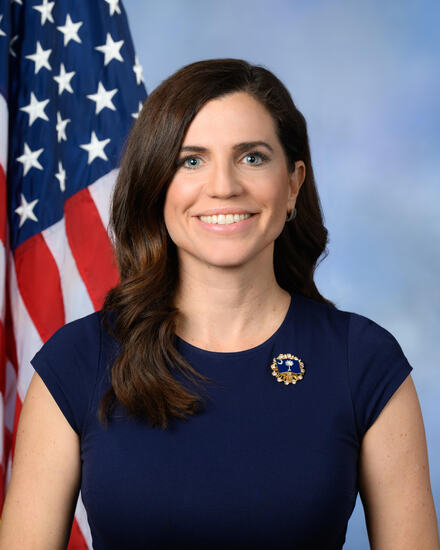
Rep. Nancy Mace
Sponsored bills
Maddy summaryHRES 1577 is a resolution expressing congressional support for National Adoption Day (November 23, 2024) and National Adoption Month (November 2024). It highlights that over 108,000 children in U.S. foster care are waiting for adoption and encourages Americans to consider adoption to help provide safety, permanency, and well-being for children. The resolution does not create new laws but formally recognizes the importance of adoption and urges the public to support efforts to place children in permanent families. It directly affects public awareness and encourages citizen engagement during these designated observances.
Maddy summaryHRES 1579 is a House resolution requiring all Members, officers, and employees of the House to use single-sex facilities (such as restrooms, locker rooms, and changing rooms) in Capitol and House office buildings that correspond to their biological sex. It prohibits the use of facilities not matching one's biological sex within these locations. The Sergeant-at-Arms would enforce this rule. This resolution applies solely to internal House operations and does not affect public facilities or external policies.
Maddy summaryThe Sunshine Protection Act of 2023 would end the practice of changing clocks twice a year for daylight saving time (DST) by making DST permanent nationwide, unless a state chooses to remain on standard time. It repeals the requirement to switch clocks back to standard time in the fall, directly affecting all U.S. states and territories that currently observe DST. The bill allows states that previously opted out of DST under the Uniform Time Act (like Arizona and Hawaii) to maintain their current time zone choices without further action. Key provisions include adjusting time zone offset language in existing law and granting states the authority to select either permanent DST or standard time based on their current arrangements. This change would eliminate seasonal time changes for most Americans, though states could still choose to stay on standard time if they prefer.
Maddy summaryHR 10111, the UAP Whistleblower Protection Act, expands federal whistleblower protections to cover disclosures about the use of taxpayer funds for researching unidentified anomalous phenomena (UAP). It amends existing laws to explicitly include "the use of Federal taxpayer funds to evaluate or research unidentified anomalous phenomena material" as a protected disclosure category. This applies to federal civilian employees, FBI personnel, Department of Defense personnel, DOD contractors, federal civilian contractors, and intelligence community workers. The bill ensures these individuals cannot face retaliation for reporting misuse of public funds related to UAP research, without altering how UAP investigations are conducted.
Maddy summaryHRES 1566 is a symbolic House resolution honoring all U.S. veterans on Veterans Day 2024. It recognizes the service and sacrifice of the estimated 15.8 million veterans living in the U.S. as of 2023, including those who served in conflicts from World War II to post-9/11. The resolution calls on the American public to observe Veterans Day to acknowledge veterans' role in preserving national freedom. As a non-binding resolution, it has no direct policy impact but formally expresses congressional recognition of veterans' contributions.
Maddy summaryThe North American Grasslands Conservation Act of 2024 establishes a competitive grant program to support voluntary conservation and restoration of grassland ecosystems across North America. The bill creates a North American Grasslands Conservation Council and regional councils to recommend projects for funding, with a focus on protecting grasslands from conversion to cropland or development while supporting ranchers, farmers, and Tribal communities. It authorizes $60-90 million annually for fiscal years 2025-2029, including a 10% set-aside for Indian Tribes to incorporate Indigenous Traditional Ecological Knowledge into conservation efforts. The bill also includes provisions for native seed research and a pilot program studying regenerative grazing on federal lands to improve soil health and climate resilience.
Maddy summaryThis bill requires the Judicial Conference to submit reports within 180 days of enactment, reviewing three federal evidence rules (412, 26, and 16) to identify potential amendments. The reports would focus on further limiting the use of an alleged victim's sexual history or predisposition in court, narrowing discovery requests about their private records, and strengthening privacy protections for any admissible evidence. These changes would directly affect individuals involved in federal criminal and civil cases involving sexual assault. The bill does not change current law but mandates studies to propose stricter privacy safeguards and narrower evidence admissibility standards.
Maddy summaryHR 4587, the Red Snapper Act, prevents the National Oceanic and Atmospheric Administration (NOAA) from implementing fishing area closures in the South Atlantic for red snapper until two data requirements are met. Specifically, NOAA cannot issue rules with area closures until the South Atlantic Great Red Snapper Count study is complete and its data is integrated into the official stock assessment. This bill directly affects NOAA’s rulemaking authority and recreational and commercial fishermen in the South Atlantic region who rely on red snapper fishing. The legislation aims to ensure management decisions are based on the latest scientific data before restricting fishing areas.
Maddy summaryHR 10010, the Protect American Fisheries Act of 2024, amends the Magnuson-Stevens Act to address economic harm to U.S. fisheries. It adds "economic cause" to the definition of fishery disasters, specifically when foreign activities distort markets, disrupt sustainable harvesting, or threaten the economic viability of U.S. fisheries. The bill defines "foreign person" broadly to include foreign governments, companies, and U.S. entities controlled by foreign interests, and requires documentation of foreign activities like illegal fishing, predatory pricing, or harmful subsidies when declaring a disaster. This change directly affects U.S. fishing communities and industries by expanding the criteria for federal disaster assistance to include economic impacts from foreign actors.