

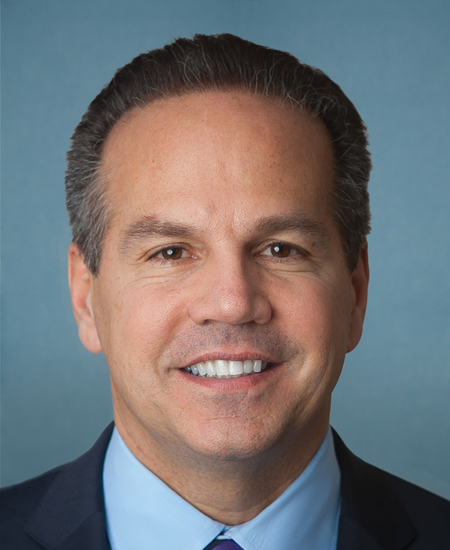
This resolution condemns all acts of political violence, as well as attacks on health care facilities, health care personnel, and patients. The resolution also states that all people have the freedom to access reproductive health care services and medical advice without fear of violence, intimidation, or harassment. Finally, the resolution calls on the Biden Administration to use all appropriate authorities to uphold public safety, protect health care facilities, and safeguard health care personnel and patients.
Rep. David N. Cicilline
Sponsored bills
Maddy summaryHR 51, the Washington, D.C. Admission Act, would admit Washington, D.C. as the 51st state, named "Washington, Douglass Commonwealth," granting its residents full representation in Congress with two Senators and one Representative. The bill establishes procedures for admission, including elections for state officials, with the state initially having one Representative until the next congressional apportionment. It would create a "Capital" area (including the White House, Capitol, and other key federal buildings) that remains under federal jurisdiction as the seat of the U.S. government, while the rest of the District becomes the new state. The bill also includes provisions to ensure continuity of federal services, property management, and legal procedures during the transition to statehood.
Platform Integrity Act This bill specifies that providers and users of interactive computer services (e.g., social media) may be held liable for third-party content if they promote or otherwise recommend the content.
War Crimes Rewards Expansion Act This act expands the Department of State's rewards program to authorize rewards for providing information leading to the arrest, conviction, or transfer of a foreign national accused of war crimes, crimes against humanity, or genocide as such crimes are defined under the law of an international criminal tribunal, the applicable country, or the United States. Currently, rewards are authorized for information leading to the arrest, conviction, or transfer of a foreign national accused of such crimes only as defined under the statutes of the relevant tribunal.
21st Century President Act This act revises the definition of immediate family for purposes of a criminal offense involving a threat to kill, kidnap, or inflict bodily harm on a former President or a member of the immediate family of a former President. Specifically, it replaces gender-specific references to a former President's wife and widow with the gender-neutral terms spouse and surviving spouse .
Uyghur Forced Labor Prevention Act This bill imposes various restrictions related to China's Xinjiang Uyghur Autonomous Region, including by prohibiting certain imports from Xinjiang and imposing sanctions on those responsible for human rights violations there. Goods manufactured or produced in Xinjiang shall not be entitled to entry into the United States unless U.S. Customs and Border Protection (1) determines that the goods were not manufactured by convict labor, forced labor, or indentured labor under penal sanctions; and (2) reports such a determination to Congress and to the public. The President shall periodically report to Congress a list of foreign entities and individuals knowingly facilitating (1) the forced labor of Uyghurs, Kazakhs, Kyrgyz, and members of other Muslim minority groups in Xinjiang; and (2) efforts to contravene U.S. laws regarding the importation of forced labor goods from Xinjiang. The President shall impose property-blocking sanctions on the listed individuals and entities and impose visa-blocking sanctions on the listed individuals. Securities issuers required to file annual or quarterly reports with the Securities Exchange Commission shall disclose in such reports instances in which the issuer knowingly engaged in certain activities related to Xinjiang, such as working with an entity building detention facilities or surveillance systems there. After such a disclosure, the President shall determine whether to investigate if sanctions or criminal charges are warranted. The Forced Labor Enforcement Task Force and the Department of State shall report to Congress strategies to address forced labor in Xinjiang or any other part of China. The State Department shall also report to Congress a determination of whether the treatment of Muslim groups in Xinjiang constitutes crimes against humanity or genocide under U.S. law.
Expanding the Voluntary Opportunities for Translations in Elections Act or the Expanding the VOTE Act This bill expands access to voting materials for individuals with limited proficiency in the English language, including by establishing incentive grants for states and political subdivisions to provide translated voting materials. Additionally, the bill directs the Government Accountability Office to study the impact of (1) reducing the threshold requirement under Section 203 of the Voting Rights Act of 1965, and (2) expanding the definition of language minorities to include native speakers of additional languages.
American Choice and Innovation Online Act This bill prohibits certain large online platforms from engaging in specified acts, including giving preference to their own products on the platform, excluding or disadvantaging competing products from another business on the platform, or discriminating among similarly situated users. Further, a platform may not materially restrict or impede the capacity of a competing business user to access or interoperate with the same platform, operating system, or hardware or software features. The bill also restricts the platform's use of nonpublic data obtained from or generated on the platform and prohibits the platform from restricting access to platform data generated by the activity of a competing business user. The bill also provides additional restrictions related to installing or uninstalling software, search or ranking functionality, and retaliation for contact with law enforcement regarding actual or potential violations of law. The bill establishes affirmative defenses for the prohibited conduct. The Federal Trade Commission or the Department of Justice must designate whether an entity is a platform covered by the bill, and both must carry out enforcement activities. The bill also provides for civil penalties, injunctions, conflicts of interest, a private right of action, and the forfeit of profits for repeat offenders.
This act directs the Speaker of the House of Representatives and the President pro tempore of the Senate to arrange for the posthumous award of a Congressional Gold Medal to commemorate Glen Doherty, Tyrone Woods, J. Christopher Stevens, and Sean Smith, four Americans killed in the September 11, 2012, attack on the U.S. consulate in Benghazi, Libya. (Stevens was the U.S. Ambassador to Libya at the time, Smith was an officer in the Foreign Service, and Doherty and Woods were both government contractors and former Navy SEALs.) After the medal has been awarded, it shall be given to the Central Intelligence Agency Museum.
Real Courts, Rule of Law Act of 2022 This bill establishes the U.S. Immigration Courts, a system of courts to be independent of the executive branch. The bill also transfers all functions of the Executive Office for Immigration Review (EOIR) to the Immigration Courts, with some exceptions. (Currently, the EOIR, located in the Department of Justice, has authority to adjudicate immigration cases.) The trial division of the Immigration Courts shall have jurisdiction over various immigration-related matters, including (1) removal proceedings, (2) reviews of rescissions of lawful permanent resident status, and (3) reviews of credible fear determinations in applications for refugee status. The appellate division shall have jurisdiction over appeals of decisions by the trial division and certain Department of Homeland Security determinations. The bill establishes various requirements and authorities relating to the Immigration Courts, including qualifications, length of term in office, and mandatory retirement age for judges. Each appellate division judge must be appointed by the President with the advice and consent of the Senate, and the appellate division shall appoint the trial division judges.