Flag Code Modernization Act of 2021 This bill revises provisions regarding customs and practices with respect to the American flag. Among other changes, the bill permits U.S. postal workers to wear the flag on their uniforms and modifies provisions regarding the position and manner of display of the flag.
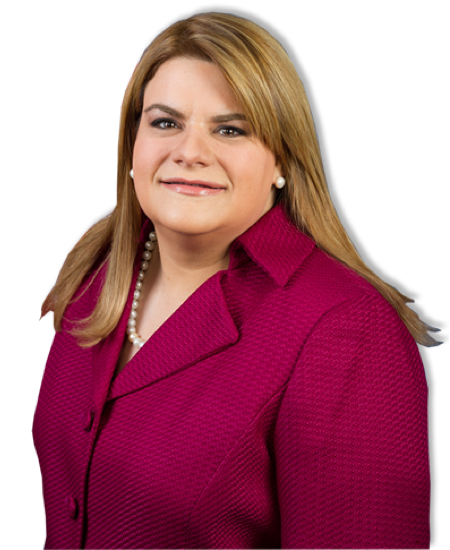
Rep. Jenniffer González-Colón
Sponsored bills
Preventing Anti-Semitic Hate Crimes Act This bill requires a designated officer or employee of the Department of Justice (DOJ) to facilitate the expedited review of anti-Semitic hate crimes and reports of anti-Semitic hate crimes. Further, the bill requires DOJ to issue guidance for state, local, and tribal law enforcement agencies on expanding public education campaigns to raise awareness of anti-Semitic hate crimes. Finally, the bill increases the statutory maximum prison term for an individual who is convicted of a federal hate crime offense after a prior conviction for a hate crime offense under federal law or a hate crime felony under state law.
Family Reunification Act of 2021 This bill addresses issues related to aliens obtaining legal permanent resident status, including by removing certain deadlines in a provision that allows eligible aliens to obtain such status. Specifically, the bill amends a provision that allows an alien to obtain lawful permanent resident status if the alien (1) is physically present in the United States, (2) entered the United States without inspection or meets certain other criteria, (3) is a beneficiary of a qualifying family-based immigrant petition or a labor certification application filed no later than April 30, 2001, and (4) has filed an application and meets other requirements. This bill removes the April 30, 2001, deadline for the filing of the required immigrant petition or labor certification. It also removes another requirement for certain applying aliens to have been physically present in the United States on December 21, 2000. Furthermore, a beneficiary of a family-based immigrant petition that appears to be eligible for approval may not be removed while the petition is pending. The bill also makes nonimmigrant V visas available to a beneficiary of an approved family-based immigrant petition, subject to certain requirements, regardless of when the immigrant petition was filed or how long it has been pending. Currently, a V visa is only available to an alien whose approved family-based immigrant petition was filed no later than December 11, 2000, and has been pending for at least three years. A V visa holder may not receive any means-tested public benefits or certain health insurance-related benefits.

Afghan Allies Protection Act of 2021 This bill provides for 4,000 additional special immigrant visas to qualified nationals of Afghanistan who were employed by or on behalf of the United States or the International Security Assistance Force after October 6, 2001. The visa allotment, in addition to any unused allocations of such special immigrant visas since FY2015, shall be available beginning FY2021, and unused visas shall carry over to subsequent fiscal years until exhausted.
Conrad State 30 and Physician Access Reauthorization Act This bill modifies the Conrad 30 Waiver program, which incentivizes qualified foreign physicians to serve in underserved communities. It also extends statutory authority for the program for three years from this bill's enactment. Aliens coming to the United States under a J-1 nonimmigrant visa to receive medical training typically must leave the country and reside for two years abroad before being eligible to apply for an immigrant visa or permanent residence. The Conrad program waives this requirement for individuals who meet certain qualifications, including serving for a number of years at a health care facility in an underserved area. The bill increases the number of waivers that a state may obtain each fiscal year from 30 to 35 if a certain number of waivers were used the previous year, and provides for further adjustments depending on demand. An alien physician may be employed at an academic medical center to meet the Conrad program's employment requirements if the alien's work is in the public interest, even if the medical center is not in an underserved area. Employment contracts for alien physicians under the Conrad program shall contain certain information, such as the maximum number of on-call hours per week the physician shall have to work. Certain alien physicians (along with the physician's spouse and children) shall be exempt from the direct annual numerical limits on immigration, including those physicians that have met certain requirements related to visas for physicians to serve in underserved areas.
No Stolen Trademarks Honored in America Act This bill modifies the bar against U.S. courts enforcing or validating trademarks that were confiscated by the Cuban government. The bill prohibits U.S. courts from enforcing or validating such confiscated trademarks if the mark had been used in connection with a confiscated business or asset. Currently, the prohibition applies only if the confiscated trademark is being asserted in the United States by a Cuban national. Under the bill, the prohibition shall not apply if the original trademark owner, or a successor, has expressly consented to the enforcement action. The prohibition shall apply only if the entity asserting the trademark rights knew or should have known, when it acquired the rights, that the mark was the same or substantially similar to one connected to a confiscated business or asset.
Save Our Seas 2.0 Amendments Act This bill revises provisions governing the administration of the Marine Debris Foundation and the Marine Debris Program. Specifically, the bill allows the foundation to use appropriated funds for employee salaries for the two years following the bill's enactment. The bill also allows the foundation to locate its principal office outside of the District of Columbia and encourages the foundation to locate it in a coastal state. In addition, the bill requires the foundation to develop best practices for conducting outreach to Indian tribes. The National Oceanic and Atmospheric Administration (NOAA) may enter into other agreements, outside of contracts, under the Marine Debris Program. NOAA may also make in-kind contributions for projects under the program.
Major Richard Star Act This bill provides that combat-disabled uniformed services retirees with fewer than 20 years of creditable service may concurrently receive, without reduction, veterans' disability compensation and retired pay or combat-related special compensation.
Preparedness and Risk Management for Extreme Weather Patterns Assuring Resilience and Effectiveness Act of 2022 or the PREPARE Act of 2022 This bill directs the President to establish the Interagency Council on Extreme Weather Resilience, Preparedness, and Risk Identification and Management, which shall establish government-wide goals and provide recommendations for addressing extreme weather resilience, preparedness, and risk identification and management. Each federal agency shall submit biannually to the Office of Management and Budget and to the council a comprehensive plan that integrates consideration of extreme weather into its operations and overall mission objectives.
John Lewis Civil Rights Fellowship Act of 2022 This bill establishes the John Lewis Civil Rights Fellowship Program within the J. William Fulbright Educational Exchange Program (commonly referred to as the Fulbright Program). The fellowship program shall honor the legacy of Representative John Lewis and advance U.S. foreign policy priorities by promoting studies, research, and international exchange in the subject of nonviolent civil rights movements around the world. The Fulbright Foreign Scholarship Board shall annually select qualified individuals to serve as fellows in the fellowship program. The Bureau of Educational and Cultural Affairs may determine the number of fellows for each year, with at least 25 fellows each year whenever feasible. Each fellow shall (1) work in an internship or research position with an approved organization in a country with an operational Fulbright U.S. Student Program, and (2) receive an award sufficient to cover the fellow's reasonable costs during the fellowship period and certain travel and lodging expenses related to the program.