

Guaranteeing Ukrainian Autonomy by Reinforcing its Defense (GUARD) Act of 2022 This bill provides support for Ukraine and imposes sanctions related to Nord Stream 2, the pipeline constructed to increase exports of natural gas from Russia. The Department of State must periodically report to Congress a determination as to whether Russia's government meets the criteria to be designated a state sponsor of terrorism. The bill authorizes the State Department to provide Foreign Military Financing assistance to Ukraine in FY2022. The bill also authorizes providing Ukraine with lethal assistance, such as anti-armor weapon systems and anti-aircraft weapons systems. From FY2022-FY2026, Ukraine shall have priority access to excess defense articles. During the same time period, the bill also authorizes providing Ukraine with assistance, including (1) International Military Education and Training assistance; (2) assistance to strengthen cybersecurity and intellectual property enforcement; (3) support and training for banking reform, subsidy reform, corporate governance, and the privatization of state-owned enterprises; and (4) assistance to combat corruption and improve the rule of law. Within 15 days of this bill's enactment, the President must impose sanctions on any entity responsible for planning, constructing, or operating Nord Stream 2, as well as any corporate officer of such an entity. The bill also subjects the President's authority to waive certain sanctions to congressional review. The U.S. Agency for Global Media may expand broadcasting in countries of the former Soviet Union to combat Russian disinformation. The bill requires reports to Congress on various topics, including a strategy on using U.S. diplomacy to support Ukraine.
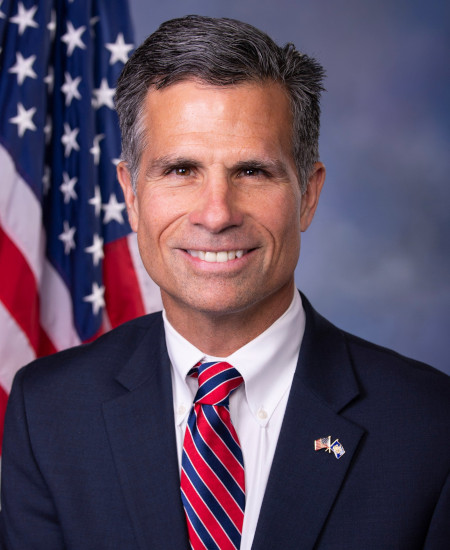
Rep. Daniel Meuser
Sponsored bills
Protect Our Law enforcement with Immigration Control and Enforcement Act of 2021 or the POLICE Act of 2021 This bill makes assaulting a law enforcement officer a deportable offense.
American Tech Workforce Act of 2021 This bill eliminates the Optional Practical Training Program and modifies requirements for H-1B visas (nonimmigrant workers in specialty occupations and fashion models). (The Optional Practical Training Program provides an eligible F-1 student visa holder temporary employment authorization before or after completion of the student's studies, or both.) Under this bill, the employer must pay an H-1B visa holder the greater of (1) the annual wage paid to a U.S. worker who did identical or similar work in the two years before the employer's H-1B application; or (2) $110,000, with this amount to be adjusted annually for inflation. Currently, the H-1B visa holder must be paid the greater of (1) the employer's actual wage for similarly qualified U.S. workers in the specific position, or (2) the local prevailing wage for the occupational classification. The bill also removes a requirement for the employer to provide the visa holder with working conditions such that the working conditions of similarly employed workers will not be affected. The bill imposes limits on assigning H-1B visa holders to third-party work sites, such as limiting the visa validity period to one year if the visa holder performs any part of their assignment at a third-party work site. The bill requires the H-1B applications with the highest listed compensation to be granted before those with lower listed compensation.
Halt All Lethal Trafficking of Fentanyl Act or the HALT Fentanyl Act This bill places fentanyl-related substances as a class into schedule I of the Controlled Substances Act. A schedule I controlled substance is a drug, substance, or chemical that has a high potential for abuse; has no currently accepted medical value; and is subject to regulatory controls and administrative, civil, and criminal penalties under the Controlled Substances Act. Additionally, the bill establishes a new, alternative registration process for schedule I research that is funded by the Department of Health and Human Services or the Department of Veterans Affairs or that is conducted under an investigative new drug exemption from the Food and Drug Administration. The bill also makes several other changes to registration requirements for conducting research with controlled substances, including permitting a single registration for related research sites in certain circumstances, waiving the requirement for a new inspection in certain situations, and allowing a registered researcher to perform certain manufacturing activities with small quantities of a substance without obtaining a manufacturing registration.
Protect American Taxpayer Dollars from Illegal Immigration Act This bill prohibits expending federal funds for legal settlements to individuals who violated certain laws relating to the proper time and place to enter the United States, if the settlement pertains to claims based solely on the lawful detention of such an individual as part of a family unit after the individual's entry into the United States at the southern border after January 20, 2017.
Public Safety Enhancement Act of 2021 This bill reauthorizes through FY2026 the Community Oriented Policing Services (COPS) grant program. Additionally, the bill requires a certain amount of funds made available under the COPS grant program to be used for the hiring and retention of law enforcement officers.
Keep Food Local and Affordable Act of 2021 This bill freezes the minimum wage for H-2A (temporary agricultural workers) in certain states through December 31, 2022. Specifically, the bill prohibits an increase to the adverse effect wage rate for H-2A workers in any state (1) that had an unemployment rate of not more than 5% in the Bureau of Labor Statistics' August 2021 report; or (2) where the food price index, according to bureau reports, increased by more than 3% between December 2020 and September 2021 and the governor requests a freeze to the adverse effect wage rate. (Generally, the minimum wage for an H-2A worker is the highest of the adverse effect wage rate, the prevailing hourly wage or piece rate, the federal minimum wage, or the applicable state minimum wage.)
Illegal Immigrant Payoff Prohibition Act This bill prohibits the payment of a settlement to an alien for a civil action brought against the United States in connection with the alien's inadmissibility to, or unlawful presence in, the United States.
Smarter Pretrial Detention for Drug Charges Act of 2021 This bill removes the presumption of pretrial detention for an individual who is charged with a federal drug offense for which the maximum term of imprisonment is 10 years or more.
Frederick Douglass Trafficking Victims Prevention and Protection Reauthorization Act of 2021 This bill reauthorizes through FY2026 and revises programs and activities to support survivors of human trafficking and prevent such trafficking domestically and abroad. The bill expands and authorizes programs for survivors, including a program to prevent re-exploitation. It also extends through FY2026 a special assessment on certain persons convicted of a human trafficking offense, which funds programs for human-trafficking survivors. Additionally, the bill provides privacy and other protections for survivors, including specified financial protections and protections against retaliation for survivors who pursue civil claims against a perpetrator. The bill also allows courts to reduce sentences for certain individuals who commit human trafficking crimes as minors. To prevent trafficking domestically, federal departments must incorporate anti-trafficking efforts into contracting activities and personnel policies, and the bill supports private sector efforts to address human trafficking in its policies and services. Furthermore, the bill supports the identification, investigation, and prosecution of human trafficking crimes, with an expanded focus on forced labor. To prevent trafficking globally, the bill prohibits access to a trade program for developing countries and otherwise restricts development assistance for countries that fail to meet minimum standards for eliminating trafficking. It also changes the criteria for determining whether a country has met applicable standards. In addition, the bill authorizes sanctions on persons convicted of severe forms of trafficking and requires integration of counter-trafficking activities into foreign assistance programs. The bill also requires reporting by the Government Accountability Office, federal agencies, and states concerning human trafficking.