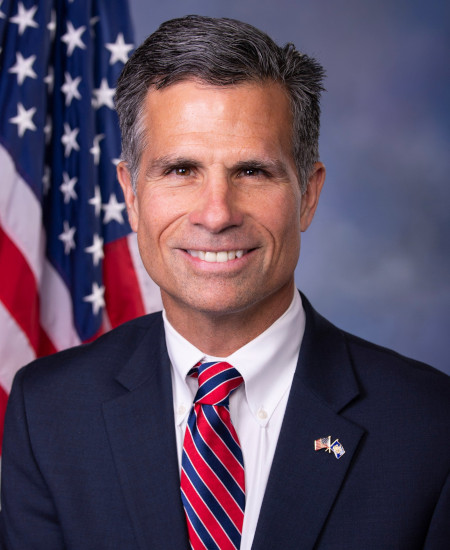
Photo of Daniel Meuser
R United States House · District 9 · Pennsylvania On the 2026 ballot

Rep. Daniel Meuser

Compare
Total votes
2,837
all sessions
Attendance
97%
95 missed
Lower than 82% of chamber peers
With party
96%
of cast votes
Near the chamber average
Bipartisan score
2%
crosses aisle rarely
Near the chamber average
Sponsored
1,147
bills & resolutions
Near the chamber average
Committees
6
assignments
1,147 bills and resolutions

Sponsored bills

Total
1,147
Primary
62
Co-sponsor
1,085
This page
1,147
matching current filters
Co-sponsor HR 5741
In committee · United States House · Co-sponsor
Uniform Treatment of Custodial Assets Act

Maddy summaryThis bill prevents federal regulators from requiring banks, credit unions, and trust companies to treat custody assets (like digital assets held for clients) as liabilities on their financial statements or to hold extra capital against them. It specifically stops institutions from recognizing liabilities for digital asset services they don’t own, unless those liabilities exceed related expenses. The law applies broadly to depository institutions but includes an exception: commingled cash held for third parties must still be listed as a liability. Key provisions aim to clarify accounting rules for digital assets, reducing regulatory complexity for financial institutions managing client custody. It directly affects banks, credit unions, and trust companies handling digital assets or custody services.

In committee Sep 27, 2023 1 co-sponsor
Co-sponsor HR 5096
In committee · United States House · Co-sponsor
Healthy Poultry Assistance and Indemnification Act

Healthy Poultry Assistance and Indemnification Act This bill expands the Animal and Plant Health Inspection Service (APHIS) producer indemnity and compensation program to include compensation for all poultry growers and layers located in an APHIS-determined control area.  Currently, APHIS provides indemnity and compensation to producers to remove animals classified as affected, suspect, or exposed to diseases of concern, including highly pathogenic avian influenza (HPAI). An APHIS-determined  control area consists of both an infected zone and a buffer zone.  Under the bill, APHIS must compensate all owners of poultry growing or laying facilities for flocks of birds that the facility owner was prohibited from growing or laying due to the location of the facility within a control area. This may include facilities that are located in the buffer zones and have non-infected poultry. Further, the bill establishes a new compensation payment formula that requires payments to be based on the owner’s average income from the five most recent flocks. Under the bill, APHIS's compensation determination is final and not subject to judicial or administrative review (other than by the Secretary of Agriculture or a designee).


In committee Sep 26, 2023 1 co-sponsor
Co-sponsor HR 5638
In committee · United States House · Co-sponsor
Aldyl A Hazard Reduction and Community Safety Act

Maddy summaryThis bill requires gas pipeline operators to identify and remove Aldyl A polyethylene piping from high-risk areas. Specifically, pipeline owners must assess their systems for this piping within 1 year, report findings within 3 years, and remove it from pressurized locations in designated high-consequence areas (like densely populated zones or environmentally sensitive sites) within 5 years. The law mandates coordination with state regulators to minimize disruptions while prioritizing public safety and environmental protection. It directly affects gas pipeline operators managing facilities in class 1-4 locations and high-consequence areas as defined by federal law.

In committee Sep 22, 2023 1 co-sponsor
Co-sponsor HR 5041
In committee · United States House · Co-sponsor
Better CARE for Animals Act of 2023

Maddy summaryThe Better CARE for Animals Act of 2023 amends the Animal Welfare Act to strengthen enforcement of animal welfare standards. It gives the Attorney General authority to bring civil cases for violations, including seeking penalties up to $10,000 per day per violation and injunctions to remove or relocate animals. The bill also requires the Secretary of Agriculture and Attorney General to coordinate through a new Memorandum of Understanding, focusing on repeat violators. These changes directly affect dealers, exhibitors, and enforcement agencies by expanding civil enforcement tools and clarifying jurisdiction over rule violations.

In committee Sep 19, 2023 1 co-sponsor
Co-sponsor HR 1435
Passed · United States House · Co-sponsor
Preserving Choice in Vehicle Purchases Act

Maddy summaryHR 1435, the Preserving Choice in Vehicle Purchases Act, amends the Clean Air Act to restrict states from implementing vehicle emissions rules that limit the sale or use of new gasoline-powered cars. It directly affects states with stricter emissions standards (like California) by adding a new definition that blocks state rules "directly or indirectly" limiting internal combustion engine vehicles as defined in federal regulations as of January 1, 2023. The bill requires the EPA to revoke existing state emissions waivers granted between January 2022 and the bill’s enactment if they don’t comply with this new definition. This creates a concrete federal standard preventing states from advancing policies that could reduce demand for conventional vehicles.

Passed Sep 18, 2023 1 co-sponsor
Co-sponsor HR 5465
In committee · United States House · Co-sponsor
Congressional Access to Bureaucratic Offices Act

Maddy summaryHR 5465, the Congressional Access to Bureaucratic Offices Act (CABO Act), requires federal agency heads to allow Members of Congress and their staff access to agency headquarters buildings during regular business hours. It mandates that access be granted upon presentation of valid congressional identification (for Members) or a staff badge while accompanied by the employing Member (for staff), with exceptions for areas requiring secret-level security clearance. The bill also ensures this access applies during declared emergencies (like national emergencies under the National Emergencies Act or public health emergencies), without imposing additional costs by using existing agency funds. This directly affects how federal agencies manage physical access for congressional personnel.

In committee Sep 15, 2023 1 co-sponsor
Co-sponsor HR 5399
In committee · United States House · Co-sponsor
Humane Cosmetics Act of 2023

Maddy summaryThe Humane Cosmetics Act of 2023 bans cosmetic animal testing in the United States, prohibiting companies from conducting or contracting such testing after its enactment (effective 1 year later). It also bans selling or transporting cosmetics developed using animal testing conducted after that date within U.S. interstate commerce. The law directly affects cosmetic manufacturers, retailers, and suppliers operating in the U.S. market, requiring them to use non-animal testing methods for safety evaluations. Exceptions exist for foreign regulatory requirements or when no alternative testing methods are available for specific ingredients.

In committee Sep 15, 2023 1 co-sponsor
Co-sponsor HCONRES 64
In committee · United States House · Co-sponsor
Expressing the sense of Congress that all trade agreements the United States enters into, should provide reasonable access and collaboration of each nation involved in such an agreement, for the purpose of search and recovery activities relating to members of the United States Armed Forces still missing and unaccounted for from prior wars or military conflicts.

This concurrent resolution expresses the sense of Congress that all trade agreements the United States enters into with a foreign country should provide reasonable collaboration with that country for the purpose of search, investigation, and recovery activities for U.S. personnel missing and unaccounted for from prior wars or military conflicts.

In committee Sep 14, 2023 1 co-sponsor
Co-sponsor HR 3152
Passed · United States House · Co-sponsor
Fight CRIME Act

Maddy summaryHR 3152, the "Fight CRIME Act," aims to maintain international restrictions on Iran's missile-related activities by requiring diplomatic efforts to extend these restrictions before they expire in October 2023. The bill mandates annual reports detailing U.S. diplomatic strategies, potential impacts of expiration, and measures to deter missile technology transfers to Iran. It establishes sanctions against foreign individuals or entities that knowingly support Iran's missile or drone programs, including asset freezes and visa restrictions. These sanctions apply regardless of whether UN restrictions remain in effect after their expiration, directly affecting foreign entities involved in these activities.

Passed Sep 13, 2023 1 co-sponsor
Showing 601 to 610 of 1,147 bills
Previous 1 … 60 61 62 … 115 Next