

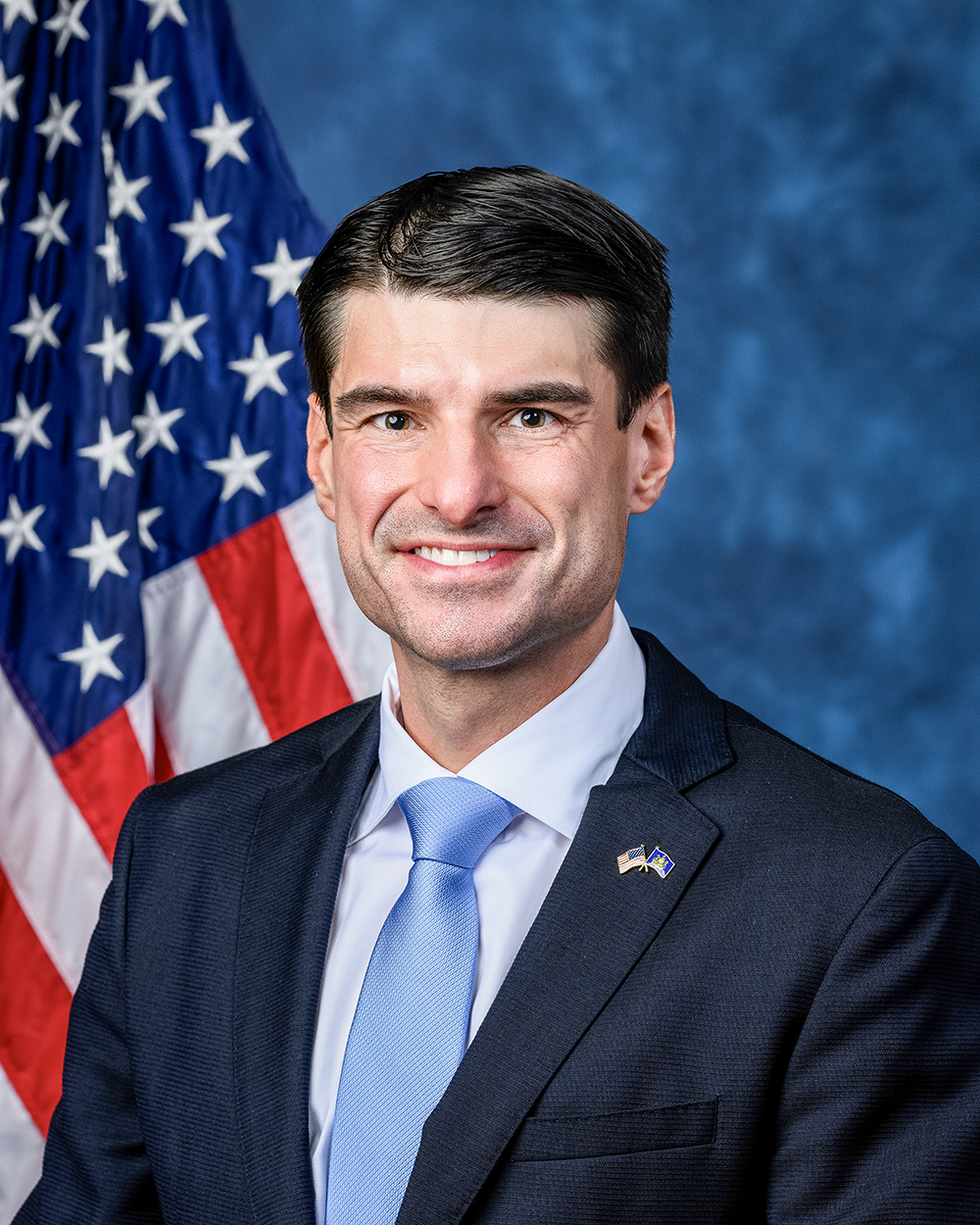
Photo of Robert P. Bresnahan, Jr.
R United States House · District 8 · Pennsylvania On the 2026 ballot

Rep. Robert P. Bresnahan, Jr.

Compare
Total votes
669
all sessions
Attendance
99%
6 missed
Higher than 75% of chamber peers
With party
94%
of cast votes
Lower than 80% of chamber peers
Bipartisan score
3%
crosses aisle rarely
Higher than 79% of chamber peers
Sponsored
335
bills & resolutions
Near the chamber average
Committees
10
assignments
335 bills and resolutions

Sponsored bills

Total
335
Primary
22
Co-sponsor
313
This page
335
matching current filters
Co-sponsor HR 1576
In committee · United States House · Co-sponsor
Protecting American Agriculture from Foreign Adversaries Act of 2025

Maddy summaryThis bill requires the U.S. Department of Agriculture (USDA) to join the Committee on Foreign Investment in the United States (CFIUS) for reviews of certain transactions involving foreign adversaries. It specifically targets acquisitions of U.S. agricultural land, biotechnology, or agriculture-related infrastructure (like transportation, storage, or processing) by entities from China, North Korea, Russia, or Iran. The USDA must notify CFIUS about reportable transactions, prompting the committee to determine if a full review is needed. The provisions expire for any country removed from the official list of foreign adversaries in federal regulations.

In committee Feb 25, 2025 1 co-sponsor
Co-sponsor HR 1551
In committee · United States House · Co-sponsor
Protect and Serve Act of 2025

Maddy summaryHR 1551, the Protect and Serve Act of 2025, creates a new federal criminal offense for intentionally harming law enforcement officers under specific circumstances. It imposes harsher penalties, including up to 10 years in prison for serious injury or life imprisonment if death occurs, kidnapping is involved, or a firearm is used. The law applies when the crime crosses state lines, involves interstate weapons, occurs on federal property, or targets federal officers. Prosecutions require the Attorney General’s written certification, considering factors like prior state convictions and public safety impact. The bill directly affects law enforcement officers and federal prosecutors by expanding federal jurisdiction for certain violent crimes against them.

In committee Feb 25, 2025 1 co-sponsor
Co-sponsor HR 1548
In committee · United States House · Co-sponsor
Leveling the Playing Field 2.0 Act

Maddy summaryHR 1548, the "Leveling the Playing Field 2.0 Act," amends U.S. trade laws to strengthen enforcement of antidumping and countervailing duty regulations. The bill creates new rules for handling multiple investigations on the same merchandise (successive investigations), addresses market distortions in foreign countries that affect production costs, and improves mechanisms to prevent companies from circumventing existing duties. It also establishes procedures for investigating currency undervaluation as a form of subsidy and strengthens requirements for importers to certify compliance with trade laws. These changes primarily affect U.S. importers of foreign goods, foreign exporters, and the Department of Commerce, which administers these trade enforcement mechanisms.

In committee Feb 24, 2025 1 co-sponsor
Co-sponsor HR 1502
In committee · United States House · Co-sponsor
North Platte Canteen Congressional Gold Medal Act

Maddy summaryHR 1502 authorizes the creation of a Congressional Gold Medal to honor the volunteers and communities (primarily from Nebraska, Colorado, and Kansas) who supported the North Platte Canteen during World War II. The bill directs the Treasury Secretary to design and strike the medal, which will be presented to the individuals who contributed to the canteen’s operations and then permanently displayed at the Lincoln County Historical Museum in North Platte, Nebraska. It also permits the sale of bronze duplicates to cover production costs, with proceeds going to the U.S. Mint. This is a commemorative measure recognizing historical service, not a policy change affecting current laws or programs.

In committee Feb 21, 2025 1 co-sponsor
Co-sponsor HR 1464
In committee · United States House · Co-sponsor
MODERN WIC Act of 2025

More Options to Develop and Enhance Remote Nutrition in WIC Act of 2025 or the MODERN WIC Act of 2025 This bill permanently allows individuals to remotely certify their eligibility for, and receive benefits through, the Special Supplemental Nutrition Program for Women, Infants, and Children (WIC). Specifically, the bill requires that a state agency allow an individual seeking a WIC certification, recertification, or a nutritional risk evaluation to do so by phone or through video teleconference, in addition to the in-person option. A state agency has 90 days to collect data for a nutritional risk evaluation for a remotely certified individual. Further, a state agency may consider an applicant who meets the income eligibility standards to be temporarily eligible on an interim basis to participate in the program and may certify the individual for immediate participation without waiting for a nutritional risk evaluation. The bill also allows states to provide benefits on WIC electronic benefit transfer cards through mail or remote issuance instead of requiring participants to pick up or reload benefits in person at a WIC office. Further, the Department of Agriculture must report to Congress about the use of remote technologies and other digital tools in the WIC program. Currently, individuals are generally required to be physically present to certify their WIC eligibility and receive benefits, with exceptions. The Food and Nutrition Service  has temporarily waived these requirements and allowed remote certification and benefits using authorities that were provided by laws that were enacted to address COVID-19.

In committee Feb 21, 2025 1 co-sponsor
Co-sponsor HR 1505
In committee · United States House · Co-sponsor
Public Safety Employer-Employee Cooperation Act

Maddy summaryHR 1505, the Public Safety Employer-Employee Cooperation Act, establishes federal standards for collective bargaining rights for public safety officers (including police, firefighters, and emergency medical personnel) in states that do not meet minimum requirements. The Federal Labor Relations Authority (FLRA) will determine after 180 days whether a state law "substantially provides" key rights, such as forming unions, negotiating wages/hours, and using binding arbitration to resolve disputes. If a state fails this assessment, federal bargaining rules apply within two years, but existing state laws with stronger protections remain valid. The bill explicitly respects state laws that exceed its standards and exempts small jurisdictions (under 5,000 population or 25 full-time employees).

In committee Feb 21, 2025 1 co-sponsor
Co-sponsor HR 1470
In committee · United States House · Co-sponsor
SOS Act of 2025

Maddy summaryHR 1470, the SOS Act of 2025, increases federal funding for school resource officers (SROs) by raising annual allocations from $1,047 million to $1,097 million for fiscal years 2026-2035 under the 1968 Omnibus Crime Control Act. It directly affects schools and local law enforcement agencies by mandating that at least $50 million annually must be allocated through grants for SRO programs. The bill modifies existing funding provisions to expand support for school safety initiatives, requiring applications from local governments or law enforcement agencies. This represents a concrete policy change in federal school safety funding levels and allocation rules.

In committee Feb 21, 2025 1 co-sponsor
Co-sponsor HR 1492
In committee · United States House · Co-sponsor
To amend title XI of the Social Security Act to equalize the negotiation period between small-molecule and biologic candidates under the Drug Price Negotiation Program.

Maddy summaryHR 1492 amends the Social Security Act to extend the negotiation period for standard drug manufacturers under the federal drug pricing program. Specifically, it changes the timeframe from 7 years to 11 years for small-molecule drugs (like traditional pills) to negotiate prices with the government, aligning it with the existing 12-year period for complex biologic drugs (like insulin or monoclonal antibodies). This adjustment directly affects pharmaceutical companies that produce small-molecule drugs, giving them a longer window to negotiate pricing terms. The bill makes this change effective as if it had been part of the 2022 law that established the program.

In committee Feb 21, 2025 1 co-sponsor
Co-sponsor HR 1509
In committee · United States House · Co-sponsor
Accelerating Kids’ Access to Care Act of 2025

Maddy summaryThis bill would require states to create a simplified process for out-of-state healthcare providers to join Medicaid and CHIP programs. Qualified providers (those already enrolled in Medicare or another state's program with low fraud risk) could enroll without excessive screening and would be approved for five years. It directly affects children under 21 enrolled in Medicaid or CHIP by expanding access to providers outside their state, particularly in underserved areas. The change applies to all states' Medicaid programs but takes effect three years after enactment.

In committee Feb 21, 2025 1 co-sponsor
Co-sponsor HR 1441
In committee · United States House · Co-sponsor
PURE Water Act

Maddy summaryThe PURE Water Act (HR 1441) creates a federal tax credit for individuals who install qualifying home water filtration systems. It allows a 20% credit on primary residence filtration costs and 10% on secondary residence costs, capped at $2,500 per tax year, with unused portions carryable forward. The credit applies only to systems that remove at least 90% of lead, PFAS, and PFOA from drinking water, excluding maintenance costs. This directly affects individual taxpayers who purchase qualifying filters for their U.S. homes, effective for tax years beginning after December 31, 2024.

In committee Feb 18, 2025 1 co-sponsor
Showing 281 to 290 of 335 bills
Previous 1 … 28 29 30 … 34 Next