

Securing Access for Venue Equity Act or the SAVE Act This bill expands a grant program established to support venue operators in response to COVID-19 (i.e., coronavirus disease 2019) to include hospitality businesses, such as amusement and theme parks, scenic and sightseeing transportation businesses, and travel arrangement and reservation services.
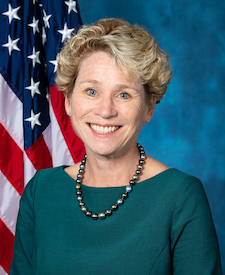
Rep. Chrissy Houlahan
Sponsored bills
Safe Step Act This bill requires a group health plan to establish an exception to medication step-therapy protocol in specified cases. A medication step-therapy protocol establishes a specific sequence in which prescription drugs are covered by a group health plan or a health insurance issuer. A request for such an exception to the protocol must be granted if (1) an otherwise required treatment has been ineffective, (2) such treatment is expected to be ineffective and delaying effective treatment would lead to irreversible consequences, (3) such treatment will cause or is likely to cause an adverse reaction to the individual, (4) such treatment is expected to prevent the individual from performing daily activities or occupational responsibilities, (5) the individual is stable based on the prescription drugs already selected, or (6) there are other circumstances as determined by the Employee Benefits Security Administration. The bill requires a group health plan to implement and make readily available a clear process for an individual to request an exception to the protocol, including required information and criteria for granting an exception. The bill further specifies timelines under which plans must respond to such requests.
Pennsylvania National Heritage Areas Reauthorization Act This bill reauthorizes in Pennsylvania through FY2036 the Rivers of Steel National Heritage Area, the Lackawanna Valley National Heritage Area, the Delaware and Lehigh National Heritage Corridor, the Schuylkill River Valley National Heritage Area, and the Oil Region National Heritage Area. The bill eliminates the limitation on the total amount that may be appropriated for the Rivers of Steel National Heritage Area, the Lackawanna Valley National Heritage Area, the Schuylkill River Valley National Heritage Area, and the Oil Region National Heritage Area.
Protect Democracy in Burma Act of 2021 This bill requires the Department of State to report to Congress on the military coup in Burma (Myanmar), including a description of U.S. efforts to (1) engage with the Association of Southeast Asian Nations to support a return to Burma's democratic transition and democratic values throughout Southeast Asia, and (2) influence the United Nations to hold accountable those responsible for the coup.
Dental Care for Veterans Act This bill expands eligibility for veterans for dental care provided by the Department of Veterans Affairs (VA). Specifically, the bill makes all veterans who are enrolled in the VA health care system eligible for VA-provided dental services. Currently, only veterans who have a service-connected dental issue or meet other narrow criteria are eligible for certain dental services. The bill phases in eligibility over four years based upon existing eligibility, degree of service-connected disability or other disability, prisoner of war status, award of a Purple Heart, financial need, or VA health care eligibility.
Veterans Expedited TSA Screening Safe Travel Act or the VETS Safe Travel Act This bill makes certain veterans eligible for the Transportation Security Administration (TSA) PreCheck Program at no cost if they meet the program's background check and security requirements. Veterans who are eligible for this fee waiver are those who are in the annual patient enrollment system of the Department of Veterans Affairs (VA) and require the use of a wheelchair, prosthetic limb, or other assistive device to aid with mobility due to (1) loss, or loss of use, of a limb; (2) full or partial paralyzation; or (3) permanent blindness. The VA and the TSA must develop and implement a process to provide disabled veterans effective outreach about TSA programs that are designed to improve the screening process for passengers with disabilities.
Ethan's Law This bill establishes a framework to regulate the storage of firearms on residential premises at the federal, state, and tribal levels. At the federal level, the bill establishes statutory requirements for firearms on residential premises to be safely stored if a minor is likely to gain access without permission or if a resident is ineligible to possess a firearm. An individual who violates the requirements is subject to criminal penalties. A firearm stored in violation of the requirements is subject to seizure and forfeiture. At the state and tribal levels, the bill requires the Department of Justice to award grants to implement functionally identical requirements for the safe storage of firearms.
Research Advancing to Market Production for Innovators Act This bill provides commercialization services for federally funded small business research and development under the Small Business Innovation Research (SBIR) and Small Business Technology Transfer (STTR) programs. Specifically, the bill (1) expedites the application and award process for SBIR proposals and STTR solicitations, (2) requires determinations of commercialization potential for projects undertaken through SBIR and STTR awards, (3) provides continued flexibility of technical and business assistance for SBIR and STTR awardees, (4) instructs participating federal agencies to designate a technology commercialization official to help awardees commercialize, and (5) requires the Small Business Administration and the U.S. Patent Office to reach an interagency agreement to help SBIR and STTR awardees with intellectual property protection.
This resolution reaffirms and recognizes the importance of partnerships between the United States and African countries, encourages greater and more strategic collaboration to achieve and sustain socioeconomic transformation in Africa, and encourages the United States to advance interests in Africa to reach specified goals.
Reading Early and Addressing Dyslexia Act or the READ Act This bill directs the Department of Education (ED) to establish an early literacy and dyslexia intervention pilot program to award grants to five state educational agencies to address early reading deficiencies and dyslexia. Under the program, ED must identify (1) evidence-based methods of screening students in grades K-3 for early reading deficiencies and dyslexia; (2) intensive interventions for these students, including phonological awareness and phonemic awareness, sound symbol recognition, and decoding skills; and (3) best practices to instruct educators on the science of reading and how to execute screenings and intensive interventions for these students. Each participating state educational agency must select at least two local educational agencies (LEAs) to participate in the program. Participating LEAs must provide intensive interventions identified by ED that develop basic reading skills and incorporate systematic phonics instruction to every student in grades K-3, screen each student in grades K-3 three times during each school year using the screening methods identified by ED, notify parents or guardians of screenings, and conduct diagnostic assessments and provide intensive interventions for each student suspected of having an early reading deficiency or dyslexia. The bill also directs ED to establish an online platform to provide educational agencies with resources, such as methods of targeting instruction for early reading deficiencies and dyslexia.