

Judicial Ethics and Anti-Corruption Act of 2022 This bill makes various changes to the federal framework governing judicial ethics. Among the changes, the bill prohibits federal judges and Supreme Court Justices from owning individual stocks and securities; requires the Judicial Conference of the United States to issue regulations restricting the solicitation or acceptance of gifts in connection with a private judicial seminar; expresses the sense of Congress that the Code of Conduct for U.S. Judges shall apply to Supreme Court Justices; requires federal judges and Supreme Court Justices to report on each association or interest that would require recusal, including any financial interest of a spouse or minor child who resides in the household; and establishes a committee to review complaints against the Supreme Court.
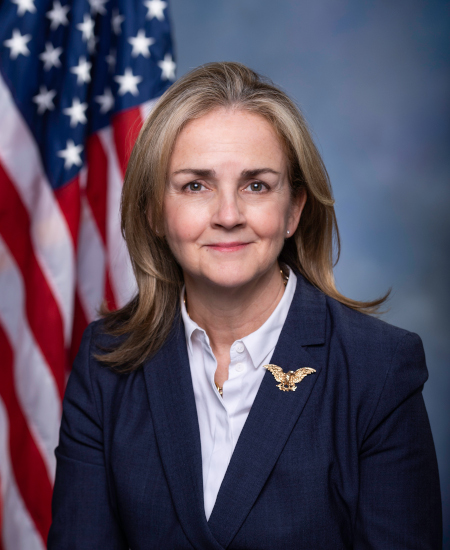
Rep. Madeleine Dean
Sponsored bills
Stopping Harmful Image Exploitation and Limiting Distribution Act of 2022 or the SHIELD Act of 2022 This bill establishes a new criminal offense related to the distribution of intimate visual depictions. Specifically, it makes it a crime to knowingly distribute (or intentionally threaten to distribute) an intimate visual depiction of an individual (1) with knowledge of or reckless disregard for the individual's lack of consent and reasonable expectation of privacy, and (2) without a reasonable belief that distributing the depiction touches a matter of public concern. A violator is subject to criminal penalties—a fine, a prison term of up to two years for each individual victim depicted, or both.
Stopping the Fraudulent Sales of Firearms Act This bill makes it unlawful to import, manufacture, or sell a firearm or ammunition by fraudulent means (e.g., false representations). Further, it makes it unlawful to transmit a wire, radio, or television communication in interstate or foreign commerce related to such a fraudulent importation, manufacture, or sale. A violator is subject to criminal penalties—a fine, a prison term of up to five years, or both.
Latonya Reeves Freedom Act of 2022 This bill prohibits government entities and insurance providers from denying community-based services to individuals with disabilities that require long-term service or support that would enable such individuals to live in the community and lead an independent life. Specifically, these entities may not discriminate against such individuals in the provision of community-based services by such actions as imposing prohibited eligibility criteria, cost caps, or waiting lists or failing to provide a specific community-based service. Additionally, community-based services must be offered to individuals with such disabilities prior to institutionalization. Institutionalized individuals must be notified regularly of community-based alternatives. The bill requires the Department of Justice to issue regulations requiring government entities and insurance providers to offer community-based long-term services to individuals with such disabilities who would otherwise qualify for institutional placement. Government entities must ensure sufficient availability of affordable, accessible, and integrated housing that is not a disability-specific residential setting or a setting where services are tied to tenancy. Regulations shall also (1) require government entities and insurance providers to perform self-evaluation on current services, policies, and practices and concerning compliance with requirements of this bill; and (2) require government entities to submit a transition plan. The bill provides funds for FY2022 for the Department of Health and Human Services to provide technical assistance with respect to transition plans. The bill allows civil actions by individuals subjected to, or about to be subjected to, a violation of its requirements.
Porch Pirates Act of 2022 This bill extends federal criminal penalties for obstruction of correspondence and theft of stolen mail matter (which apply to U.S. Postal Service mail) to matter (e.g., packages) sent or delivered by private or commercial interstate carriers.
Preventing Pretrial Gun Purchases Act This bill prohibits the sale or disposition of a firearm or ammunition to a person who is subject to a pretrial release order that prohibits the person from purchasing, possessing, or receiving firearms. It also establishes grants for states and Indian tribes to report information about pretrial release orders to the National Instant Criminal Background Check System.
Protect Children Through Safe Gun Ownership Act This bill establishes certain requirements and education programs for the safe storage of firearms, including by establishing grants to provide parents with educational materials on gun safety and the importance of secure gun storage.
Ethiopia Stabilization, Peace, and Democracy Act This bill imposes sanctions and addresses other issues related to the conflict in Ethiopia. The President must impose property-blocking sanctions (and visa-blocking sanctions in the case of an individual) against a foreign entity or individual that has taken certain actions to expand or extend the civil war or other conflicts in Ethiopia. The bill prohibits assistance, with certain exceptions, to Ethiopia's security forces unless the Department of State certifies to Congress that Ethiopia's government has ceased all military operations associated with the civil war and met other specified conditions. The Department of the Treasury must instruct U.S. representatives at international financial institutions to oppose, with some exceptions, such institutions providing loans or assistance to the governments of Ethiopia or Eritrea. Furthermore, the U.S. International Development Finance Corporation may not provide certain support for projects in Ethiopia. These restrictions must terminate after the State Department certifies that certain conditions, such as a cessation of military operations associated with the civil war in Ethiopia, have been met. The President may provide support for activities necessary to preserve evidence of atrocities in Ethiopia and to pursue accountability for such atrocities. Within 90 days of this bill's enactment, the State Department must report to Congress a determination of whether actions in Ethiopia by the armed forces of Ethiopia and Eritrea, the Tigrayan Peoples Liberation Front, and other armed actors constitute genocide, war crimes, or crimes against humanity.
End Prison Gerrymandering Act This bill requires the Department of Commerce, beginning with the 2030 decennial census, to attribute an individual incarcerated in a correctional center to the individual's last place of residence before incarceration. Further, a state must treat such an individual's last place of residence in the state before incarceration as the individual's place of residence for purposes of congressional redistricting.
Comprehensive Addiction Resources Emergency Act of 2021 This bill establishes programs, grants, and other activities to address substance use disorders. Specifically, the Department of Health and Human Services (HHS) must establish a program for purchasing and distributing opioid overdose reversal drugs for states and Indian tribes. HHS must also award grants for and otherwise support addressing substance use, particularly in states, tribes, territories, and localities with disproportionately high drug overdose rates; increasing access to preventive, medical, recovery, and related services; developing innovative models of delivering treatment and harm reduction services; and expanding the treatment capacity of Medicaid providers. In addition, HHS must issue model standards of care for treatment services and recovery residences and may award grants for training health care professionals. The bill also supports prevention and treatment services for workers, addiction and pain management research, and data collection on substance use disorders. Further, dispensers, distributors, and manufacturers of schedule II controlled substances (e.g., oxycodone), with the exception of opioid treatment programs, must certify that they maintain effective drug diversion controls. Violators are subject to specified civil and criminal penalties. Collected penalties shall be used for the grant programs and other substance use disorder activities established under the bill.