Ensuring Survivor Benefits during COVID-19 Act of 2021 This bill requires the Department of Veterans Affairs to get a medical opinion to determine if a service-connected disability was the principal or contributory cause of death in situations where a veteran's death certificate identifies COVID-19 (i.e., coronavirus disease 2019) as the principal or contributory cause of death, the certificate does not clearly identify any of the veteran's service-connected disabilities as the principal or contributory cause of death, and a claim for dependency and indemnity compensation is filed with respect to the veteran.
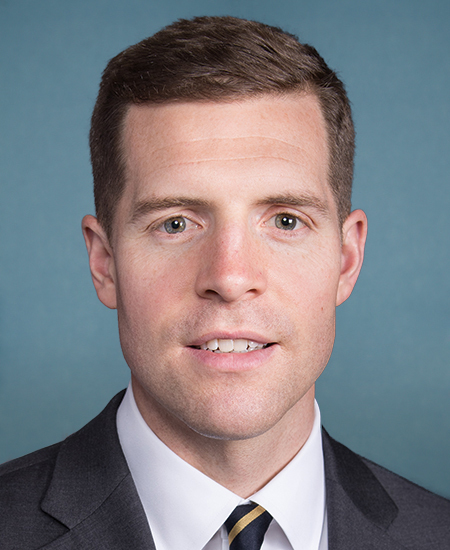
Rep. Conor Lamb
Sponsored bills
Funding for Aviation Screeners and Threat Elimination Restoration Act or the FASTER Act This bill repeals the requirement that a portion of aviation security service fees collected from passengers be credited as offsetting receipts and deposited in the general fund of the Treasury. It requires such fees to be deposited into a separate account in the Treasury for expenditure to pay only the costs of activities and services for which the fee is imposed (i.e., aviation security screening).
RTP Full Funding Act of 202 1 This bill revises provisions regarding the recreational trails program of the Department of Transportation (DOT). Specifically, the bill requires DOT to estimate the total amount of nonhighway recreational fuel taxes received by the Department of the Treasury and transferred to the Highway Trust Fund; the Federal Highway Administration to establish financial management information system codes for certain motorized and non-motorized use projects, including single and diverse use projects; DOT to reserve amounts of the state-apportioned funds for administrative, research, technical assistance, and training expenses to carry out the recreational trails program; and states to obligate a specific amount of reserved funds each fiscal year for the recreational trails program.
Jenna Quinn Law This bill allows the Department of Health and Human Services to provide grants for evidence-informed child sexual abuse awareness and prevention programs. The grants may be awarded for a period of up to five years.
No Tax Breaks for Outsourcing Act This bill modifies the tax treatment of the foreign source income of domestic corporations. The bill includes provisions that modify calculations of the gross income of U.S. shareholders to include net CFC tested income in the current taxable year, apply limitations on the foreign tax credit on a country-by-country basis, limit the tax deduction for the interest expense of a U.S. corporation that is a member of a financial reporting group (i.e., a group that prepares consolidated financial statements according to generally accepted accounting principles or international financial reporting standards), modify the rules for the taxation of inverted corporations (i.e., U.S. corporations that acquire foreign companies to reincorporate in a foreign jurisdiction with income tax rates lower than the United States), and treat certain foreign corporations managed and controlled primarily in the United States as domestic corporations for tax purposes.
Protecting the Right to Organize Act of 20 21 This bill expands various labor protections related to employees' rights to organize and collectively bargain in the workplace. Among other things, it (1) revises the definitions of employee , supervisor , and employer to broaden the scope of individuals covered by the fair labor standards; (2) permits labor organizations to encourage participation of union members in strikes initiated by employees represented by a different labor organization (i.e., secondary strikes); and (3) prohibits employers from bringing claims against unions that conduct such secondary strikes. The bill also allows collective bargaining agreements to require all employees represented by the bargaining unit to contribute fees to the labor organization for the cost of such representation, notwithstanding a state law to the contrary; and expands unfair labor practices to include prohibitions against replacement of, or discrimination against, workers who participate in strikes. The bill makes it an unfair labor practice to require or coerce employees to attend employer meetings designed to discourage union membership and prohibits employers from entering into agreements with employees under which employees waive the right to pursue or a join collective or class-action litigation. The bill further prohibits employers from taking adverse actions against an employee, including employees with management responsibilities, in response to that employee participating in protected activities related to the enforcement of the prohibitions against unfair labor practices (i.e., whistleblower protections). Such protected activities include providing information about a potential violation to an enforcement agency, participating in an enforcement proceeding, initiating a proceeding concerning an alleged violation or assisting in such a proceeding, or refusing to participate in an activity the employee reasonably believes is a violation of labor laws. Finally, the bill addresses the procedures for union representation elections, provides employees with the ability to vote in such elections remotely by telephone or the internet, modifies the protections against unfair labor practices that result in serious economic harm, and establishes penalties and permits injunctive relief against entities that fail to comply with National Labor Relations Board orders.
For the People Act of 2021 This bill addresses voter access, election integrity and security, campaign finance, and ethics for the three branches of government. Specifically, the bill expands voter registration (e.g., automatic and same-day registration) and voting access (e.g., vote-by-mail and early voting). It also limits removing voters from voter rolls. The bill requires states to establish independent redistricting commissions to carry out congressional redistricting. Additionally, the bill sets forth provisions related to election security, including sharing intelligence information with state election officials, supporting states in securing their election systems, developing a national strategy to protect U.S. democratic institutions, establishing in the legislative branch the National Commission to Protect United States Democratic Institutions, and other provisions to improve the cybersecurity of election systems. Further, the bill addresses campaign finance, including by expanding the prohibition on campaign spending by foreign nationals, requiring additional disclosure of campaign-related fundraising and spending, requiring additional disclaimers regarding certain political advertising, and establishing an alternative campaign funding system for certain federal offices. The bill addresses ethics in all three branches of government, including by requiring a code of conduct for Supreme Court Justices, prohibiting Members of the House from serving on the board of a for-profit entity, and establishing additional conflict-of-interest and ethics provisions for federal employees and the White House. The bill requires the President, the Vice President, and certain candidates for those offices to disclose 10 years of tax returns.

Air Carrier Access Amendments Act of 2021 This bill expands provisions prohibiting discrimination against disabled individuals by an air carrier. Specifically, it enumerates certain actions that an air carrier must take or may not take with respect to a disabled individual. It also requires the Department of Transportation (DOT) to ensure that disabled individuals traveling in air transportation are able to file complaints with DOT in response to disability-related discrimination and receive assistance from DOT through a hotline or comparable electronic means. The bill authorizes an aggrieved individual and the Department of Justice to bring a civil action for discrimination. The Architectural and Transportation Barriers Compliance Board shall prescribe regulations setting forth minimum standards for aircraft with new or existing type certificates to ensure the accessibility of individuals with disabilities, including those who use wheelchairs. The standards shall address, among other things, boarding and deplaning equipment, seating accommodations, lavatories, visually accessible announcements, and proper stowage of assistive devices in the cargo hold to prevent damage.
Capitol Remembrance Act This bill requires the Architect of the Capitol (AOC) to design and install in a prominent location in the U.S. Capitol a permanent exhibit that depicts the January 6, 2021, attack on the Capitol. To the extent possible, the AOC must preserve property that was damaged during the attack and include it in the exhibit. The AOC must also include (1) existing photographic records relating to the attack; and (2) a plaque to honor the U.S. Capitol Police and other law enforcement agencies that protected the Capitol, the individuals who died or sustained injuries to protect the Capitol, and the staff who helped restore the Capitol complex after the attack.
This joint resolution proposes a constitutional amendment authorizing Congress and the states to set reasonable limits on the raising and spending of money by candidates and others to influence elections. The amendment grants Congress and the states the power to implement and enforce this amendment by legislation. They are allowed to distinguish between natural persons and corporations or other artificial entities created by law, including by prohibiting such entities from spending money to influence elections.