

Maddy summaryThis bill creates a pilot program to protect affordable housing in communities impacted by infrastructure projects. It requires federal agencies to plan for preserving affordable housing - through community land trusts, shared equity programs, or long-term rental housing - when mitigating, retrofitting, or removing infrastructure like highways. The program mandates that housing must remain affordable for low- and moderate-income residents for at least 30 years, preventing displacement. A joint report to Congress by 2027 will evaluate the program’s impact on housing costs and demographics.
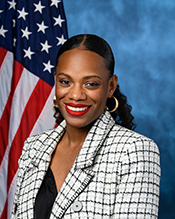
Rep. Summer L. Lee
Sponsored bills
Maddy summaryThe National Food as Medicine Program Act of 2024 creates a federal grant program to help states implement or expand initiatives that provide medically prescribed, nutrient-rich food (like fresh produce or tailored meals) to address chronic health conditions and food insecurity. States must partner with healthcare providers and community organizations to offer these interventions, using locally-sourced, sustainably produced food grown through regenerative or organic methods. The program requires states to evaluate outcomes like reduced hospital visits and improved health metrics, with reports submitted to the federal government after three years. It directly affects state Medicaid programs and healthcare providers participating in these initiatives.
Maddy summaryHRES 1525 is a non-binding resolution calling for the U.S. government to address policies contributing to forced migration and displacement. It urges reforms such as overhauling economic sanctions, investing in developing countries to reduce poverty and instability, and reforming trade agreements to protect workers. The resolution also calls for expanding legal immigration pathways, improving asylum processing, and creating a roadmap to citizenship for immigrants living in the U.S. As a resolution, it does not create new laws but sets policy priorities for future legislative action.
Maddy summaryThis bill raises the federal minimum wage to $15 per hour initially, with future increases tied to a "stability wage" calculated using average hourly earnings and cost-of-living adjustments (CPI). It modifies income tax brackets so that tax rates apply to income levels adjusted based on this stability wage calculation. The bill eliminates special minimum wage certificates for workers with disabilities and changes how earned income is counted for means-tested benefits. These changes would affect most workers, taxpayers across income levels, and individuals receiving government benefits based on income. The bill's provisions would take effect three months after enactment.
Maddy summaryHR 9878, the No Shame at School Act of 2024, requires schools to automatically certify students from households with unpaid meal fees for free or reduced-price meals (instead of allowing discretion), and mandates retroactive reimbursement for past unpaid meals. It directly affects school districts and students in households owing meal fees by prohibiting stigmatizing practices like special tokens, public lists of names, or withholding grades due to unpaid fees. Key provisions ban schools from physically segregating students, using debt collectors, or taking food away from students who owe fees, while requiring clear communication to households about meal applications. The bill defines "covered child" as any student enrolled in a participating school meal program whose household owes fees or is eligible for free/reduced meals.
Maddy summaryThe Child Safety and Well-Being Act of 2024 (HR 9875) establishes a Children's Commission to represent children's interests in federal policymaking. The Commission, composed of 15 diverse members including experts, youth with lived experience, and representatives from various backgrounds, will advise Congress and federal agencies on policies affecting children, particularly marginalized youth defined as those experiencing systemic barriers. The Commission will review agency actions, receive complaints about how children are treated, and publish annual reports with recommendations to improve child well-being policies. It is authorized $5 million annually for operations and must study the feasibility of requiring agencies to create "child impact statements" assessing how policies affect children.
Maddy summaryHRES 1516 is a resolution passed by the U.S. House of Representatives to commend Big Brothers-Big Sisters of America on its 120th anniversary. It recognizes the organization’s work in providing youth mentorship that helps young people graduate from school and plan for their future. The resolution highlights how the organization, operating in over 5,000 communities nationwide, has supported millions of young people through long-term mentor relationships. As a symbolic gesture, it does not create new laws or policies but expresses congressional support for the organization’s mission.
Maddy summaryThis resolution formally censures Representative Glen Clay Higgins (LA-03) for a September 25, 2024, social media post containing racist remarks and false claims about Haitians. The bill requires Higgins to appear in the House chamber to receive the censure, with the resolution publicly read by the Speaker. It specifically references his post describing Haiti as "the nastiest country," falsely accusing Haitians of eating pets, and labeling them "slapstick gangsters and thugs." The censure is a formal disciplinary action by the House, not a policy change.
Maddy summaryHR 9835, the Sexual Abuse Services in Detention Act, authorizes federal funding to provide emotional support services for individuals who have experienced sexual abuse while in detention. It creates three key mechanisms: (1) $10 million annually for grants to nonprofit providers collaborating with correctional facilities to deliver crisis counseling, safety planning, and resources; (2) $5 million annually for training grants to help correctional staff understand and support survivors; and (3) a $2 million annual national resource center to share best practices and training materials. The bill directly affects incarcerated survivors of sexual abuse and the facilities holding them, requiring services to be provided by specialized nonprofits with correctional experience. Funding is authorized for fiscal years 2024-2029, supplementing existing programs without replacing them.
Maddy summaryThis bill makes it illegal to intimidate election workers while they perform duties like vote counting, tabulation, or certification during federal elections. It creates a legal presumption that carrying visible firearms (including realistic replicas) near voters or election workers constitutes intimidation, unless proven otherwise. The law applies to actual firearms, imitation firearms, and antique firearms that could reasonably be mistaken for real weapons. Courts can also impose temporary restrictions on firearm carrying in related cases to protect election workers and voters.