This resolution celebrates the contributions of small businesses in every U.S. community and supports the designation of National Small Business Week. Further, it supports efforts to provide small businesses with aid and assistance through certain programs and initiatives.
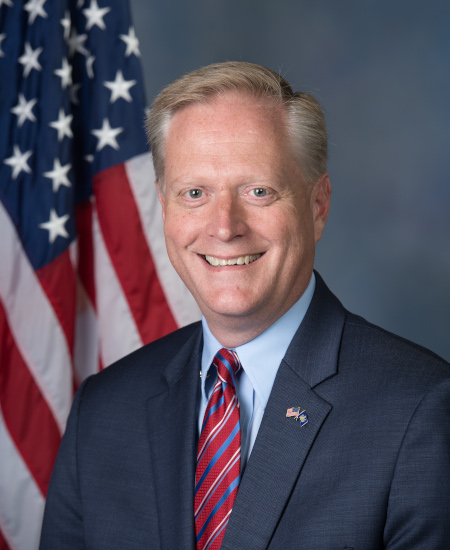
Rep. Fred Keller
Sponsored bills
This joint resolution nullifies the rule issued by the Centers for Disease Control and Prevention on February 3, 2021, that requires the use of face masks on planes, trains, buses, and other public conveyances and at transportation hubs to prevent the transmission of COVID-19.
Protection of Women and Girls in Sports Act of 2021 This bill makes it a violation of federal law for a recipient of federal funds who operates, sponsors, or facilitates athletic programs or activities to permit a person whose sex is male to participate in an athletic program or activity that is designated for women or girls. The bill specifies that sex shall be recognized based solely on a person's reproductive biology and genetics at birth.
This concurrent resolution expresses the sense of Congress that the President should consider the effect on Pennsylvania when conducting domestic and international energy policy, including pipeline approvals and permits for energy and mineral development.
Maddy summaryHR 7477, the CERTS Tax Exemption Act, ensures that grants provided under the Coronavirus Economic Relief for Transportation Services Act are tax-free for eligible transportation service providers. The bill directly affects companies and organizations providing transportation services that receive these specific federal grants. Key provisions state that grant amounts cannot be counted as taxable income, deductions related to grant-funded costs cannot be denied, and tax attributes (like basis increases) must be treated as tax-free for partnerships and S corporations. This change simplifies tax treatment for recipients by preventing unintended tax liabilities on relief funds.
Competency-Based Education Act of 2022 or the CBE Act of 2022 This bill creates a framework under which students participating in competency-based education programs may receive federal student aid. Competency-based education refers to education that measures academic progress and attainment (1) by direct assessment of the student's mastery of competencies, (2) by expressing the student's mastery of competencies in terms of equivalent credit or clock hours, or (3) through a combination of both methods in addition to credit or clock hours. The bill also prohibits the Department of Education from enforcing certain regulations related to the definition of credit hour.
America Reopens Act This bill restricts the implementation and enforcement of various COVID-19 response measures in transportation, education, and other areas. Specifically, the bill prohibits any federal agency or federally funded entity from requiring that U.S. citizens or permanent residents wear face coverings or show proof of COVID-19 vaccination or testing when using public conveyances (e.g., planes or trains) or transportation hubs when traveling domestically or returning from foreign countries. Further, Canadian and Mexican nationals may enter the United States for business through land ports of entry without regard to their COVID-19 vaccination status. The bill also restricts federal funding of public institutions of higher education unless the institution (1) makes in-person instruction available to all students; and (2) allows students to opt out of COVID-19 requirements concerning vaccination, testing, and face covering. This restriction does not apply to distance education programs offered for reasons unrelated to COVID-19 or certain health-related educational programs. Additionally, the Department of Education must provide grants to parents for certain educational expenses, such as tuition at a private school, if their child lacks access to in-person instruction at a public elementary or secondary school due to COVID-19. The bill also prohibits the use of federal funds to implement or enforce a system or plan for verifying an individual's COVID-19 vaccination status, such as vaccine passports.

Supply Chain Disruptions Relief Act This bill modifies the treatment of liquidations of new motor vehicle inventory as qualified LIFO (last in first out accounting method) inventory. It allows new motor vehicle dealers to elect to wait until the end of 2025 to replace their inventory for purposes of determining income attributable to the sale of such inventory during 2020 and 2021.
Further Incentivizing Nutritious Donations of Food Act of 2022 or the FIND Food Act of 2022 This bill provides tax incentives for food donation. Specifically, it expands the charitable tax deduction for contributions of food inventory to allow donations at reduced prices, allows a deduction for the cost of transporting donated food, and allows a tax credit for donations of food by farmers.
This resolution supports the preservation of the stepped-up basis tax rule that allows recipients of inherited assets such as land, equipment, or buildings to adjust the cost basis of the assets to reflect their fair market value. The resolution opposes any efforts to impose new taxes on family farms or small businesses and recognizes the importance of generational transfers of farm and family-owned businesses.