

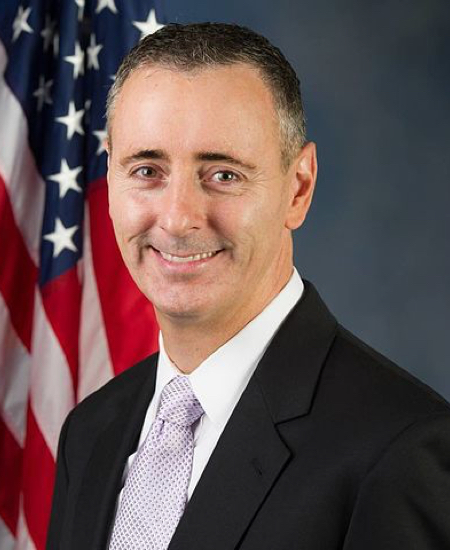
Photo of Brian K. Fitzpatrick
R United States House · District 1 · Pennsylvania On the 2026 ballot

Rep. Brian K. Fitzpatrick

Compare
Total votes
2,837
all sessions
Attendance
100%
9 missed
Higher than 75% of chamber peers
With party
76%
of cast votes
Lower than 98% of chamber peers
Bipartisan score
12%
some cross-party votes
Higher than 97% of chamber peers
Sponsored
4,059
bills & resolutions
Higher than 99% of chamber peers
Committees
6
assignments
4,059 bills and resolutions

Sponsored bills

Total
4,059
Primary
180
Co-sponsor
3,879
This page
4,059
matching current filters
Co-sponsor HR 4619
In committee · United States House · Co-sponsor
Medicare Mental Health Inpatient Equity Act of 2025

Maddy summaryThis bill eliminates a lifetime limit on inpatient psychiatric hospital care for Medicare beneficiaries. Currently, Medicare restricts coverage to 190 days total for such care; this bill removes that cap entirely. The key change amends Section 1812 of the Social Security Act to allow unlimited coverage for inpatient psychiatric hospital services under Medicare. The provision takes effect January 1, 2027, directly affecting Medicare patients requiring long-term inpatient mental health treatment.

In committee Jul 22, 2025 1 co-sponsor
Co-sponsor HR 4613
In committee · United States House · Co-sponsor
Bubble Tax Modernization Act of 2025

Maddy summaryThis bill modifies the tax treatment of certain alcoholic beverages by merging the classification for mead and low-alcohol wine under a single tax category. It defines "low alcohol by volume wine" as still wine containing less than 8.5% alcohol by volume and no more than 0.64 grams of carbon dioxide per 100 milliliters. This change directly affects winemakers and honey-based beverage producers who previously faced different tax rules for these products. The updated definition takes effect for wine produced after December 31, 2025.

In committee Jul 22, 2025 1 co-sponsor
Co-sponsor HR 4582
In committee · United States House · Co-sponsor
To amend the Family and Medical Leave Act of 1993 and title 5, United States Code, to clarify that organ donation surgery qualifies as a serious health condition.

Maddy summaryThis bill amends the Family and Medical Leave Act (FMLA) and federal employee leave rules to clarify that recovery from organ donation surgery qualifies as a "serious health condition." It directly affects private-sector workers covered by the FMLA and federal civil service employees. The key change adds "including recovery from surgery related to organ donation" to the definitions of serious health conditions in both the FMLA and federal leave statutes. This ensures eligible employees can use their existing family and medical leave benefits to recover after donating an organ, without requiring new leave entitlements.

In committee Jul 22, 2025 1 co-sponsor
Co-sponsor HR 4576
In committee · United States House · Co-sponsor
Build More Housing Near Transit Act of 2025

Maddy summaryThis bill amends federal transit grant rules to incentivize local housing policies near transit. It defines "pro-housing policies" as actions removing regulatory barriers (like eliminating parking minimums or streamlining approvals for multi-family housing) and adds a 1-point scoring boost in grant evaluations for projects demonstrating such policies within walking distance of transit. Local governments and developers seeking federal transit capital grants can earn this boost by documenting these policies, with HUD consulted to assess expected housing outcomes. The policy directly affects how transit projects are scored for funding, aiming to align housing production with transit access.

In committee Jul 22, 2025 1 co-sponsor
Co-sponsor HR 4560
In committee · United States House · Co-sponsor
Building Resilient Infrastructure and Communities for All Act of 2025

Maddy summaryHR 4560 amends disaster relief laws to change how federal funds for pre-disaster hazard mitigation are distributed. It requires the President to allocate funds using a new formula: 33% equally among states, 33% based on population, and 33% based on hazard vulnerability, with states directing at least 50% of funds to locally recommended projects. The bill ensures tribal governments receive a minimum $75 million in funding and prevents projects funded under this section from affecting eligibility for other disaster assistance. These changes directly affect states, local governments, and tribal nations managing disaster resilience projects.

In committee Jul 22, 2025 1 co-sponsor
Co-sponsor HR 4335
In committee · United States House · Co-sponsor
Abraham Accords Defense Against Terror Act

Maddy summaryHR 4335, the Abraham Accords Defense Against Terror Act, streamlines U.S. defense exports to countries that have normalized relations with Israel (via the Abraham Accords) and cooperate with the U.S. on countering Iran and Iran-aligned threats in the Middle East and North Africa. The bill authorizes the Secretary of State to identify qualifying countries and fast-tracks approval for military sales, leases, or transfers to them, requiring a 15-day congressional notification with specific safeguards. Key safeguards include ensuring sensitive U.S. technology isn’t shared with China or Russia and mandating regular strategy reports to Congress on implementation, threat assessments, and pending defense deals over $25 million. This directly affects participating Middle Eastern nations and U.S. defense export processes, aiming to accelerate security cooperation without altering Israel’s military edge. The bill focuses on procedural changes to expedite defense cooperation, not on new funding or policy outcomes.

In committee Jul 22, 2025 1 co-sponsor
Co-sponsor HR 3351
Passed · United States House · Co-sponsor
Improving Access to Small Business Information Act

Maddy summaryHR 3351, the Improving Access to Small Business Information Act, exempts certain actions by the Small Business Capital Formation Advocate from federal paperwork rules under the Paperwork Reduction Act. Specifically, it clarifies that the Advocate’s routine communications and information-sharing activities are not considered "collections of information" requiring prior approval or specific formatting under those rules. However, the bill retains some requirements, such as needing to display control numbers on forms, though it removes the need for the Advocate to submit paperwork to the Office of Management and Budget. This procedural change aims to streamline the Advocate’s ability to provide information to small businesses without triggering additional federal administrative burdens.

Passed Jul 22, 2025 1 co-sponsor
Co-sponsor HR 2625
Passed · United States House · Co-sponsor
VERY Act of 2025

Maddy summaryThis bill changes the terminology used in federal law regarding veterans' employment. It amends Title 38 of the U.S. Code to replace every instance of "employment handicap" with "employment barrier" and "employment handicaps" with "employment barriers." The change affects how the government describes obstacles veterans face in finding jobs within existing law. It is a purely technical update to language, not a new policy or program, and does not alter any current veteran employment benefits or requirements.

Passed Jul 22, 2025 1 co-sponsor
Co-sponsor HR 1522
In committee · United States House · Co-sponsor
Federal Retirement Fairness Act

Maddy summaryHR 1522, the Federal Retirement Fairness Act, changes federal retirement rules to include temporary employees' service after January 1, 1988, in retirement benefit calculations. It directly affects temporary federal employees (including U.S. Postal Service workers) and Members of Congress who served after that date. The bill removes a previous cutoff date in retirement law, allowing their temporary service to count toward retirement eligibility. This means eligible temporary workers can now have their full service period considered when calculating retirement benefits.

In committee Jul 22, 2025 1 co-sponsor
Co-sponsor HR 1144
In committee · United States House · Co-sponsor
Frederick Douglass Trafficking Victims Prevention and Protection Reauthorization Act of 2025

Frederick Douglass Trafficking Victims Prevention and Protection Reauthorization Act of 2025   This bill reauthorizes programs and activities that combat international trafficking; establishes a new program to help victims of trafficking; and updates various elements of the federal framework to combat international trafficking. Specifically, this bill reauthorizes through FY2029 programs and activities at various federal departments and agencies to combat international trafficking and reduce the prevalence of modern slavery. The bill also reauthorizes International Megan’s Law through FY2029. Among its provisions, the law requires sex offenders to provide certain information about their intended travel outside of the United States. Additionally, the bill authorizes the Department of Health and Human Services to carry out a new program to help victims of trafficking integrate or reintegrate into society. The bill requires the Department of State's Trafficking in Persons Report to include information about trafficking in persons for the purposes of organ removal.  With respect to country rankings for anti-trafficking efforts, the bill narrows the types of countries that are listed on the Tier 2 Watch List and increases the length of time a country may remain on the Tier 2 Watch List after being downgraded to the lowest ranking and then reinstated to the watch list. (The Tier 2 Watch List refers to countries that are making efforts to meet international standards for combatting human trafficking but still have a significant number of severe trafficking cases.)   Finally, the bill requires counter-trafficking strategies, activities, and efforts to be further incorporated into U.S. foreign assistance.

In committee Jul 22, 2025 1 co-sponsor
Showing 691 to 700 of 4,059 bills
Previous 1 … 69 70 71 … 406 Next