

Arctic Refuge Protection Act This bill repeals the Arctic National Wildlife Refuge oil and gas program. The bill designates approximately 1,559,538 acres of land within Alaska in the Arctic National Wildlife Refuge as a component of the National Wilderness Preservation System.
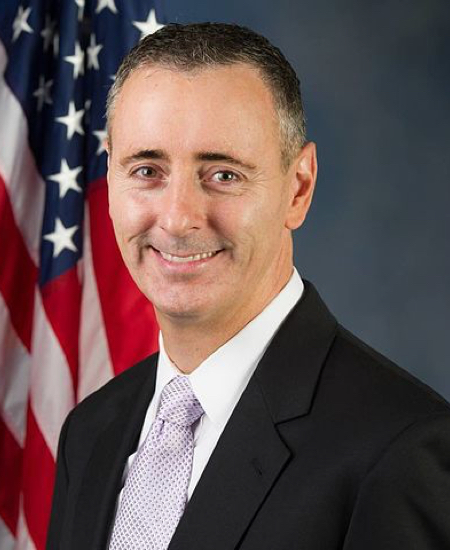
Rep. Brian K. Fitzpatrick
Sponsored bills
Thin Blue Line Act This bill expands the list of statutory aggravating factors in death penalty determinations to also include killing or targeting a law enforcement officer, firefighter, or other first responder.
Citizen Legislature Anti-Corruption Reform of Congress Act or the CLEAN Congress Act This bill (1) requires bills, orders, resolutions, or votes submitted by Congress to the President to include only one subject that is clearly and descriptively expressed in the measure's title; and (2) makes ineffective any provision of law that excludes its application to a Member of Congress or to an employee in a Member's office.
Citizen Legislature Anti-Corruption Reform of Elections Act or the CLEAN Elections Act This bill establishes requirements for nonpartisan redistricting and open primary elections. States must (1) conduct congressional redistricting using a plan developed by a nonpartisan independent redistricting commission, beginning with the 2020 census; and (2) hold open primaries for federal elections. A state may not use federal funds provided for election administration purposes unless it certifies to the Election Assistance Commission that it (1) conducts redistricting for its state legislative districts using a plan developed by a nonpartisan independent redistricting commission, and (2) holds open primaries for elections for state and local office.
This resolution expresses support for the designation of Rare Disease Day.
Expanded Genetic Screening Act of 2021 This bill requires state Medicaid programs to cover noninvasive prenatal genetic screening for pregnant women. (Noninvasive prenatal genetic screening uses naturally occurring fetal DNA from the mother's blood to screen for genetic abnormalities.)
Telehealth Improvement for Kids' Essential Services Act or the TIKES Act This bill requires several agencies to promote and evaluate the use of telehealth under Medicaid and the Children's Health Insurance Program (CHIP). Specifically, the bill requires (1) the Centers for Medicare & Medicaid Services to issue guidance to states on ways to increase access to telehealth; (2) the Medicaid and CHIP Payment and Access Commission to study the impact of telehealth on health care access, utilization, costs, and outcomes; and (3) the Government Accountability Office to evaluate federal interagency collaboration with respect to the provision of telehealth services to individuals under the age of 18.
Support Our Schools Act This bill provides additional FY2021 funding for the Department of Education to address the continued impact of COVID-19 (i.e., coronavirus disease 2019) on elementary and secondary schools and institutions of higher education (IHEs). It also provides additional FY2021 funding for specified purposes to the National Endowment for the Arts, the National Endowment for the Humanities, the Institute of Museum and Library Services, and the Administration for Native Americans. In addition, the bill modifies the so-called 90/10 rule to require for-profit IHEs to include all forms of federal education aid in the revenue calculation for federal student-aid program eligibility. (Generally, this rule requires a for-profit IHE to derive at least 10% of its revenue from sources other than federal financial aid.)
PPP Flexibility for Farmers and Ranchers Act This bill expands eligibility for agricultural producers under the Paycheck Protection Program, established to support small businesses in response to COVID-19 (i.e., coronavirus disease 2019), to include certain agricultural producers organized as partnerships. Currently, only certain agricultural producers that are sole proprietorships, independent contractors, or self-employed individuals may receive support under the program.
Restoring Integrity to America's Elections Act This bill revises provisions regarding the Federal Election Commission (FEC), including to change FEC membership. Specifically, the bill reduces the number of appointed members of the FEC from six to five and permits no more than two members to be affiliated with the same political party. Further, it removes the Secretary of the Senate and Clerk of the House as ex officio members. Next, the bill establishes the Blue Ribbon Advisory Panel to recommend to the President individuals for nomination to the FEC. The President shall appoint the FEC chair, subject to Senate confirmation. The bill distributes the FEC's powers between the chair and the other FEC members. Further, it requires the FEC to ensure that its forms allow for the use of an accent mark as part of an individual's identification. The bill modifies the process for (1) the FEC to initiate an investigation, and (2) a party aggrieved by the FEC's dismissal of the party's complaint or the FEC's failure to take action on the party's complaint to seek judicial review in federal court. Additionally, individuals who submit written comments regarding requests for advisory opinions must be given an opportunity to appear at FEC hearings on those requests. The bill also permanently extends the FEC's administrative penalty authority. Finally, the bill provides statutory authority for limitations on ex parte communications as applied to FEC members and employees. It also specifies that FEC attorneys may represent the FEC before the Supreme Court.