Maddy summaryThis bill authorizes the U.S. Mint to produce two types of commemorative $2.50 coins for the 250th anniversary of the Declaration of Independence: a circulating coin for everyday use and a numismatic (collector) coin. Both would feature designs based on the 1926 Sesquicentennial coin - showing allegorical liberty holding the Declaration on one side and Independence Hall on the other - with "1776-2026" inscriptions. The bill requires the Mint to issue these coins by July 4, 2026, if technically and economically feasible, but does not mandate their production or affect any specific groups beyond the public who may purchase them.
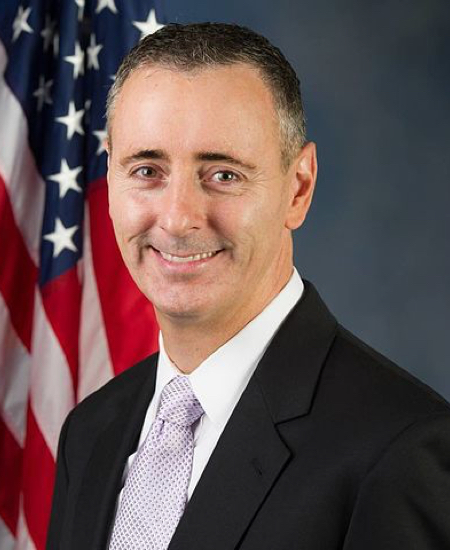
Rep. Brian K. Fitzpatrick
Sponsored bills
Maddy summaryHR 7516, the "No Funds for Forced Labor Act," requires the U.S. Treasury to direct American representatives at international financial institutions (like the World Bank) to oppose loans for projects that use or risk using forced labor, particularly those involving state-run entities in Xinjiang. It mandates these institutions to vet projects for forced labor risks, explain their vetting process, and detail mitigation steps before funding. The bill directly affects international financial institutions and the projects they fund, especially those linked to Xinjiang. It does not ban all loans but targets projects with documented forced labor concerns, requiring annual reports to Congress on implementation. The law focuses on policy changes to prevent U.S.-aligned financial support for forced labor practices.
Maddy summaryHR 7498, the After Hours Child Care Act, creates a new Child Care and Development Innovation Fund to expand child care access for parents working nontraditional hours (like evenings, nights, or weekends). The bill directly affects working parents with young children who struggle to find care outside standard 9-to-5 hours, aiming to help them stay employed and advance in their careers. It authorizes $25,000-$500,000 grants for up to 5 years to eligible entities (such as child care providers or partnerships with businesses) to expand existing programs, establish new onsite workplace child care, or improve facilities and staff training. Grantees must cover 25% of costs, and the Secretary of Health and Human Services must report every two years on the program’s impact, including children served and changes in child care availability.
Maddy summaryHR 4671 establishes a Wildland Fire Management Casualty Assistance Program to support families of firefighters and wildland fire support personnel injured or killed in the line of duty. The program requires the Secretary of the Interior to develop procedures for notifying next-of-kin about critical injuries or deaths, reimbursing travel expenses for family visits, and providing centralized case management. It mandates a centralized website offering free, personalized information about federal benefits and complaint mechanisms for survivors. The bill also defines "next-of-kin" priority (spouse, children, parents, etc.) and requires data collection on casualty assistance quality, without affecting existing Line of Duty Death benefits.
Maddy summaryThe PROTECT Firefighters Act requires the U.S. Fire Administrator to develop a strategy within one year to improve equipment, training, and staffing for firefighter Rapid Intervention Teams (RITs), which are rescue units deployed during emergencies to save trapped firefighters. The strategy must assess current standards across states, identify barriers to modern equipment and training (including for teams responding to maritime fires at ports), and review firefighter fatality reports to link equipment gaps to deaths. It also mandates a follow-up briefing 18 months after enactment to update Congress on progress toward standardizing equipment and training. The bill directly affects RITs nationwide and those serving maritime facilities, with no direct funding or program changes - only a mandated assessment and reporting process.
Maddy summaryThis resolution expresses the House of Representatives' support for designating February 2026 as "National Teen Dating Violence Awareness and Prevention Month." It cites CDC statistics showing teen dating violence affects nearly half of teens (44.3%) and disproportionately impacts young women, with 1 in 9 females and 1 in 36 males reporting sexual dating violence in the past year. The resolution urges schools, communities, and the public to observe the month through awareness and prevention activities but does not create new laws or allocate funding.
Maddy summaryHR 7480, the FAIR Act, sets pay adjustments for federal employees in 2027. It increases base pay by 3.1% for most federal workers under standard pay systems and for employees paid according to local civilian wages in high-cost areas. Additionally, it raises locality pay adjustments by 1% for 2027. The bill directly affects all federal employees covered by these pay systems through concrete, formula-based adjustments.
Maddy summaryHR 7460, the Airborne Act of 2026, creates a new tax credit for property owners to improve indoor air quality in commercial, public, and nonprofit buildings. It provides tax credits of $1 per square foot for air quality assessments, $5 per square foot for air cleaning system upgrades, and $50 per square foot for HVAC upgrades, with higher rates ($25/$250) if projects meet prevailing wage and 15% apprentice labor requirements. The credit applies only to properties meeting ASHRAE air quality standards (62.1-2022 or 241-2023) and requires certification by the Department of Energy. Property owners can claim the credit against federal taxes, with annual limits capping upgrade credits at 50% of related costs.
Safe Vehicle Access for Survivors Act This bill requires providers of connected vehicle services, upon the request of a domestic violence survivor, to terminate or disable an identified domestic abuser’s access to a vehicle’s connected capabilities and data. Specifically, within two business days of receiving a request from a survivor, a covered provider must, if technically feasible (1) terminate or disable the connected vehicle account associated with the identified abuser or the relevant vehicle, or the vehicle’s connected capabilities; or (2) instruct the survivor on how to terminate or disable connected services directly. Covered providers may not make the termination of connected vehicle services or accounts contingent on any requirement other than the provision of specified information by the survivor. For example, a provider may not require a survivor to pay a fee or extend their contract with the provider. Under the bill, an abuser is an individual identified by a survivor who committed or allegedly committed certain acts against the survivor, including domestic violence, sexual assault, stalking, and sex trafficking. A survivor is an adult against whom such an act was committed. Further, a covered provider is a vehicle manufacturer, affiliate, or entity acting on behalf of a manufacturer that provides a connected vehicle service. Connected vehicle service is any capability that enables a person to remotely access data from or send commands to a vehicle. Finally, the Federal Communications Commission must prescribe regulations governing how covered providers address survivors’ requests related to connected vehicles.

Maddy summaryHRES 1044 is a non-binding resolution expressing the House of Representatives' support for designating 2026 as the "National Year of the Volunteer." It aims to honor volunteers who contribute to community safety, health, education, and civic life, while encouraging nationwide efforts to boost volunteerism ahead of the U.S. 250th anniversary. The resolution does not create new laws or funding but serves as a symbolic gesture to highlight the value of volunteer service and inspire greater community engagement.