Supporting Our First Responders Act This bill requires the Department of Health and Human Services to award grants on a competitive basis to nongovernmental or governmental entities that provide medical transport and emergency medical services (EMS). Grant recipients may use funds to, for example, support the EMS workforce (e.g., by providing salaries and stipends or covering certification costs) and purchasing vehicles, personal protective equipment, and other resources.
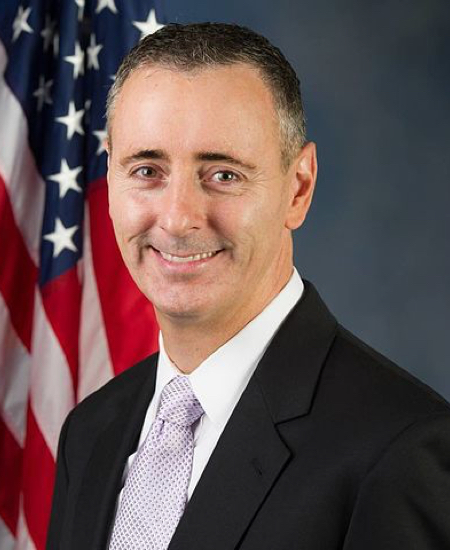
Rep. Brian K. Fitzpatrick
Sponsored bills
Hydrogen for Industry Act of 2022 This bill requires the Department of Energy (DOE) to establish grant programs to support the use of hydrogen in energy. Specifically, DOE must establish a grant program for projects that demonstrate the uses of hydrogen in heavy industry (e.g., steel, cement, glass, and chemical manufacturing). It also directs DOE to establish a grant program for (1) carrying out projects that demonstrate the end uses of hydrogen; (2) constructing a new commercial-scale facility that will use hydrogen as a fuel or feedstock; or (3) retooling, retrofitting, or expanding an existing facility to enable the use of hydrogen as a fuel or feedstock in industrial end-use applications of hydrogen.
Hydrogen Infrastructure Finance and Innovation Act This bill requires the Department of Energy (DOE) to establish a hydrogen infrastructure finance and innovation pilot program. Under the program, DOE must provide grants and low-interest loans to certain entities for hydrogen infrastructure, including projects for hydrogen transportation, storage, or delivery.
This bill extends until September 30, 2026, the use of Highway 209, a federally owned road within the boundaries of the Delaware Water Gap National Recreation Area, by certain commercial vehicles that serve local businesses.
National Center for the Advancement of Aviation Act of 202 2 This bill establishes the National Center for the Advancement of Aviation to (1) develop a skilled and robust U.S. aviation and aerospace workforce; (2) serve as a national independent forum to support collaboration and cooperation between aviation and aerospace stakeholders regarding the advancement of the U.S. aviation and aerospace workforce; and (3) serve as a repository for research conducted by institutions of higher education, research institutions, or other stakeholders regarding the aviation and aerospace workforce, or related technical and skill development. The center must perform the following duties improve access to aviation and aerospace education and related skills training to help grow the U.S. aviation and aerospace workforce; support Armed Forces personnel and veterans seeking to transition to a career in civil aviation or an aerospace-related field through outreach, training, apprenticeships, or other means; and amplify and support the research and development efforts conducted as part of the National Aviation Research Plan and work done at the Federal Aviation Administration Technical Centers regarding the aviation and aerospace workforce. Additionally, the center may issue grants to certain entities to create, develop, deliver, or update middle and high school aviation curricula and aviation curricula used at institutions of higher education, secondary educations institutions, or by technical training and vocational schools; support the professional development of educators using the curricula; establish new education programs that teach technical skills used in aviation maintenance; establish scholarships, internships or apprenticeships for individuals pursuing employment in the aviation maintenance industry; support outreach about educational opportunities and careers in the aviation maintenance industry; and support the transition to career in aviation maintenance, including for members of the Armed Forces.

This resolution condemns the Iranian regime's torture and murder of Mahsa Amini. The resolution condemns the Iranian regime's laws that discriminate against women. The resolution also condemns the Iranian regime's use of violence against those peacefully protesting the government and seeking freedom. Finally, the resolution recognizes the right to self-determination for the Iranian people struggling to establish a democratic, secular, and nonnuclear Iran.
More Homes on the Market Act This bill increases the tax exclusion of gain from the sale of a principal residence and requires an annual inflation adjustment to such increased amount.
Post-Disaster Mental Health Response Act This bill authorizes the provision of professional counseling services to victims of declared emergencies (current law limits such authorization to victims of major disasters).
Maximizing Outcomes through Better Investments in Lifesaving Equipment for (MOBILE) Health Care Act This bill allows a health center that currently receives funding through a Health Resources & Services Administration Health Center Program grant to use a New Access Point grant to set up a mobile unit regardless of whether the health center also establishes a permanent health care delivery site. New Access Point grants help health centers establish new delivery sites to provide comprehensive primary care to medically underserved populations. Under current law, health centers may only use the grants to set up a mobile unit if they also establish a permanent site.
Nonprofit Security Grant Program Improvement Act of 2022 This bill modifies the Nonprofit Security Grant Program of the Department of Homeland Security and reauthorizes appropriations for such program through FY2028. The Federal Emergency Management Agency (FEMA) must establish an office, headed by a senior FEMA official, to administer the program. Office responsibilities include those related to outreach, engagement, education, and technical assistance. FEMA must also publish grant guidelines and may prohibit states from closing application processes before the publication of the guidelines. FEMA must seek to enter into a contract or other agreement with an independent research organization for the conduct of a study that analyzes and reports on (1) the effectiveness of the program for preparedness against terrorism and other threats; (2) the risk-based formula and allocations under the program; and (3) the risk profile of and any identifiable factors leading to the low participation of traditionally underrepresented groups and states under the program.