

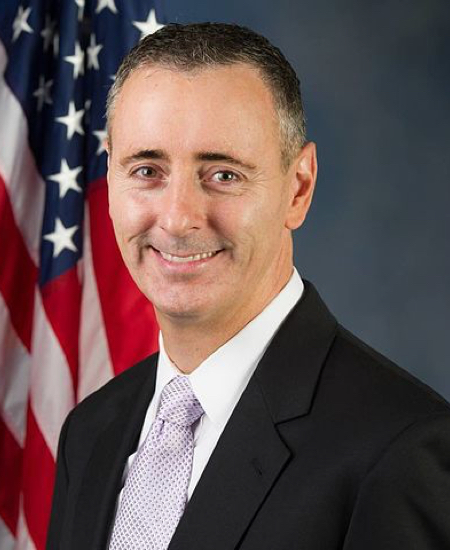
Photo of Brian K. Fitzpatrick
R United States House · District 1 · Pennsylvania On the 2026 ballot

Rep. Brian K. Fitzpatrick

Compare
Total votes
2,837
all sessions
Attendance
100%
9 missed
Higher than 75% of chamber peers
With party
76%
of cast votes
Lower than 98% of chamber peers
Bipartisan score
12%
some cross-party votes
Higher than 97% of chamber peers
Sponsored
4,059
bills & resolutions
Higher than 99% of chamber peers
Committees
6
assignments
4,059 bills and resolutions

Sponsored bills

Total
4,059
Primary
180
Co-sponsor
3,879
This page
4,059
matching current filters
Co-sponsor HR 2627
In committee · United States House · Co-sponsor
Keep STEM Talent Act of 2025

Maddy summaryThis bill changes visa rules for foreign graduate students pursuing STEM master's or doctoral degrees in the U.S. It requires these students to apply for admission before starting their program and adds background checks and credential verification to their visa process. It also creates a new pathway to permanent residency for STEM degree holders who secure jobs in their field at median wage levels, and allows students to seek permanent residency while on student visas (dual intent). The bill directly affects international students in STEM fields, U.S. universities, and employers hiring these graduates.

In committee Apr 3, 2025 1 co-sponsor
Co-sponsor HR 2598
In committee · United States House · Co-sponsor
IDEA Full Funding Act

Maddy summaryThe IDEA Full Funding Act (HR 2598) mandates specific annual federal funding levels for the Individuals with Disabilities Education Act (IDEA), directly affecting schools and students with disabilities nationwide. It requires the federal government to appropriate either a fixed dollar amount or a specified percentage (increasing annually from 4.5% to 40%) of a calculated total - based on the number of eligible students and average per-pupil costs - starting in fiscal year 2026 through 2035. The bill sets clear, escalating funding targets, with the higher of two calculated amounts (dollar figure or percentage) becoming available for obligation each fiscal year. This establishes a binding financial commitment to address long-standing underfunding of special education services under IDEA.

In committee Apr 2, 2025 1 co-sponsor
Co-sponsor HR 2609
In committee · United States House · Co-sponsor
PEACE Act

Maddy summaryThe PEACE Act (HR 2609) requires U.S. diplomats to receive mandatory training on the Abraham Accords and other Middle East peace agreements. It directs the State Department to develop new courses and online modules about these agreements' history, implementation, and diplomatic impact for Foreign Service officers, with a bipartisan advisory board advising on curriculum. The bill also authorizes fellowships for diplomats to engage with partner countries in the region and mandates annual reports to Congress on training progress. This affects U.S. diplomats and State Department training programs, focusing solely on educational requirements without altering diplomatic policy.

In committee Apr 2, 2025 1 co-sponsor
Primary HR 2596
In committee · United States House · Lead sponsor
Renewable Natural Gas Incentive Act of 2025

Maddy summaryHR 2596 creates a $1.00 per gallon tax credit for renewable natural gas (RNG) used as transportation fuel in vehicles, boats, or aircraft. The credit applies to producers and businesses that sell or use RNG meeting specific requirements, including registration under existing rules and producer certification. RNG must be derived from biomass and produced within the U.S., with blended fuel treated as RNG only under strict contractual and certification conditions. The credit expires for sales or uses after December 31, 2035, and applies to fuel sold or used after December 31, 2025.

In committee Apr 2, 2025 0 co-sponsors
Co-sponsor HR 2588
In committee · United States House · Co-sponsor
Improving Reporting to Prevent Hate Act of 2025

Maddy summaryHR 2588, the Improving Reporting to Prevent Hate Act of 2025, requires the Attorney General to evaluate whether local governments with populations over 100,000 (that apply for specific grants) are credibly reporting hate crimes. It flags jurisdictions that report zero hate crimes or no data annually, making them ineligible for grants unless they meet specific reporting standards. Jurisdictions can avoid penalties by conducting significant community education on hate crimes, such as adopting reporting policies or holding public forums. The Attorney General must publish an annual report on jurisdictions using the education exception. This bill focuses on improving data accuracy for hate crimes, not changing hate crime laws or definitions.

In committee Apr 2, 2025 1 co-sponsor
Co-sponsor HR 2540
In committee · United States House · Co-sponsor
SSI Savings Penalty Elimination Act

Maddy summaryThis bill raises the asset limits for Supplemental Security Income (SSI) recipients to allow more savings without losing benefits. It increases the individual resource limit from $2,250 to $20,000 (in 2025) and the couple limit from $1,500 to $10,000, with automatic annual inflation adjustments based on the Consumer Price Index. These changes directly affect low-income seniors and people with disabilities who rely on SSI. The bill eliminates the current "savings penalty" that previously forced recipients to spend down savings to qualify. The new limits will adjust each year to maintain their real value against inflation.

In committee Apr 1, 2025 1 co-sponsor
Co-sponsor HR 2582
In committee · United States House · Co-sponsor
Expanding Partnerships for Innovation and Competitiveness Act

Maddy summaryHR 2582, the Expanding Partnerships for Innovation and Competitiveness Act, creates a nonprofit organization called the Foundation for Standards and Metrology to support the National Institute of Standards and Technology (NIST). The Foundation will work with researchers, universities, industry, and nonprofits to advance measurement science, technical standards, and technology commercialization to enhance U.S. economic security. It will be governed by a Board of Directors with 11 appointed members representing diverse stakeholders, and must become financially self-sustaining within five years. The Foundation will conduct studies, support research facilities, facilitate commercialization of federally funded research, and report annually to Congress on its activities and financial status. The bill authorizes $500,000-$1,250,000 annually from NIST's budget to fund the Foundation starting in fiscal year 2026.

In committee Apr 1, 2025 1 co-sponsor
Co-sponsor HR 2559
In committee · United States House · Co-sponsor
Taiwan Allies Fund Act

Maddy summaryHR 2559, the Taiwan Allies Fund Act, authorizes $40 million annually (2026-2028) from existing foreign aid funds to support countries maintaining or strengthening unofficial ties with Taiwan, particularly those facing economic or diplomatic pressure from China. The bill directs funds to help eligible countries diversify supply chains, counter Chinese propaganda, develop health initiatives as alternatives to China's "Health Silk Road," and advance Taiwan's participation in international organizations. Countries receiving funds cannot get more than $5 million per year, and the State Department must coordinate with Taiwan and report annually on fund usage and effectiveness. This is a targeted financial assistance program, not a policy change affecting Taiwan's status or U.S. diplomatic recognition.

In committee Apr 1, 2025 1 co-sponsor
Co-sponsor HR 2531
In committee · United States House · Co-sponsor
Workplace Violence Prevention for Health Care and Social Service Workers Act

Workplace Violence Prevention for Health Care and Social Service Workers Act This bill requires the Department of Labor to address workplace violence in health care, social service, and similar sectors. Specifically, Labor must issue an occupational safety and health standard that requires certain employers to take actions to protect workers and other personnel from workplace violence. The standard applies to employers in the health care sector, in the social service sector, and in sectors that conduct activities similar to those in the health care and social service sectors. Among other elements, the standard must require each employer to (1) develop a workplace violence prevention plan, (2) promptly investigate incidents of workplace violence, and (3) provide relevant training and education to employees.  The bill requires certain hospitals and skilled nursing facilities to comply with this standard as a condition of Medicare participation.

In committee Apr 1, 2025 1 co-sponsor
Co-sponsor HR 2569
In committee · United States House · Co-sponsor
Train Noise and Vibrations Reduction Act of 2025

Maddy summaryHR 2569, the Train Noise and Vibrations Reduction Act of 2025, requires the Comptroller General to produce a report within one year of enactment. The report must include specific recommendations and cost-benefit estimates for reducing train noise and vibrations near homes, covering modifications to trains/tracks, speed limits, building insulation, track-home distances, and operational limits. This bill does not directly change laws or affect anyone immediately; it mandates a study to inform future policy decisions. The report will examine various approaches to mitigate noise and vibration impacts on residential areas.

In committee Apr 1, 2025 1 co-sponsor
Showing 991 to 1,000 of 4,059 bills
Previous 1 … 99 100 101 … 406 Next