

Maddy summaryHR 1449, the Energy Resilient Communities Act, creates a federal grant program to fund clean energy microgrids that support critical community infrastructure like hospitals, schools, and emergency facilities. Eligible entities - including states, local governments, nonprofits, and tribal agencies - can apply for grants covering up to 90% of costs for technical assistance, community outreach, or microgrid projects in environmental justice communities. Key provisions prioritize projects that reduce emissions, lower energy costs for low-income residents, minimize land use impacts, and ensure 40% of construction labor comes from local residents meeting specific criteria (e.g., displaced workers, environmental justice community members). The program authorizes $1.5 billion over 10 years, with at least 10% reserved for community-owned microgrid projects, and requires annual reporting on project outcomes and labor practices.
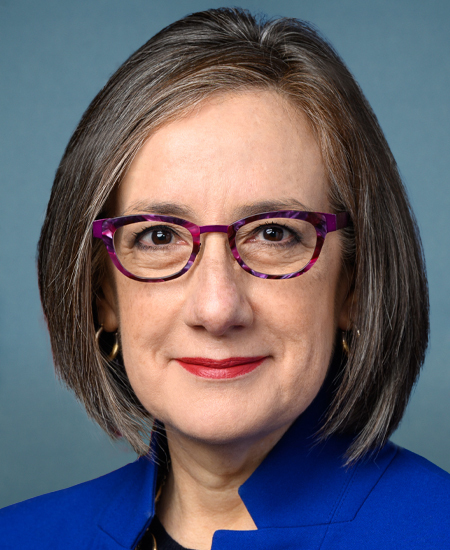
Rep. Andrea Salinas
Sponsored bills
Maddy summaryThis bill would require states to create a simplified process for out-of-state healthcare providers to join Medicaid and CHIP programs. Qualified providers (those already enrolled in Medicare or another state's program with low fraud risk) could enroll without excessive screening and would be approved for five years. It directly affects children under 21 enrolled in Medicaid or CHIP by expanding access to providers outside their state, particularly in underserved areas. The change applies to all states' Medicaid programs but takes effect three years after enactment.
Maddy summaryThis bill establishes a Veterans Affairs grant program to fund peer-to-peer mental health support for veterans. It provides up to $250,000 per grant to eligible organizations (like veteran nonprofits, service groups, or state agencies) to hire veterans as peer specialists who host nonclinical support groups and offer 24/7 mental health assistance. The program prohibits grant recipients from collecting or reporting veterans' personal information. It directly affects veterans seeking accessible, nonclinical mental health support through peer-led services.
Buffalo Soldiers Congressional Gold Medal Act of 2025 This bill provides for a Congressional Gold Medal to be awarded to the Buffalo Soldier regiments (six all-Black cavalry and infantry regiments authorized by Congress in 1866 to serve in the Armed Forces) in recognition of their vital service to the United States.
Goldie's Act This bill expands enforcement provisions under the Animal Welfare Act (AWA). Specifically, the bill directs the Department of Agriculture (USDA) to document and record detailed descriptions of violations of the act observed during inspections and investigations. USDA must provide a copy of all records documenting violations to state, local, and municipal animal control or law enforcement officials within 24 hours of such inspections or investigations. Inspections must be held at least once a year of each research facility, the premises of each animal dealer, and each exhibitor of animals. If violations are found during inspections, then USDA must conduct any necessary follow-up inspections until all the violations are corrected. Inspectors must confiscate or destroy in a humane manner animals found to be suffering physical or psychological harm as a result of failure to comply with the AWA. Violators are subject to civil penalties as outlined in the bill.
Creating Access to Rural Employment and Education for Resilience and Success Act or the CAREERS Act This bill reauthorizes the Rural Innovation Stronger Economy (RISE) Grant Program and expands the program to include support for career pathway programs or industry or sector partnerships in industries in rural communities. As background, this Department of Agriculture (USDA) program offers grant assistance to create and augment high-wage jobs, accelerate the formation of new businesses, support industry clusters, and maximize the use of local productive assets in eligible low-income rural areas. Under the bill, RISE grant program funds may be used to support career pathway programs (i.e., a combination of rigorous and high-quality education, training, and other services) or industry or sector partnerships in industries in rural communities. These industries may include public utilities (i.e., telecommunications, broadband, water, wastewater, disposal, and electric supply services), conservation practices and management, health care, child care, manufacturing, and agribusiness. The bill removes the current requirement that the program provide grants (to the maximum extent practicable) for job accelerators in at least 25 states. Instead, USDA must ensure the regional diversity of grant recipients or participants in providing for job accelerators, career pathway programs, and industry or sector partnerships. The bill also includes additional reporting requirements for career pathway programs and industry or sector partnership grant recipients.
Rural Telehealth and Education Enhancement Act of 2025 This bill reauthorizes the Distance Learning and Telemedicine Program through FY2030. This Department of Agriculture program provides grants to help rural communities gain the technology and training necessary to engage in telemedicine and distance learning.
Maddy summaryThis bill creates a new federal tax credit for family child care providers who operate from their primary residence. It allows eligible providers to claim up to $5,000 annually toward specific startup costs like licensing fees, supplies (diapers, toys), insurance, fencing, playground equipment, and required renovations. To qualify, providers must be licensed/registered, serve at least two non-family children, and operate from their home. The credit is limited to one year per provider (no repeat claims) and expires after seven years. It directly affects small-scale home-based child care operators seeking to establish or improve their licensed services.
Maddy summaryHR 1330 establishes the Smithsonian National Museum of the American Latino, authorizing its location within the National Mall's "Reserve" area. The bill requires the Smithsonian Board to coordinate with federal agencies managing potential museum sites, including notifying relevant congressional committees before land transfers. It mandates that the museum's exhibits and programs accurately represent the diverse cultures, histories, and viewpoints of Hispanic and Latino communities in the U.S., seeking input from a broad range of community experts. The Smithsonian must also submit regular reports to Congress detailing compliance with these representation requirements.
Maddy summaryHR 1321, the "Ending DOGE Conflicts Act," requires special government employees (like officials overseeing federal contracts) who own, control, or lead companies doing business with the government to file financial disclosure reports with the Office of Government Ethics. These employees must now comply with the same financial disclosure rules as other government officials under Title 5 of the U.S. Code. Until their initial report is certified as compliant by the Office of Government Ethics, these employees are prohibited from performing any official duties related to federal contracting. The bill directly affects high-level government officials with direct financial ties to federal contractors.