

Sanctioning Russia Act of 2025 This bill imposes penalties on certain persons (individuals and entities) if the President determines that the Russian government or a person acting at Russia's direction is involved with (1) refusing to negotiate a peace agreement with Ukraine; (2) violating a negotiated peace agreement; (3) initiating another invasion of Ukraine; or (4) overthrowing, dismantling, or seeking to subvert the Ukrainian government. If the President makes such a determination, the bill requires certain actions including the President must impose visa- and property-blocking sanctions on specified persons such as the Russian president, certain Russian military commanders, and any foreign person that knowingly provides defense items to the Russian armed forces; the President must increase the rate of duty on all goods and services imported from Russia into the United States to at least 500% relative to the value of such goods and services; the President must increase the rate of duty on all goods and services imported into the United States from countries that knowingly engage in the exchange of Russian-origin uranium and petroleum products to at least 500% relative to the value of such goods and services; the Department of the Treasury must impose property-blocking sanctions on any financial institution organized under Russian law and owned wholly or partly by Russia, and any financial institution that engages in transactions with those entities; and the Department of Commerce must prohibit the export, reexport, or in-country transfer to or in Russia of any U.S.-produced energy or energy product.
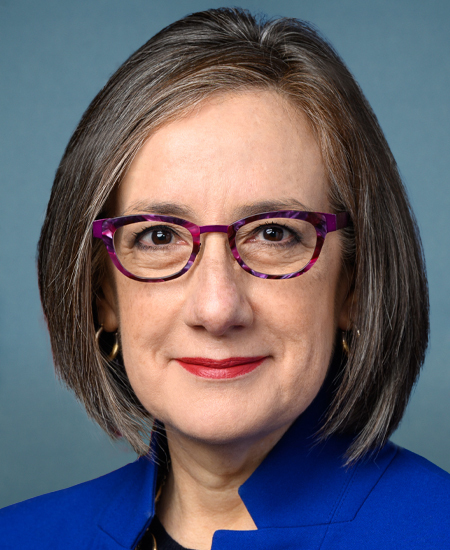
Rep. Andrea Salinas
Sponsored bills
Maddy summaryHR 2533, the EASE Act of 2025, requires Medicare and Medicaid to test a new telehealth model designed to improve specialty care access for rural and underserved Medicare/Medicaid beneficiaries. The bill mandates the Centers for Medicare & Medicaid Services (CMS) to partner with nonprofit provider networks - comprising at least 50 community health centers or rural clinics (half in rural areas) - to deliver specialty care via telehealth and coordinate with primary care providers. Eligible individuals must be enrolled in Medicare Part B, Medicaid, or CHIP and reside in designated rural or underserved areas. The model requires networks to collect and evaluate data on service delivery, with funding subject to existing program rules. This creates a structured pilot program focused on expanding remote specialty care access in underserved regions.
Maddy summaryThis symbolic resolution (HCONRES 23) expresses Congress's support for International Transgender Day of Visibility, observed annually on March 31. It encourages Americans to recognize and celebrate transgender community achievements while acknowledging ongoing challenges like discrimination in employment, healthcare, and public accommodations. The resolution does not create new laws or policies but formally endorses the day's purpose through non-binding statements of support and recognition. It directly affects the broader public by promoting awareness and respect for transgender individuals' rights and contributions.
Maddy summaryHR 2485, the Arts Education for All Act, requires states and school districts to integrate arts education into K-12 curricula and report on its availability. It mandates states to describe how they will support arts courses, increase certified arts educators (especially in high-need schools), and use arts to enhance teaching in core subjects like math and science (Section 202). Schools must track and report on arts course offerings, teacher qualifications, and student access - including disaggregated data by school poverty levels (Section 203). The bill also expands arts access in juvenile justice programs (Section 301) and funds research on effective arts education methods (Section 401). It directly affects public schools, arts educators, and youth in after-school and correctional settings.
Maddy summaryThe Sarah Katz Caffeine Safety Act would require restaurants and retail food establishments with 20 or more locations to label menu items containing 150 milligrams or more of caffeine per serving with a "High caffeine" warning. It would mandate that packaged foods and dietary supplements with more than 10 milligrams of caffeine display the exact caffeine content, whether naturally occurring or added, along with a safety advisory about daily limits (400 milligrams for healthy adults). The bill directs the FDA to review caffeine safety in food and beverages, and the NIH to study caffeine's effects on vulnerable populations including children, pregnant women, and those with heart conditions or mental health conditions. It also requires a public education campaign about caffeine safety and a GAO study on the marketing of caffeinated beverages to children and teens, with reports due within 6 months and 180 days respectively.
Maddy summaryThe CALL Act (HR 1853) requires the U.S. Department of Agriculture to conduct a comprehensive study on barriers to conservation practice adoption on leased agricultural land. It examines factors like lease agreements, landowner awareness, and regional differences affecting farmers (who operate leased land but don’t own it) and landowners. The study will analyze existing data, including the TOTAL Survey, and assess how lease structures influence conservation efforts, with special focus on Black, Indigenous, and beginning farmers. The USDA must submit a final report by December 2026 with recommendations for improving conservation participation on leased land. This is a research-focused bill with no immediate policy changes, aiming to inform future USDA actions.
Climate Agricultural Conservation Practices Act This bill requires the Natural Resources Conservation Service (NRCS) to consider climate benefits in reviews or revisions of its conservation practice standards. Climate benefits include a reduction in agricultural greenhouse gas emissions, an increase in carbon sequestration, or mitigation against (or adaptation to) increased weather volatility. As background, NRCS administers most of the Department of Agriculture conservation programs, which assist producers and landowners who wish to practice conservation on agricultural lands. The NRCS conservation practice standards provide guidance and set out minimum quality criteria for implementing federally funded conservation practices.
Save America's Forgotten Equines Act of 2025 or the SAFE Act of 2025 This bill permanently prohibits the slaughter of equines (e.g., horses and mules) for human consumption. (Current law prohibits the slaughter of dogs and cats for human consumption. This bill extends the prohibition to equines.) Specifically, this bill prohibits a person from knowingly (1) slaughtering an equine for human consumption; or (2) shipping, transporting, possessing, purchasing, selling, or donating an equine to be slaughtered for human consumption or equine parts for human consumption. The bill subjects a violator to a fine. The bill applies to conduct in or affecting interstate or foreign commerce or within the special maritime and territorial jurisdiction of the United States. However, it does not apply to an activity carried out by an Indian for a religious ceremony. As background, in recent years, the appropriations acts have prohibited the Department of Agriculture (USDA) from using federal funds to inspect horses before they are slaughtered for human consumption. Therefore, there are currently no USDA-inspected horse slaughter facilities in the United States.
Delivering for Rural Seniors Act of 2025 This bill directs the Food and Nutrition Service (FNS) to award competitive grants to state agencies under a home delivery pilot program for participants in the Commodity Supplemental Food Program (CSFP). As background, the CSFP works to improve the health of low-income persons at least 60 years of age by supplementing their diets with nutritious Department of Agriculture foods. Under the pilot program, a state agency must distribute grant funds to an eligible entity (i.e., a local agency or subdistributing agency) to operate projects that facilitate home delivery of commodities to CSFP participants. Grant funds may be used for costs associated with transportation and distribution of commodities to CSFP participants, staffing required to operate home delivery services, and home delivery outreach to CSFP participants or potential participants. A state agency must prioritize eligible entities that serve CSFP participants who reside in rural areas. A state agency must also submit an annual report to FNS about the project, including best practices regarding the use of home delivery to improve the effectiveness of the CSFP.
Maddy summaryHRES 261 is a symbolic resolution recognizing the heritage, culture, and contributions of Latinas in the United States. It celebrates Latinas' historical and ongoing roles in fields like business, military service, science, arts, and public office, while acknowledging persistent challenges like wage gaps and systemic barriers. The resolution specifically highlights that Latinas make up approximately 1 in 6 U.S. women (31 million people) and emphasizes their economic impact (contributing $1.3 billion to GDP in 2021) and cultural achievements. It does not create new policies or allocate funds but formally honors these contributions and calls for continued efforts to address inequities. This resolution directly affects Latinas as a recognized demographic group within U.S. society.