

Maddy summaryThis bill prohibits Members of Congress, their spouses, and dependent children from owning or trading certain investments, including stocks, commodities, and derivatives (referred to as "covered investments"). It requires affected individuals to divest these investments within 90-180 days, with specific exemptions for Treasury bonds, diversified mutual funds, small business interests, and family trusts meeting strict conditions. Violations incur penalties of 10% of the investment's value plus disgorgement of profits, paid directly to the U.S. Treasury. The law applies to all covered individuals during federal service, with exceptions for investments acquired through inheritance or occupational trading (e.g., a spouse’s finance job).
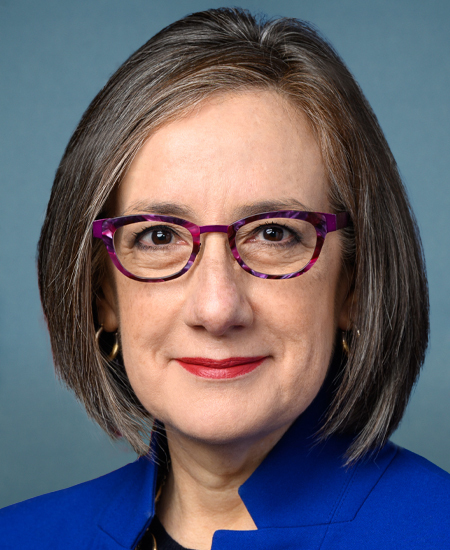
Rep. Andrea Salinas
Sponsored bills
Maddy summaryThe Tipped Worker Protection Act eliminates the sub-minimum wage for tipped workers, requiring employers to pay the full minimum wage instead of the current $2.13/hour rate that relies on tips to make up the difference. During a transition period, tipped workers would receive a minimum cash wage of $3.60/hour in the first year, increasing by $1.50 annually until reaching the full minimum wage. The bill also prohibits employers from keeping tips or using them for anything other than distributing to employees, requires transparency about service charges, and establishes rules for voluntary tip pooling. This bill directly affects workers in restaurants, bars, and other service industries who traditionally receive tips as part of their compensation.
Maddy summaryHR 5105, the UNLOCK Act, amends the Housing and Community Development Act of 1974 to expand eligibility for federal housing funds. It allows metropolitan cities, urban counties, states, local governments, insular areas, and tribal entities to use Section 106 funds for constructing new residential housing for low- and moderate-income residents, with or without nonprofit partnerships. The key change adds a new funding category (paragraph 27) to existing housing programs, streamlining access to resources for affordable housing projects. This bill directly affects local governments and tribal entities seeking to build or support affordable housing without requiring mandatory nonprofit involvement.
Maddy summaryHR 5073, the INFORM Act of 2025, requires immigration authorities to notify the immediate family of a detained individual within 24 hours if they are transferred to a different detention facility. This applies directly to immigrants held under U.S. immigration law and their immediate family members, defined as parents, children, spouses, and certain extended family like step-relatives or domestic partners. The law mandates that notifications include the reason for the transfer and full contact details (name, address, phone number, and point of contact) for the new facility. It establishes a specific timeline and content requirement for these notifications to improve transparency during detention transfers. The bill focuses on procedural changes for facility transfers, not on altering detention policies or immigration eligibility.
Maddy summaryThis bill amends federal pay rules to provide hazard pay for specific federal firefighters. It requires that firefighters conducting prescribed burns (controlled fires for land management) and smokejumpers during training or operations receive the same hazard pay rate currently given to those fighting wildfires. The change applies to employees covered under Title 5 of U.S. Code, with implementation required within 90 days of enactment through Office of Personnel Management regulations. The policy directly affects federal wildfire management personnel performing these high-risk duties.
Maddy summaryHR 5097 establishes a new grant program under the Agricultural Marketing Act of 1946 to help specialty crop producers in the U.S. adopt mechanized and automated equipment. The bill directs the Secretary of Agriculture to award grants covering equipment like drones, sorting machines, precision irrigation systems, and robotic tools, plus required training for their use. Recipients must contribute at least 50% of the costs through non-Federal matching funds. This program directly affects commercial specialty crop growers by providing financial support to modernize operations and improve efficiency.
Maddy summaryHR 4994, the Safe Air on Airplanes Act, requires the Federal Aviation Administration to update regulations to phase out bleed air systems in aircraft. It prohibits new aircraft designs from using these systems, mandates filters to remove oil fumes in new aircraft by 2031 (7 years after enactment), and sets a 30-year phase-out schedule for existing aircraft designs (25% without bleed air by 2031, 50% by 2041, 100% by 2051). The bill directly affects aircraft manufacturers and airlines, as it changes requirements for cabin air systems that pull engine air for ventilation. These changes focus on modifying manufacturing standards and air quality systems in turbine and turbo-prop aircraft.
Maddy summaryThis bill (HJRES 115) terminates a presidential emergency declaration made on August 11, 2025, which claimed a "crime emergency" in Washington, D.C. It directly affects the District of Columbia by ending federal restrictions that prevented D.C. from using $1 billion in locally-raised funds for public safety, law enforcement, fire services, and schools. The resolution cites that the emergency declaration was legally flawed - section 740 of the DC Home Rule Act does not permit federalizing the Metropolitan Police Department - and notes that D.C. violent crime has reached a 30-year low. The bill formally ends the emergency under the DC Home Rule Act, restoring D.C.'s authority over its own budget and public safety resources.
Maddy summaryThis bill amends the Food and Nutrition Act to clarify that Social Security benefits (income under Title II of the Social Security Act) are not counted when determining eligibility for SNAP (Supplemental Nutrition Assistance Program) benefits. It directly affects seniors receiving Social Security who rely on SNAP for food assistance, ensuring their Social Security payments do not reduce their SNAP benefits. The key change adds Social Security income to the list of non-countable resources under SNAP rules. The amendment takes effect 90 days after the bill is enacted.
Maddy summaryHR 4917, the Expanding the VOTE Act, amends the Voting Rights Act to increase language access for voters. It expands the definition of "voting materials" to include digital formats and requires states to provide language assistance (both written and oral) for minority language groups, with special provisions for American Indian and Alaska Native languages when written translations aren't feasible. The bill creates grants to help jurisdictions provide voting materials in languages that don't currently trigger Section 203 coverage, and mandates a study on lowering population thresholds for language assistance requirements. This directly affects states, local election jurisdictions, and voters who speak minority languages, including those in communities not currently covered by existing language access rules.