

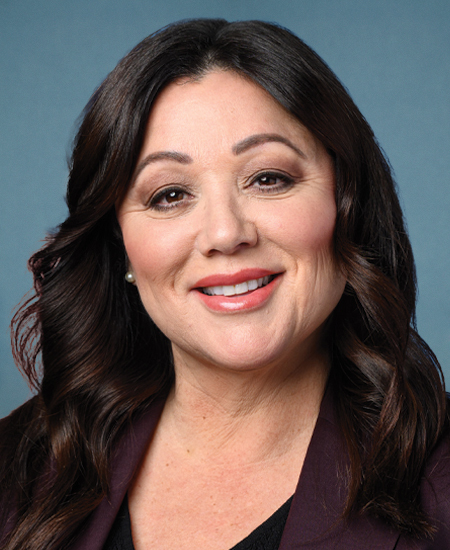
Photo of Lori Chavez-DeRemer
R United States House · District 5 · Oregon

Rep. Lori Chavez-DeRemer

Compare
Total votes
1,210
all sessions
Attendance
98%
24 missed
Near the chamber average
With party
79%
of cast votes
Lower than 99% of chamber peers
Bipartisan score
11%
some cross-party votes
Higher than 98% of chamber peers
Sponsored
417
bills & resolutions
Near the chamber average
Committees
0
assignments
417 bills and resolutions

Sponsored bills

Total
417
Primary
25
Co-sponsor
392
This page
417
matching current filters
Co-sponsor HRES 967
In committee · United States House · Co-sponsor
Amending the Rules of the House of Representatives to permit Members to vote by proxy in certain cases, and for other purposes.

Maddy summaryHRES 967 would amend House rules to allow Members who have recently given birth to vote by proxy for up to six weeks after childbirth. Specifically, a new rule permits a Member to designate another Member as their proxy during this period to cast votes on their behalf. The proxy cannot be used to count the Member's presence for quorum purposes in the House or its committees. This change directly affects female Members during their postpartum leave, with no other proxy voting allowed under the amendment.

In committee Jan 16, 2024 1 co-sponsor
Co-sponsor HR 5335
In committee · United States House · Co-sponsor
Special Forest Products Program Reauthorization Act of 2023

Maddy summaryThis bill reauthorizes a fee program for harvesting botanical products (like mushrooms, flowers, and roots) on National Forest System lands. It requires the U.S. Forest Service to charge fees based on fair market value to cover management costs, while strictly limiting harvests to sustainable levels. Personal use of small amounts for home consumption is exempt from fees. Collected funds must be returned to the specific forest units where fees were collected to support inventory, sustainability monitoring, and restoration activities.

In committee Jan 11, 2024 1 co-sponsor
Co-sponsor HR 6929
In committee · United States House · Co-sponsor
Affordable Connectivity Program Extension Act of 2024

Maddy summaryThe Affordable Connectivity Program Extension Act of 2024 allocates $7 billion in funding for the Affordable Connectivity Program (ACP) during fiscal year 2024. The ACP provides subsidies to low-income households to help cover the cost of internet service and connected devices like laptops or tablets. This funding ensures the program can continue supporting eligible households throughout the year, with the money remaining available until fully spent. The bill extends existing program funding without changing eligibility criteria or service requirements.

In committee Jan 10, 2024 1 co-sponsor
Co-sponsor HR 2839
Signed into law · United States House · Co-sponsor
To amend the Siletz Reservation Act to address the hunting, fishing, trapping, and animal gathering rights of the Confederated Tribes of Siletz Indians, and for other purposes.

Maddy summaryThis bill (Public Law 118-33, enacted December 26, 2023) amends the Siletz Reservation Act to preserve the existing 1980 Siletz Agreement governing hunting, fishing, trapping, and gathering rights for the Confederated Tribes of Siletz Indians. It requires any future government-to-government agreements between the Tribe and Oregon to be mutually agreed upon, while prohibiting new or expanded fishing rights in the Columbia River or Willamette River (from mouth to Willamette Falls) in any successor agreements. The bill also clarifies that judicial challenges to the 1980 Consent Decree must be reviewed on the merits, without using res judicata as a defense. It does not change existing tribal rights but establishes a framework for updating agreements under specific conditions.

Signed into law Dec 26, 2023 1 co-sponsor
Co-sponsor HR 1722
Signed into law · United States House · Co-sponsor
Grand Ronde Reservation Act Amendment of 2023

Maddy summaryThis bill amends the Grand Ronde Reservation Act to redefine the reservation boundary as specifically the 84-acre Thompson Strip, replacing a prior description of lands within Oregon. It also prohibits the Confederated Tribes of Grand Ronde from using any land acquired through federal land claim settlements (including land purchased with settlement funds) for gaming under federal law. The amendment applies to the tribe's current and future land holdings related to settlement agreements. The bill explicitly states it does not affect the tribe's existing treaty rights.

Signed into law Dec 26, 2023 1 co-sponsor
Co-sponsor HR 1147
Passed · United States House · Co-sponsor
Whole Milk for Healthy Kids Act of 2023

Maddy summaryHR 1147, the Whole Milk for Healthy Kids Act of 2023, allows schools participating in the National School Lunch Program to offer whole milk as an option during lunch. It amends the school lunch law to explicitly permit schools to serve flavored and unflavored whole milk alongside reduced-fat, low-fat, and fat-free milk choices for students. The bill also requires the Secretary of Agriculture to adjust meal regulations to account for saturated fat from whole milk, ensuring it doesn't count against meal fat limits. This change directly affects participating schools and the students who receive school lunches, expanding their milk beverage options.

Passed Dec 18, 2023 1 co-sponsor
Co-sponsor HR 6507
In committee · United States House · Co-sponsor
Mark Our Place Act

Maddy summaryThis bill expands eligibility for government-furnished headstones, markers, or medallions for Medal of Honor recipients. It directly affects veterans who have received the Medal of Honor but were previously excluded from this benefit due to a specific rule. The key change modifies eligibility rules to remove an exclusion (previously applying to certain recipients), ensuring all Medal of Honor recipients qualify for these headstones or markers. The bill also corrects a reference to the wrong section of law in the existing statute.

In committee Dec 15, 2023 1 co-sponsor
Co-sponsor HR 6673
In committee · United States House · Co-sponsor
STATES 2.0 Act

Maddy summaryThe STATES 2.0 Act would allow states to regulate cannabis according to their own laws without federal interference, while establishing a federal framework for interstate commerce. It would create a federal excise tax on marijuana to support regulation without adding excessive costs to consumers, and would require the FDA to regulate marijuana products as drugs, food, or cosmetics. The bill would exempt state-legal cannabis activities from federal prohibition, including removing cannabis from the federal controlled substances schedule when sold in compliance with state law. It would also allow federally recognized tribes to regulate cannabis within their jurisdictions under tribal law, and would require a study on how cannabis legalization affects traffic safety.

In committee Dec 11, 2023 1 co-sponsor
Co-sponsor HR 6687
In committee · United States House · Co-sponsor
Innovative FEED Act of 2023

Maddy summaryThe Innovative FEED Act of 2023 defines and regulates "zootechnical animal food substances" - substances added to animal feed to affect digestion, reduce foodborne pathogens, or alter gut microbiome without providing nutrition. It requires these substances to be approved as food additives by the FDA under existing rules, with specific data on intended effects and mandatory labeling stating "Not for use in the diagnosis, cure, mitigation, treatment, or prevention of disease in animals." The bill excludes drugs, hormones, ionophores, and other substances from this category. This directly affects animal feed manufacturers, the FDA’s regulatory process, and the labeling requirements for these products.

In committee Dec 8, 2023 1 co-sponsor
Co-sponsor HR 5933
Passed · United States House · Co-sponsor
DETERRENT Act

Maddy summaryThe DETERRENT Act requires institutions of higher education to disclose foreign gifts and contracts meeting specific value thresholds ($50,000 or more) to the Department of Education, with special rules for contracts involving "foreign countries of concern" or "foreign entities of concern." It creates a public database of these disclosures, mandates faculty and staff to report foreign gifts related to research, and establishes a waiver process for institutions seeking to contract with prohibited foreign entities. Institutions that fail to comply face fines ranging from 1% to 100% of their federal funding, depending on the violation and whether it's a first or repeat offense. The bill applies primarily to institutions receiving significant federal funding, particularly those with substantial research programs. It aims to increase transparency around foreign influence in higher education while maintaining academic freedom.

Passed Dec 7, 2023 1 co-sponsor
Showing 181 to 190 of 417 bills
Previous 1 … 18 19 20 … 42 Next