Assault Weapons Excise Act This bill imposes an additional 1000% excise tax on large capacity ammunition feeding devices and semiautomatic assault weapons. It exempts from such additional tax devices and weapons acquired by the United States or by a state or local government.
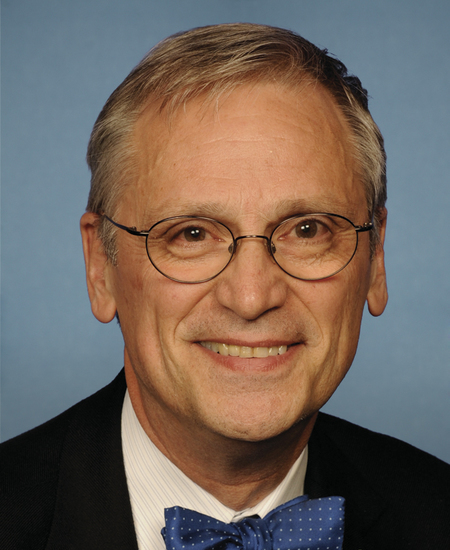
Rep. Earl Blumenauer
Sponsored bills
Maddy summaryThis non-binding resolution (HR 8040) expresses Congress's view that many national security threats are non-military and calls for reducing the Pentagon's 2023 budget by $100 billion. It directs the Secretary of Defense to consider a 2021 CBO report when implementing potential cuts, while exempting specific accounts like military personnel pay and defense health programs from reductions. The resolution proposes reallocating the savings to address non-military national priorities. It does not alter actual funding but sets a policy direction for the Department of Defense budget.
Enhanced Pay for Election Workers Act This bill directs the Election Assistance Commission to establish a program to make payments to states to provide enhanced pay for election workers, including individuals serving as election officials or poll workers on a temporary or unpaid basis.
Ruthie and Connie LGBTQ Elder Americans Act of 2022 This bill addresses matters related to lesbian, gay, bisexual, transgender, and queer (LGBTQ) individuals in certain federal programs serving older Americans, particularly by including an individual's LGBTQ status within the scope of the greatest social needs served by such programs.
Protecting Our Kids Act This bill makes various changes to federal firearms laws, including to establish new criminal offenses and to expand the types of weapons and devices that are subject to regulation. Among the changes, the bill generally prohibits the sale or transfer of certain semiautomatic firearms to individuals who are under 21 years of age; establishes new federal criminal offenses for gun trafficking and related conduct; establishes a federal statutory framework to regulate ghost guns (i.e., guns without serial numbers); establishes a framework to regulate the storage of firearms on residential premises at the federal, state, and tribal levels; subjects bump stocks to regulation under federal firearms laws; generally prohibits the import, sale, manufacture, transfer, and possession of large capacity ammunition feeding devices; and requires the Department of Justice to report on the demographic data of persons who are determined to be ineligible to purchase a firearm based on a background check performed by the national instant criminal background check system.
Coal Cleanup Taxpayer Protection Act of 2021 This bill prohibits self-bonding practices for coal reclamation, establishes limits on bonding practices associated with surface coal mining operations, and establishes requirements for coal mining operations to provide sufficient financial resources to complete mine reclamation. Currently, self-bonding practices allow coal mining operations to demonstrate that they have sufficient corporate assets to complete reclamation, without requiring cash or collateral up-front as in the case of surety or collateral bonds. The bill prohibits the Office of Surface Mining and Reclamation Enforcement (OSMRE) and state regulatory authorities from accepting new self-bonds for coal reclamation. In addition, the bill requires any existing self-bonds or corporate bonds utilized for coal reclamation to be converted to surety or collateral bonds. The OSMRE must issue rules establishing limitations on surety bonds to minimize the financial liability to the federal or state government. The OSMRE may approve state or federal alternative coal mining bond programs that result in no greater risk of financial liability to the federal government than a surety or collateral bond program.
Federal Extreme Risk Protection Order Act of 2022 This bill authorizes and establishes procedures for federal courts to issue federal extreme risk protection orders. Additionally, the bill establishes grants to support the implementation of extreme risk protection order laws at the state and local levels, extends federal firearms restrictions to individuals who are subject to extreme risk protection orders, and expands related data collection. Extreme risk protection order laws, or red flag laws, generally allow certain individuals (e.g., law enforcement officers or family members) to petition a court for a temporary order that prohibits an at-risk individual from purchasing and possessing firearms. Among its provisions, the bill authorizes a family or household member, or a law enforcement officer, to petition for a federal extreme risk protection order with respect to an individual who poses a risk to themselves or others; directs the Department of Justice to establish a grant program to help states, local governments, Indian tribes, and other entities implement extreme risk protection order laws; extends federal restrictions on the receipt, possession, shipment, and transportation of firearms and ammunition to individuals who are subject to extreme risk protection orders; and requires the Federal Bureau of Investigation to compile records from federal, tribal, and state courts and other agencies that identify individuals who are subject to extreme risk protection orders.

This resolution recognizes World Oceans Day and affirms the individual and collective duty, both nationally and internationally, to protect, conserve, maintain, and rebuild our oceans and its resources. It also expresses commitment to increasing the investment of federal funds into scientific research and monitoring to better understand the changing oceans, empower the federal government to address and mitigate the effects of the changing climate, and accomplish the goals of the United Nations Decade of Ocean Science for Sustainable Development.
This resolution condemns in the strongest terms the great replacement theory, which it describes as a white supremacist conspiracy theory that has been used to falsely justify racially motivated, violent acts of terrorism domestically and internationally.
Healthy Homes Act This bill expands the low-income housing tax credit to include an additional credit amount for healthcare-oriented housing (e.g., low-income buildings that meet certain requirements, e.g., healthcare screening available on building premises, adequate space for physicians to conduct screenings, and telehealth capacity). The bill directs the Governmental Accountability Office to study the utilization of the low-income housing tax credit with respect to healthcare-oriented housing.