

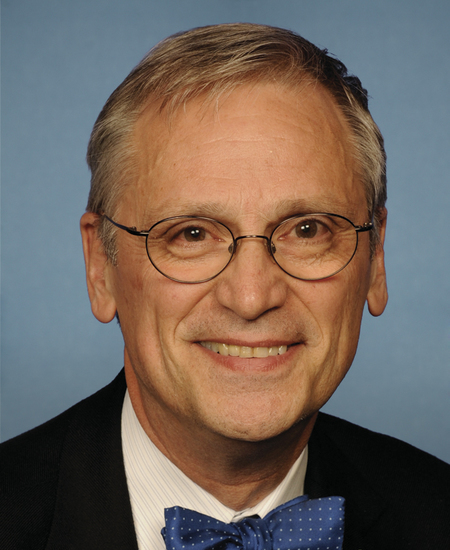
Photo of Earl Blumenauer
D United States House · District 3 · Oregon

Rep. Earl Blumenauer

Compare
Total votes
2,168
all sessions
Attendance
93%
141 missed
Lower than 93% of chamber peers
With party
97%
of cast votes
Near the chamber average
Bipartisan score
1%
crosses aisle rarely
Near the chamber average
Sponsored
1,643
bills & resolutions
Higher than 86% of chamber peers
Committees
0
assignments
1,643 bills and resolutions

Sponsored bills

Total
1,643
Primary
94
Co-sponsor
1,549
This page
1,643
matching current filters
Co-sponsor HR 8426
In committee · United States House · Co-sponsor
Public Service Freedom to Negotiate Act of 2024

Maddy summaryThe Public Service Freedom to Negotiate Act of 2024 establishes federal minimum standards for collective bargaining rights for public employees and supervisory employees. The Federal Labor Relations Authority will determine if each state's laws "substantially provide" for these rights, and if not, federal standards will apply to that state. These standards include the right to self-organization, collective bargaining, recognition of labor organizations, and procedures for resolving disputes. The bill preserves existing collective bargaining agreements and excludes certain employee categories like emergency services workers from some provisions.

In committee May 16, 2024 1 co-sponsor
Co-sponsor HR 8435
In committee · United States House · Co-sponsor
To amend the Internal Revenue Code of 1986 to treat certain price protection payments as eligible rollover distributions, and for other purposes.

Maddy summaryThis bill changes tax treatment for certain payments made to employees in Employee Stock Ownership Plans (ESOPs). Specifically, it allows "price protection payments" received when employees retire, die, or become disabled to be treated as eligible rollover distributions - meaning they can be moved to another retirement account without immediate tax. The bill defines these payments as those made under agreements covering employer stock distributions after certain loans, with different rules applying to payments before 2025 versus after 2024. It also clarifies that such agreements won't make ESOPs discriminatory and ensures these payments don't count toward tax deduction limits. The changes apply to payments made after December 12, 2019, with some provisions effective after 2024.

In committee May 16, 2024 1 co-sponsor
Co-sponsor HR 1797
Passed · United States House · Co-sponsor
Setting Consumer Standards for Lithium-Ion Batteries Act

Maddy summaryThis bill requires the Consumer Product Safety Commission (CPSC) to create new safety standards for lithium-ion batteries used in electric bicycles and scooters within 180 days of the bill's enactment. The standards aim to prevent battery-related fires by setting specific safety requirements for these batteries and devices. The CPSC must define which battery types and devices fall under the rule as part of the standard. Once established, the standard will function as an official safety rule under existing consumer product safety law.

Passed May 16, 2024 1 co-sponsor
Co-sponsor HR 8297
In committee · United States House · Co-sponsor
Project Turnkey Act

Maddy summaryThis bill establishes the Project Turnkey Program, allocating $1 billion annually to fund affordable housing and homelessness services. It directly helps vulnerable populations including homeless individuals, those at risk of homelessness, and victims fleeing domestic violence or trafficking. Key provisions allow funds for rental assistance, rehabilitating vacant properties (like hotels and motels), supportive services, and shelter operations, while requiring states to use funds to supplement - not replace - existing local housing investments. The program runs through 2034 with specific rules to streamline housing development and expand capacity for community organizations.

In committee May 8, 2024 1 co-sponsor
Co-sponsor HR 8253
In committee · United States House · Co-sponsor
BUILD GREEN Infrastructure and Jobs Act

Maddy summaryThe BUILD GREEN Infrastructure and Jobs Act establishes a $50 billion annual grant program (2025-2034) to fund electrified transportation infrastructure projects that reduce greenhouse gas emissions and improve transportation access. It prioritizes projects in frontline, vulnerable, or disadvantaged communities (requiring 40% of funds), with 30-40% allocated to rural areas and 60-70% to urban areas. The bill mandates recipients use 5% of grant funds for workforce training, pay a minimum wage of $17 per hour (increasing annually), and use renewable energy sources for project operations. Eligible projects include electric buses, rail systems, port infrastructure with EV charging, and micromobility initiatives that reduce emissions and improve transportation services.

In committee May 8, 2024 1 co-sponsor
Co-sponsor HRES 1202
In committee · United States House · Co-sponsor
Expressing support for the recognition of May 5 through May 11, 2024, as Wildfire Preparedness Week, the national event educating the public on fire safety and preparedness, and supporting the goals of a Wildfire Preparedness Week.

Maddy summaryHRES 1202 is a symbolic resolution expressing the U.S. House of Representatives' support for designating May 5-11, 2024, as Wildfire Preparedness Week. It encourages public education on fire safety, evacuation planning, and preventive measures like vegetation management and reducing human-caused ignitions (e.g., fireworks). The resolution does not create new laws or allocate funding but aims to raise awareness about wildfire risks, citing statistics on recent fires and health impacts from smoke exposure. It directly supports communities in wildfire-prone areas by promoting existing preparedness resources and educational initiatives. The resolution was introduced by Representatives Torres, Huffman, and Jacobs and referred to the Committee on Natural Resources.

In committee May 6, 2024 1 co-sponsor
Co-sponsor HR 8231
In committee · United States House · Co-sponsor
James Earl Jones Congressional Gold Medal Act

Maddy summaryHR 8231, the James Earl Jones Congressional Gold Medal Act, authorizes a Congressional Gold Medal to be awarded to actor James Earl Jones in recognition of his distinguished career in theater and film, and his role in advancing inclusion and equal opportunities for people of all backgrounds in the entertainment industry. The Treasury will strike the medal with an image and inscription of Jones, and may produce and sell bronze duplicates to cover costs, with proceeds deposited into the U.S. Mint's public enterprise fund. This bill serves as a ceremonial honor with no new legal requirements or policy changes.

In committee May 2, 2024 1 co-sponsor
Co-sponsor HR 8213
In committee · United States House · Co-sponsor
End DWI Act of 2024

Maddy summaryHR 8213, the End DWI Act of 2024, requires states to mandate ignition interlock devices (alcohol-detection systems) for all drivers convicted of driving while intoxicated (DWI) for a minimum of 180 days. States that fail to implement this requirement risk losing 3% of federal highway funds in 2027, increasing to 5% annually thereafter. The bill directly affects DWI offenders and states that do not adopt the interlock mandate, using federal funding as an incentive for compliance. It does not create new penalties but establishes a national standard tied to transportation funding. The legislation is based on findings showing interlocks reduce repeat offenses by up to 70% and address rising impaired driving fatalities.

In committee May 2, 2024 1 co-sponsor
Co-sponsor HR 8192
In committee · United States House · Co-sponsor
High School Voter Empowerment Act of 2024

Maddy summaryHR 8192, the High School Voter Empowerment Act of 2024, requires all public high schools (as defined by federal education law) to serve as official voter registration agencies under the National Voter Registration Act. It mandates that each high school conduct at least one annual voter registration drive targeting students enrolled in American Government or Economics courses, aged 17+ by April 10, and eligible to vote for federal office. The bill also establishes a federal grant program to reimburse schools for reasonable costs incurred during these registration drives, including documentation of activities and student registrations. This law directly affects public high schools and state election officials, creating a new requirement for schools to facilitate voter registration for eligible students.

In committee Apr 30, 2024 1 co-sponsor
Primary HR 8164
In committee · United States House · Lead sponsor
Captive Primate Safety Act

Maddy summaryThe Captive Primate Safety Act prohibits the import, export, sale, transport, breeding, or possession of certain nonhuman primates - including chimpanzees, gorillas, monkeys, and their hybrids - in interstate or foreign commerce. It directly affects private owners, breeders, and commercial traders of these animals, with limited exceptions for pre-enactment animals (requiring registration with the U.S. Fish and Wildlife Service and restrictions on breeding/sale) and registered research facilities. The law amends the Lacey Act to add these primates to prohibited species lists, effective upon enactment, with regulations to be issued within 180 days. Enforcement remains active even if regulations are delayed, ensuring immediate prohibitions on commercial trade and possession.

In committee Apr 30, 2024 0 co-sponsors
Showing 111 to 120 of 1,643 bills
Previous 1 … 11 12 13 … 165 Next