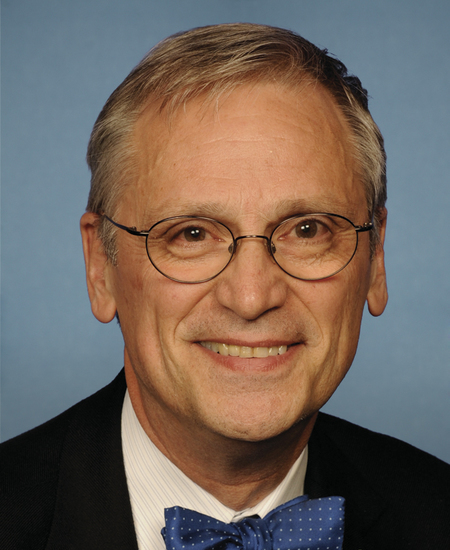
Photo of Earl Blumenauer
D United States House · District 3 · Former member · Oregon

Rep. Earl Blumenauer

Compare
Total votes
2,168
all sessions
Attendance
93%
141 missed
Lower than 93% of chamber peers
With party
97%
of cast votes
Near the chamber average
Bipartisan score
1%
crosses aisle rarely
Near the chamber average
Sponsored
1,643
bills & resolutions
Higher than 86% of chamber peers
Committees
0
assignments
1,643 bills and resolutions

Sponsored bills

Total
1,643
Primary
94
Co-sponsor
1,549
This page
1,643
matching current filters
Co-sponsor HR 274
In committee · United States House · Co-sponsor
Keep Finfish Free Act of 2021

Keep Finfish Free Act of 2021 This bill prohibits the Department of the Interior and the Department of Commerce from authorizing commercial finfish aquaculture operations in the U.S. Exclusive Economic Zone, except in accordance with a law enacted after enactment of this bill.

In committee Jul 29, 2021 1 co-sponsor
Co-sponsor HRES 565
In committee · United States House · Co-sponsor
Expressing the sense of the House of Representatives to reduce traffic fatalities to zero by 2050.

This resolution (1) commits to advancing policies that will end roadway fatalities by 2050, and (2) calls on Congress and the Department of Transportation to commit to working together to achieve zero roadway fatalities by the year 2050.

In committee Jul 28, 2021 1 co-sponsor
Co-sponsor HR 4750
In committee · United States House · Co-sponsor
Performing Artist Tax Parity Act of 2021

Performing Artist Tax Parity Act of 2021 This bill modifies the tax deduction for the expenses of performing artists (including commissions paid to managers or agents) to provide for a phaseout of such deduction for taxpayers whose adjusted gross income exceeds $100,000 ($200,000 for joint return filers). The $100,000 phaseout threshold is adjusted for inflation annually for taxable years beginning after 2021.

In committee Jul 28, 2021 1 co-sponsor
Primary HR 4079
In committee · United States House · Lead sponsor
Saving America’s Pollinators Act of 2021

Saving America's Pollinators Act of 2021 This bill addresses the use of certain pesticides and the health and status of native bees and other pollinators. First, the bill requires the Environmental Protection Agency (EPA) to establish a Pollinator Protection Board to develop an independent review process for pesticides that pose a threat to pollinators and their habitats. All active ingredients and pesticide products that contain one or more specified neonicotinoid pesticides must be deemed to generally cause unreasonable adverse effects to the environment. Under the bill, the registration of all uses of neonicotinoid pesticides must be immediately and permanently canceled. The EPA must revoke any tolerance or exemption that allows the presence of a neonicotinoid pesticide, or any pesticide chemical residue that results from neonicotinoid pesticide use, in or on food. The continued sale or use of existing stocks of neonicotinoid pesticides is prohibited, and the EPA may not register any such pesticides under the Federal Insecticide, Fungicide and Rodenticide Act. The bill requires the Department of the Interior, the EPA, and the Department of Agriculture to coordinate monitoring activities and report on the health and population status of native bees and other pollinators. Finally, a state or federal agency may be granted an exemption to use neonicotinoid pesticides if the board votes that use of the pesticide is warranted (1) in an emergency situation to avert significant risk to threatened or endangered species, (2) to quarantine invasive species, or (3) to protect public health.

In committee Jul 28, 2021 0 co-sponsors
Co-sponsor HR 4077
In committee · United States House · Co-sponsor
Closing the Meal Gap Act of 2021

Closing the Meal Gap Act of 202 1 This bill revises the requirements for calculating Supplemental Nutrition Assistance Program (SNAP) benefits. The bill increases the minimum SNAP benefit and requires benefits to be calculated using the value of a low-cost food plan. The Department of Agriculture (USDA) must determine the requirements for the low-cost food plan, which is the diet required to feed a family of four, consisting of a man and a woman 19-50 years of age, a child 6-8 years of age, and a child 9-11 years of age. USDA must (1) reevaluate and publish the market baskets of the plan by January 1, 2027, and every five years thereafter, based on current food prices, food composition data, consumption patterns, and dietary guidance; and (2) make adjustments to the plan to account for household size, changes in the cost of the diet, and the costs of food in specified areas. The bill modifies the requirements for calculating household income to determine SNAP eligibility by (1) authorizing a standard medical expense deduction for households containing an elderly or disabled member, and (2) eliminating the cap on the excess shelter expense deduction. The bill eliminates certain work requirements for SNAP. The requirements apply to able-bodied adults who are ages 18-49 and have no dependent children. The bill allows Puerto Rico, American Samoa, and the Northern Mariana Islands to participate in SNAP. Currently, the three territories receive block grants instead of participating in SNAP.


In committee Jul 28, 2021 1 co-sponsor
Co-sponsor HR 4640
In committee · United States House · Co-sponsor
Close the Medigap Act of 2021

Close the Medigap Act of 2021 This bill (1) expands guaranteed issue rights with respect to Medigap policies (Medicare supplemental health insurance policies), (2) eliminates certain limitations on Medigap policies for newly eligible Medicare beneficiaries, and (3) modifies other provisions related to Medigap policies. (Guaranteed issue rights require that a policy be offered to any eligible applicant without regard to health status.)

In committee Jul 23, 2021 1 co-sponsor
Co-sponsor HR 4651
In committee · United States House · Co-sponsor
RECOMPETE Act

Rebuilding Economies and Creating Opportunities for More People Everywhere To Excel Act or the RECOMPETE Act This bill establishes a grant program to assist economically distressed local communities and labor markets that meet specified economic criteria, including employment criteria. The Economic Development Administration (EDA) must award 10-year grants to a local government, tribal government, economic development district, or consortium of local government units located in such areas. Each grant recipient must develop and implement a comprehensive strategy to address the economic challenges specific to the area. The grants may be used to increase employment opportunities, increase local per capita income, support economic development, and develop infrastructure and housing. Additionally, the EDA must periodically evaluate each grant recipient based on certain benchmark criteria and annually report on the implementation of the program. The bill specifies formulas for determining the grant amount for each community or market and the federal share of the cost of each program or activity conducted under the program.

In committee Jul 23, 2021 1 co-sponsor
Co-sponsor HR 4641
In committee · United States House · Co-sponsor
Smoke Planning and Research Act of 2021

Smoke Planning and Research Act of 2021 This bill requires the Environmental Protection Agency (EPA) to research and mitigate the impacts of smoke emissions from wildland fires. Specifically, the EPA must establish (1) four Centers of Excellence for Wildfire Smoke at institutions of higher education, and (2) a grant program to support community mitigation efforts.

In committee Jul 23, 2021 1 co-sponsor
Co-sponsor HR 4672
In committee · United States House · Co-sponsor
ABLE Employment Flexibility Act

ABLE Employment Flexibility Act This bill permits employers to make tax-exempts contributions to ABLE (Achieving Better Life Experience) accounts in lieu of making contributions to existing tax-exempt defined contribution retirement plans. An ABLE account is established to pay the expenses (e.g., food, education, housing, transportation, employment training and support, and health care expenses) of a designated beneficiary who is disabled.

In committee Jul 22, 2021 1 co-sponsor
Co-sponsor HR 3985
Passed · United States House · Co-sponsor
Averting Loss of Life and Injury by Expediting SIVs Act of 2021

Averting Loss of Life and Injury by Expediting SIVs Act of 2021 or the Allies Act of 2021 This bill increases the number of special immigrant visas available to qualified Afghan nationals who worked for the U.S. government or the North Atlantic Treaty Organization (NATO) missions in Afghanistan. The bill also relaxes certain qualifications for such visas. Specifically, this bill makes available an additional 8,000 visas for principal aliens under this special visa program, to be available until all such visas have been issued. (The numerical limitations in this program apply only to the principal alien who applies for the visa, not to any accompanying spouse or child.) Under this bill, an alien may qualify based on a credible basis for concern about the possibility of an ongoing serious threat in Afghanistan due to their work with the U.S. government or a NATO mission, where currently the alien must have experienced such a threat. The bill also eliminates a requirement for each applicant to submit a credible sworn statement describing that threat. Furthermore, for an applicant qualifying for a visa by performing duties for U.S. military personnel stationed with a NATO mission, this bill eliminates a requirement that the duties performed qualify as sensitive and trusted duties. If an alien submits a visa application that included an accompanying spouse or child but the alien passes away before the application is granted, the surviving spouse or child shall remain eligible to receive a visa under that application. Currently, a surviving spouse or child retains eligibility only if the application was approved before the alien passed away.

Passed Jul 22, 2021 1 co-sponsor
Showing 1,151 to 1,160 of 1,643 bills