Affordable Housing and Area Median Income Fairness Act of 2022 This bill reauthorizes through FY2032 the Community Development Block Grant and other specified programs that support affordable housing. The bill also requires the Department of Housing and Urban Development (HUD) to assess alternative methods of calculating area median income (i.e., any metric used to refer to the median income level for a given area or jurisdiction for purposes of any program administered by HUD) and the use of alternative metrics in order to make housing more affordable for low-income families in urban areas.
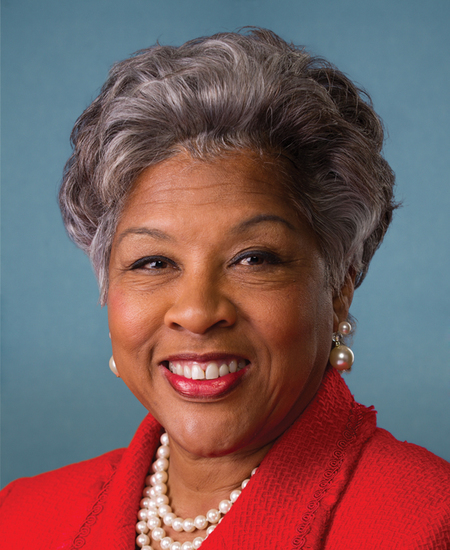
Rep. Joyce Beatty
Sponsored bills
Fair Hiring in Banking Act This bill creates exceptions to the restriction on hiring persons convicted of certain criminal offenses involving dishonesty or a breach of trust to a position with an insured depository institution or an insured credit union. Currently, a waiver must be obtained from the Federal Deposit Insurance Corporation or the National Credit Union Administration to allow the employment of such a person. Specifically, a waiver is not needed if it has been 7 years or more since the offense occurred or if the individual was incarcerated with respect to the offense and it has been 5 years or more since the individual was released from incarceration. The need for a waiver also does not apply to conduct committed before age 21 and if it has been at least 30 months since the sentencing. Individuals with a criminal record that is expunged, sealed, or pardoned are also exempt from waiver requirements.
Benjamin Berell Ferencz Congressional Gold Medal Act This bill provides for the award of a Congressional Gold Medal to Benjamin Berell Ferencz in recognition of his service to the United States and the international community during the post-World War II Nuremberg trials and his lifelong advocacy for international criminal justice and the rule of law.
Roadless Area Conservation Act of 2021 This bill bars the Department of Agriculture from allowing the construction of roads, the reconstruction of roads, or logging in an inventoried roadless area where those activities are prohibited by the Roadless Rule (i.e., certain federal regulations relating to roadless area management).
United States Innovation and Competition Act of 2021 This bill addresses U.S. technology and communications, foreign relations and national security, domestic manufacturing, education, trade, and other matters. Among other provisions, the bill provides funding for FY2022-FY2026 to support U.S. semiconductor manufacturing, research and development, and supply chain security; provides funding for wireless supply chain innovation; establishes a Directorate for Technology and Innovation in the National Science Foundation; extends through 2025 the authority of the National Aeronautics and Space Administration (NASA) to lease its non-excess real property and related personal property; authorizes various programs and policies related to space exploration; authorizes various international affairs programs and activities, including foreign assistance for the Indo-Pacific region; requires federal infrastructure programs to provide for the use of materials produced in the United States; imposes sanctions on China for cybersecurity and human rights abuses; requires the Department of Health and Human Services to consider national security risks associated with sensitive genetic information; includes initiatives related to elementary and secondary education, including those to increase computer science education; contains provisions related to higher education, including those reauthorizing through FY2027 international education programs and addressing China's influence on institutions of higher education; modifies and expands the schedule for graduated merger filing fees; prohibits federal funding for the Wuhan Institute of Virology; requires the U.S. Trade Representative to take certain actions related to digital trade and censorship practices; and extends through 2027 the Generalized System of Preferences.

Too Narrow to Succeed Act This bill requires federal institutional investors to report on their use of diverse-owned asset management firms. Additionally, the Department of Labor must conduct a survey of public- and private-sector pension plans regarding best practices for increasing the utilization and capacity of diverse-owned asset management firms.
African-American Burial Grounds Preservation Act This bill directs the Department of the Interior to establish the United States African-American Burial Grounds Preservation Program within the National Park Service (NPS). In carrying out the program, Interior may make grants to other federal agencies; state, local, and tribal governments; other public entities; educational institutions; historic preservation groups; and private nonprofit organizations for the identification of historic African-American burial grounds, the preservation and restoration of African-American burial grounds, the interpretation of African-American burial grounds, and related research and documentation for historic African-American burial grounds.
Maddy summaryHRES 1061 is a non-binding resolution supporting National Deaf History Month in April. It recognizes the contributions of deaf and hard-of-hearing individuals to U.S. society, referencing historical milestones like the founding of the American School for the Deaf (1817) and Gallaudet University (1864). The resolution encourages the public to observe the month with programs and activities but does not create new policies, funding, or requirements. It directly affirms the importance of deaf culture and history without affecting any specific group through legislative action.
Maddy summaryThis non-binding resolution (HRES 1050) encourages Congress to adopt the Black Women Best (BWB) framework in policymaking to address systemic disparities affecting Black women. It does not create new laws but recommends using this framework - based on the Congressional Caucus on Black Women and Girls' "An Economy for All" report - to center Black women's lived experiences in legislative decisions. Key issues highlighted include severe wealth gaps (Black women’s median wealth at $1,700 vs. $81,200 for White women), labor market discrimination, healthcare inequities, and housing barriers. The resolution specifically urges policymakers to prioritize frameworks like the BWB to develop more inclusive policies, without mandating any concrete legislative changes.
Medical Records Access Fairness Act This bill prohibits health care providers from charging a fee for providing copies of individuals' protected health information. This prohibition does not apply to requests for a (1) duplicate of a copy that an individual has received within the past year, (2) nonelectronic copy that is otherwise available at no cost in electronic form through an online portal, or (3) copy to an attorney of an individual.