Lymphedema Treatment Act This bill provides for Medicare coverage of lymphedema compression treatment items. Specifically, the bill provides for coverage of standard and custom fitted gradient compression garments and other approved items that are prescribed by a physician or other specified health care professional to treat lymphedema.
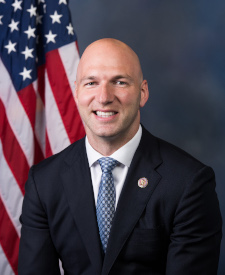
Rep. Anthony Gonzalez
Sponsored bills
Continuity for Operators with Necessary Training Required for ATC Contract Towers Act of 2021 or the CONTRACT Act of 2021 This bill exempts certain air traffic controllers from a required reduction in their retirement annuity payment on account of earnings from certain work performed while entitled to such annuity. Under current law, retired Federal Aviation Administration air traffic controllers receive an annuity payment during the period between the mandatory retirement age of 56 and the Social Security minimum age of 62. Such annuity payment is required to be reduced by a certain percentage of any excess earnings during this period. The bill exempts from such reduction in annuity payments an air traffic controller who participates in the Air Traffic Control Contract Program (a public-private partnership for air traffic control services) following mandatory retirement.
Buckeye National Scenic Trail Feasibility Study Act of 2021 This bill requires the study of the feasibility of designating the Buckeye Trail as a national scenic trail. The Buckeye Trail is a system of trails creating a loop extending approximately 1,454 miles from Lake Erie to the Ohio River, through the farmland of northwest Ohio, the hills of Appalachia, the Black Hand sandstone cliffs of the Hocking Hills region, and the Bluegrass region of southwest Ohio.
Law Enforcement Scenario-Based Training for Safety and De-Escalation Act of 2022 This bill directs the Office of Community Oriented Policing Services within the Department of Justice to develop a scenario-based training curriculum that addresses topics such as de-escalation and use of deadly force. The bill authorizes grants for entities to provide law enforcement personnel with training that is substantially similar to the curriculum.
Fair Care Act of 202 2 This bill addresses the health care system, including Medicare, Medicaid, the private health insurance market, and the prescription drug approval process. The bill also revises tax provisions related to certain health care costs and establishes requirements for lawsuits involving health care provided, at least in part, through a federal program or with federal funds.
Porch Pirates Act of 2022 This bill extends federal criminal penalties for obstruction of correspondence and theft of stolen mail matter (which apply to U.S. Postal Service mail) to matter (e.g., packages) sent or delivered by private or commercial interstate carriers.
National Response to Exploitation and Sexual abuse of Children in Unaddressed Emergencies Act or the Child RESCUE Act This bill directs the Department of Justice to establish a national working group—the United States Working Group on Children in Imminent Danger—to study policing strategies and resource needs to rescue children who are victims of child sexual abuse material or victims of sexual abuse involving child sexual abuse material. The working group must report to Congress on its findings and conclusions, as well as recommendations for legislation.
Supporting Every at-Risk Veteran In Critical Emergencies Act of 2021 or the SERVICE Act of 2021 This bill authorizes the Office of Community Oriented Policing Services within the Department of Justice to make grants to support the creation and operation of veterans' response teams in state, local, and tribal law enforcement agencies.
Fentanyl Penalties Parity Act This bill modifies the drug quantity thresholds that trigger a mandatory minimum prison term for a defendant who manufactures, distributes, imports, exports, or possesses with intent to distribute fentanyl. Specifically, the bill reduces from 400 to 20 grams the fentanyl quantity and from 100 to 5 grams the fentanyl analogue quantity that trigger a mandatory minimum prison term for high-level first-time or repeat offenders. It also reduces from 40 to 2 grams the fentanyl quantity and from 10 to 0.5 grams the fentanyl analogue quantity that trigger a mandatory minimum prison term for low-level first-time or repeat offenders.
Denying Earnings to the Military Oligarchy in Cuba and Restricting Activities of the Cuban Intelligence Apparatus Act or the DEMOCRACIA Act This bill provides for asset- and visa-blocking sanctions for conduct relating to Cuba. It also establishes an interagency task force to facilitate access to uncensored internet in Cuba. The President must sanction foreign persons that provide financial support to Cuban government sectors involved in human rights abuses or terrorism (e.g., the defense sector). This includes foreign persons that (1) are military contractors or mercenaries operating on behalf of the Cuban government, or (2) violate laws restricting trade with Cuba. Specified transactions, including remittances to immediate family members (subject to some limitations) and payments related to U.S. military and diplomatic sites, are not subject to these sanctions. The President must also sanction (1) foreign persons complicit or engaged in human rights abuses or corruption, (2) foreign persons supporting such conduct, and (3) specified Cuban government officials and their affiliates. The bill provides humanitarian exceptions to these sanctions, for example, donating food or agricultural commodities to organizations or individuals unaffiliated with the Cuban government. The President may not license sanctionable conduct, and U.S. persons seeking to engage in a permitted transaction must submit a written request to the Office of Foreign Asset Control of the Department of the Treasury. The President may waive the sanctions in the interest of U.S. national security. To terminate the sanctions, the President must certify that the Cuban government has legalized all political activities and taken other steps to promote political rights and freedoms. Congress must then enact a joint resolution approving the termination.