

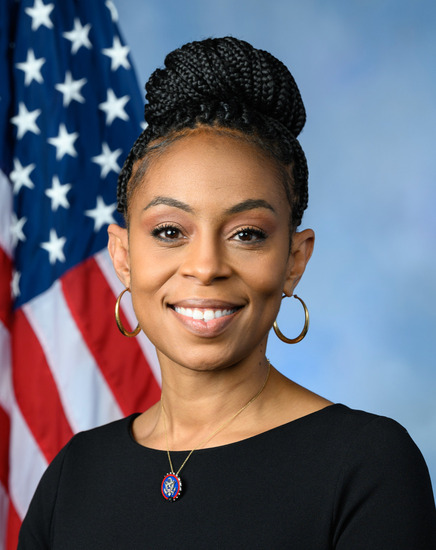
Photo of Shontel M. Brown
D United States House · District 11 · Ohio On the 2026 ballot

Rep. Shontel M. Brown

Compare
Total votes
2,501
all sessions
Attendance
100%
8 missed
Higher than 96% of chamber peers
With party
99%
of cast votes
Higher than 91% of chamber peers
Bipartisan score
1%
crosses aisle rarely
Lower than 92% of chamber peers
Sponsored
1,074
bills & resolutions
Near the chamber average
Committees
5
assignments
1,074 bills and resolutions

Sponsored bills

Total
1,074
Primary
46
Co-sponsor
1,028
This page
1,074
matching current filters
Co-sponsor HR 3682
In committee · United States House · Co-sponsor
Cady Housh and Gemesha Thomas Student Suicide Prevention Act of 2023

Maddy summaryThe Cady Housh and Gemesha Thomas Student Suicide Prevention Act of 2023 requires states to establish a policy mandating annual suicide prevention training for school staff and high school students (grades 9-12). The training must be evidence-based, cover recognizing suicide warning signs, appropriate responses, and referrals to mental health services, while including cultural competency. It allocates $48 million in federal funds, with at least 15% dedicated to supporting this training program, and requires states to collaborate with mental health experts. The bill directly affects school staff and high school students in states that adopt the policy and receive federal funding.

In committee May 26, 2023 1 co-sponsor
Co-sponsor HR 3619
In committee · United States House · Co-sponsor
Toxic-Free Beauty Act of 2023

Maddy summaryHR 3619, the Toxic-Free Beauty Act of 2023, bans the intentional addition of specific chemicals - including formaldehyde, certain parabens, phthalates, mercury, and two dyes - to cosmetic products sold across state lines. It directly affects cosmetic manufacturers and retailers, requiring them to reformulate products to remove these substances. The ban prohibits these chemicals in cosmetics introduced into interstate commerce starting January 1, 2025. This policy change updates federal safety standards under the Federal Food, Drug, and Cosmetic Act to restrict the use of identified chemicals in beauty products.

In committee May 26, 2023 1 co-sponsor
Co-sponsor HR 3620
In committee · United States House · Co-sponsor
Cosmetic Safety for Communities of Color and Professional Salon Workers Act of 2023

Maddy summaryThis bill establishes research programs to study health impacts of cosmetic chemicals on communities of color and professional salon workers. It requires manufacturers to provide translated safety data sheets for professional cosmetics in multiple languages, including Spanish, Vietnamese, Chinese, and Korean. The bill funds two resource centers: one focused on beauty justice for communities of color and another specifically for salon worker health and safety. It also allocates funds for research into developing safer cosmetic alternatives, particularly for products marketed to women and girls of color and used by salon workers.

In committee May 26, 2023 1 co-sponsor
Co-sponsor HR 3621
In committee · United States House · Co-sponsor
Cosmetic Fragrance and Flavor Ingredient Right to Know Act of 2023

Cosmetic Fragrance and Flavor Ingredient Right to Know Act of 2023 This bill imposes disclosure and labeling requirements on cosmetic products that contain certain ingredients. A cosmetic product that fails to meet such requirements may not be sold. Within two years of this bill's enactment, a cosmetic product's labeling or packaging must include a full list of its ingredients, as well as a specified statement that directs consumers to the brand owner's website for the health impacts of any ingredient that (1) is identified on specified lists of harmful or potentially harmful chemicals, such as chemicals identified as carcinogenic to humans by the Environmental Protection Agency or toxic air contaminants under California regulations; or (2) must be disclosed under certain European Union laws and is present in a product above specified concentrations. The Food and Drug Administration must publish and periodically update on its website a list of the ingredients subject to this requirement. Within one year of this bill's enactment, a brand owner must disclose the full list of ingredients for each cosmetic product on its website, as well as whether a cosmetic product contains any fragrance or flavor ingredient that is subject to this bill's labeling or packaging requirement and, if so, the ingredient's functional purpose.

In committee May 26, 2023 1 co-sponsor
Co-sponsor HR 3622
In committee · United States House · Co-sponsor
Cosmetic Supply Chain Transparency Act of 2023

Cosmetic Supply Chain Transparency Act of 2023 This bill requires the Food and Drug Administration (FDA) to maintain a list of certain nonfunctional constituents in cosmetics that are harmful to human health or the environment, authorizes the FDA to request from a brand owner (i.e., the entity bringing a cosmetic to market) certain information about a cosmetic's ingredients, and addresses related issues. For each listed nonfunctional constituent, the list must identify the ingredient or cosmetic (or category of ingredient or cosmetic) in which the constituent is known or reasonably expected to be present. The FDA must also (1) establish procedures for petitions to add substances to the list, (2) issue guidance for industry related to testing and detecting such nonfunctional constituents, and (3) establish a committee to provide advice on creating the list and developing the required industry guidance. Within a year of a nonfunctional constituent being added to the list, a supplier of an ingredient or cosmetic must test for that constituent and provide a brand owner the results and other information before selling the ingredient or cosmetic to the brand owner. A supplier of an ingredient or cosmetic must provide additional information about the item upon a brand owner's request. Brand owners must maintain records with information about the suppliers of ingredients and raw materials used in their cosmetics and provide such information to the FDA upon request. The bill also imposes civil penalties for brand owners and suppliers that violate this bill's provisions.

In committee May 26, 2023 1 co-sponsor
Co-sponsor HR 3645
In committee · United States House · Co-sponsor
To amend the Public Health Service Act to establish emergency grants to safeguard essential health care workers, and for other purposes.

Maddy summaryThis bill creates a new grant program under the Public Health Service Act to provide emergency funding for health care facilities during declared emergencies (like pandemics or natural disasters). It authorizes grants to public or private nonprofit health care facilities and home health agencies to pay hazardous duty compensation to eligible health care workers - such as nurses, medical technicians, and facility cleaners - performing essential on-site work. Grants can cover up to $13 per hour in hazard pay (capped at $25,000 annually per worker) or fund safety measures like personal protective equipment and alternative transit. The program requires the Secretary of Health and Human Services to determine if work or commutes are hazardous during emergencies.

In committee May 26, 2023 1 co-sponsor
Co-sponsor HR 3662
In committee · United States House · Co-sponsor
Adoption Tax Credit Refundability Act of 2023

Maddy summaryThis bill makes the adoption tax credit refundable, meaning adoptive parents who claim the credit can receive a cash refund even if they owe no federal income tax. Currently, the credit is non-refundable, so any excess credit beyond taxes owed is lost. The bill redesignates the credit in tax code (from section 23 to 36C), adds new requirements for third-party affidavits to verify adoptions, and applies to tax returns filed for 2024 and later. It directly affects adoptive parents who qualify for the credit but have no tax liability.

In committee May 25, 2023 1 co-sponsor
Co-sponsor HRES 439
In committee · United States House · Co-sponsor
Expressing the sense of the House of Representatives that Congress should take all appropriate measures to ensure that the United States Postal Service remains an independent establishment of the Federal Government and is not subject to privatization.

Maddy summaryHRES 439 is a non-binding resolution expressing the House of Representatives' support for keeping the U.S. Postal Service (USPS) as an independent federal agency, not subject to privatization. It highlights USPS's constitutional role, self-sustaining nature (relying on service revenue, not taxpayer funds), and its importance to rural communities, e-commerce, and over 600,000 employees. The resolution urges Congress to take action to preserve USPS's independence, emphasizing that privatization could raise prices, reduce services, and harm the nation's mail infrastructure. As a procedural resolution, it does not change law but formally states the House's position.

In committee May 23, 2023 1 co-sponsor
Co-sponsor HR 3617
In committee · United States House · Co-sponsor
To amend title 10, United States Code, to expand the authority to provide a wig and treat traction alopecia under the TRICARE program, and for other purposes.

Maddy summaryThis bill expands TRICARE coverage to include wigs and treatment for traction alopecia - a type of hair loss caused by tight hairstyles, chemical treatments, or prolonged tension on the hair - directly affecting active-duty military members who develop this condition. It amends military health law to explicitly add "traction alopecia" to coverage for wigs and treatment, and requires the military to issue new grooming guidelines by September 2024 warning service members about the health risks of tight hairstyles, dyes, and chemical products. The key change is broadening existing TRICARE benefits to specifically cover this preventable condition, while mandating education on its causes. This is a policy adjustment to improve health care access for affected service members, not a new benefit.

In committee May 23, 2023 1 co-sponsor
Co-sponsor HR 3596
In committee · United States House · Co-sponsor
Protecting our Students in Schools Act of 2023

Maddy summaryThis bill prohibits corporal punishment (such as spanking or paddling) in all schools receiving federal funding, directly affecting students, school personnel, and school administrators. It requires schools to notify parents within 24 hours if corporal punishment occurs and establishes enforcement through civil lawsuits by students/parents, Attorney General actions, and Office for Civil Rights oversight. The bill mandates states to submit school climate reports and develop training programs on positive behavioral interventions to reduce exclusionary discipline practices that disproportionately affect students of color, students with disabilities, and other marginalized groups. It creates a grant program to help schools implement these approaches, with priority given to schools with high suspension rates and disciplinary actions. The bill does not apply to private schools or home schools that don't receive federal funding.

In committee May 23, 2023 1 co-sponsor
Showing 651 to 660 of 1,074 bills
Previous 1 … 65 66 67 … 108 Next