

Maddy summary# Summary of Health Equity and Accountability Act of 2024 This comprehensive legislation addresses multiple aspects of health care access, workforce development, and immigration policy with a strong focus on health equity. ## Key Themes 1. **Workforce Diversity**: Significant emphasis on increasing racial, ethnic, and socioeconomic diversity in the health care workforce 2. **Language Access**: Mandates for language access services for individuals with limited English proficiency 3. **Underserved Communities**: Targeted investments in medically underserved areas and communities 4. **Immigration Policy**: Modifications to programs that bring health care professionals to the U.S. ## Major Provisions ### Workforce Development - **$1 billion** for nursing education enhancement and modernization grants in underserved areas - **$552 million** for health professions workforce development in 2032 (increasing annually) - **$392 million** for health professions education programs in 2025 - New grants for schools of medicine and osteopathic medicine in underserved areas - Expansion of the Conrad State 30 program for foreign physicians to address physician shortages ### Language Access - Requires health care providers to provide language access services to individuals with limited English proficiency - Mandates translation services and interpretation services for all health care settings ### Diversity Initiatives - **David Satcher Public Health and Health Services Corps** to increase awareness of health career opportunities - **Louis Stokes Public Health Scholars Program** for underrepresented students - **Patsy Mink Health and Gender Research Fellowship Program** - **Paul David Wellstone International Health Fellowship Program** - **Edward R. Roybal Health Scholar Program** ### Immigration Policy - **Conrad State 30 program extension** through 2027 - **Physician retention** provisions to help foreign physicians stay in medically underserved areas - **Dual intent for physicians** seeking graduate medical training - **Clarifications to national interest waiver** requirements - **Automatic extension** of physician nonimmigrant status during residency transitions ### Funding - **Health Professions Workforce Fund** established with multi-year funding increasing from $392 million in 2025 to $552 million in 2032 - Specific allocations for nursing workforce development and health professions education This legislation represents a comprehensive approach to addressing health care disparities through workforce development, improved access, and policy changes to support a more diverse and equitable health care system.
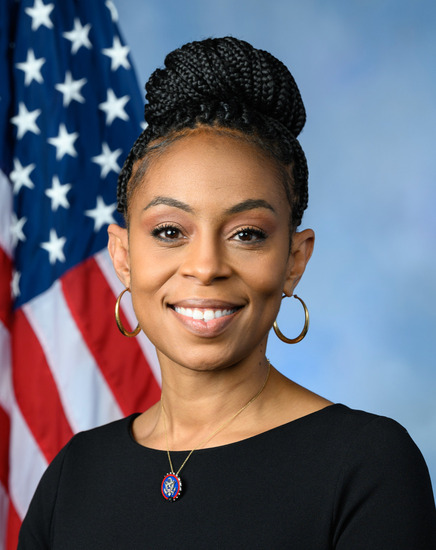
Rep. Shontel M. Brown
Sponsored bills
Maddy summaryHRES 1473 is a non-binding resolution passed by the U.S. House of Representatives that condemns racism, bigotry, and misinformation targeting Haitian people and their descendants. It celebrates the historical contributions of Haitian Americans to U.S. society, including founding cities (like Chicago via Jean Baptiste Point du Sable), advancing civil rights (W.E.B. Du Bois), and enriching healthcare, education, and culture. The resolution specifically calls on all Americans to reject racist tropes and misinformation, and urges elected officials to promote inclusivity and responsible communication. It was introduced in response to recent false claims that fueled threats against Haitian communities, such as the bomb threats in Springfield, Ohio.
Maddy summaryHRES 1468 is a non-binding resolution recognizing the significant pay disparity faced by disabled women in the U.S. workforce. It cites data showing disabled women earn, on average, 50 cents for every dollar earned by nondisabled men, with even starker gaps for disabled women of color (e.g., 44 cents for disabled Latinas). The resolution highlights systemic barriers like occupational segregation, the subminimum wage, and lack of support services contributing to these inequities. It does not create new laws or affect any group directly, but formally acknowledges these disparities and reaffirms the House’s commitment to addressing wage gaps. This is a symbolic recognition, not a policy change.
Maddy summaryThis bill modifies Medicaid and CHIP rules to let eligible out-of-state healthcare providers enroll without extra state screening. It applies to providers already in Medicare or their home state program, with low fraud risk, serving children under 21 with complex medical conditions. Providers would receive 5 years of enrollment under this streamlined process, eliminating state-level barriers. The change directly affects children seeking specialized care across state lines and the providers who serve them.
Maddy summaryHRES 1461 is a symbolic resolution designating September 2024 as "National Voting Rights Month" to raise awareness about voting access. It encourages all U.S. citizens to uphold voting rights, supports existing voting rights legislation like the Freedom to Vote Act, and recommends schools teach about voting history and current restrictions. The resolution specifically aims to highlight efforts to address historical and ongoing barriers affecting historically marginalized groups, including Black, Latino, and disabled voters. It does not create new laws but promotes educational initiatives and media campaigns about registration deadlines and election access.
Maddy summaryThe TIPS Act repeals the lower minimum wage for tipped workers, requiring employers to pay the standard federal minimum wage (instead of a reduced rate that relied on tip credits) and mandating that all tips go directly to employees - except for allowed tip pooling among staff who regularly receive tips. It also creates a new tax deduction for qualified tips received in traditional tipped occupations (like food service, hospitality, and custodial work), limited to individuals with adjusted gross income under $112,500. This deduction applies to both itemizing and non-itemizing taxpayers, with reporting requirements for tips via employer statements. The bill modifies tax forms to accommodate this change, effective for tax years starting after December 2024.
Maddy summaryHRES 1448 is a non-binding House resolution stating that the House believes every person has the right to emergency health care, including abortion care, during medical emergencies. It specifically addresses concerns that abortion restrictions force medical providers to choose between treating patients in life-threatening situations or risking criminal charges. The resolution highlights that such restrictions disproportionately harm Black, Indigenous, people of color, immigrants, low-income individuals, and LGBTQI+ patients. It does not change existing laws but expresses congressional support for ensuring access to emergency care without legal barriers. The resolution was introduced by multiple House members and referred to the Energy and Commerce Committee.
Maddy summaryHR 9570, the Smaller Class Sizes for Students and Educators Act of 2024, authorizes $2 billion annually to fund grants for local school districts serving high-poverty elementary schools. The bill requires districts to reduce kindergarten through third-grade class sizes to no more than 18 students per class at "targeted schools" (those with the highest percentage of students eligible for free/reduced lunch) using grant funds. Key provisions include using at least 97% of funds for hiring teachers, expanding classroom space (capped at 15%), and providing teacher training, while mandating annual reports on class size progress and impacts on student outcomes and teacher working conditions. This directly affects public elementary schools in high-poverty areas and aims to implement evidence-based class size reduction plans through competitive grants.
Maddy summaryHR 8199, the *Increasing Nutrition Access for Seniors Act of 2024*, would make it easier for seniors and disabled individuals in SNAP (food stamp) households to qualify for benefits. It expands certification periods to 36 months for households without earned income and creates a new standard medical deduction: states can automatically deduct $155 monthly (adjusted yearly for inflation) from income for seniors/disabled members who report over $35 in monthly medical expenses. States may also set higher deductions if they provide evidence of higher average medical costs in their area. These changes apply to new certification periods starting 180 days after enactment.
Maddy summaryThis bill would require the federal government to cover 100% of state agencies' costs for SNAP program staff salaries, hiring, and training. It sets minimum wage standards for SNAP workers at the same rate as federal employees, with annual updates tied to federal pay increases. States must submit detailed wage plans for federal approval. The policy aims to improve staffing stability and retention for SNAP operations.