

Trillion Trees Act This bills establishes a variety of requirements and incentives to plant trees and conduct other land management practices for the purposes of capturing and storing carbon in domestic and international trees and forests. Additionally, the bill provides incentives to research or develop other carbon sequestration tools. Specifically, the bill directs the Department of Agriculture (USDA) to set targets to increase forest carbon stock through January 1, 2100, for the purposes of sequestering and storing carbon in U.S. forests. It also establishes and provides funding for the Trillion Trees Challenge Fund to provide grants to nonfederal entities for activities related to reforestation efforts on public or private lands. In addition, it raises the cap on the Reforestation Trust Fund to enhance forest health in the National Forest System and requires the USDA to establish a Tree City USA Grant Program. The bill also allows the U.S. Agency for International Development to enter into an agreement with a nonprofit organization to establish an International Forest Foundation to promote reforestation and prevent deforestation. Additionally, it establishes requirements and incentives to address seedling shortages and support nurseries. Finally, the bill provides market incentives to research or develop other carbon sequestration tools relating to biochar, sustainable building practices, biochemical and bioplastic products, and biomass energy.
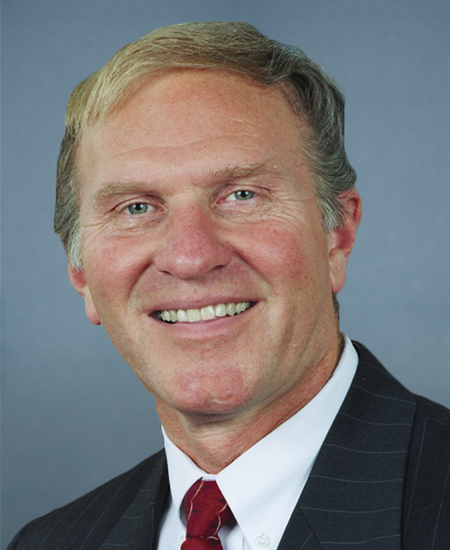
Sponsored bills
Flexible Financing for Rural America Act This bill allows rural utility service providers to submit to the Department of Agriculture (USDA) a request to adjust the interest rate or modify the terms of certain loans. The request shall include a report summarizing how the adjustment or modification will assist the borrower in providing critical utility services to a rural community. Specifically, on receipt of a request, USDA or the Department of the Treasury (in the case of a loan owned by the Federal Financing Bank) must adjust the interest rate on the loan to match certain interest rates for obligations of comparable maturity to the term remaining on the loan (or a higher rate requested by the borrower), and make modifications to the loan terms as necessary to address changes in the financial position of the borrower due to the COVID-19 public health emergency and to promote the financial sustainability of the borrower. In carrying out the adjustments or modifications, USDA or Treasury shall not impose or collect any fee from, or impose any penalty on, a borrower. The bill also provides funding to implement the adjustments and modifications and for the liquidation of residual intragovernmental amounts owed by the Federal Financing Bank in connection with certain loans.
This resolution expresses support for Israel's efforts of self-determination and collective security against external forces, recognizes Jerusalem as the legitimate capital city of Israel, and condemns actions by Hamas against the people of Israel.
United States Army Rangers Veterans of World War II Congressional Gold Medal Act This bill provides for the award of a single Congressional Gold Medal to the U.S. Army Rangers Veterans of World War II in recognition of their dedicated service during World War II.
Reducing Barriers for Military Voters Act This bill requires the Department of Defense (DOD) to develop a plan for providing end-to-end electronic voting services (e.g., services for registering to vote and returning a ballot) in participating states for absent uniformed service members who are deployed or mobilized in locations with limited or no postal service. Specifically, DOD must develop the plan by consulting with state and local election officials. Further, the plan must include (1) methods to ensure that voters have the opportunity to verify that their ballots are received and tabulated, (2) methods to generate a verifiable and auditable vote trail, and (3) an assessment of whether commercially available technologies may be used to carry out the plan. DOD must implement the plan for a trial group of voters in participating states for the 2024 federal elections. The plan must be implemented for all voters in participating states for the 2026 federal elections and subsequent years.
Taiwan Fellowship Act This bill directs the Department of State to establish a program to provide fellowships in Taiwan to qualifying U.S. government employees. Each program fellow shall work in (1) a Taiwanese government agency; or (2) a nongovernmental organization, such as the American Institute in Taiwan, whose interests are associated with the interests of the fellow's employing U.S. government agency. (In 1979, the United States established diplomatic relations with China and ended formal diplomatic ties with Taiwan. The American Institute in Taiwan is a private organization that has a contract with the State Department to represent U.S. interests in Taiwan and provide consular services.)
Modernizing the Collegiate Student Athlete Experience Act This bill establishes the National Intercollegiate Compensation Corporation, a government corporation that operates under the Federal Trade Commission to set rules and guidelines for how student athletes can be paid for their name, image, and likeness. The corporation shall be funded by fees collected from registered athlete agents and third-party licensees, or from athlete agents and third-party licensees in connection with an application for registration with the corporation. The corporation must maintain and make publicly available on its website a searchable and updated database of registered athlete agents and registered third-party licensees. The bill restricts compensation provided by third parties and preempts state laws governing the commercial use of the name, image, or likeness of a student athlete.
Purple Heart Freedom to Work Act This bill increases the monthly income limit that is used to determine whether certain Purple Heart recipients are eligible for Social Security Disability Insurance (SSDI) benefits. Specifically, when making such determinations with respect to Purple Heart recipients who are entitled to SSDI benefits based on combat-related injuries, the Social Security Administration must use the limit that applies to individuals who are blind rather than the lower limit that applies to other SSDI recipients. In addition, the bill phases out SSDI benefits for these Purple Heart recipients, with benefits reduced by $1 for every $4 of earnings in excess of the limit.
This resolution welcomes President Moon Jae-in of South Korea to the United States. It also reaffirms the importance of the U.S.-South Korea relationship to peace, security, and prosperity on the Korean Peninsula and in the Indo-Pacific region.
This resolution states that the United Nations Security Council should immediately impose an arms embargo against the military of Burma (Myanmar) and hold it accountable for its ongoing violations of human rights.