

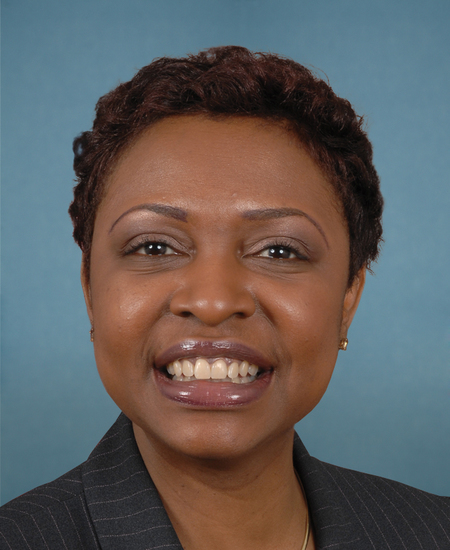
Photo of Yvette D. Clarke
D United States House · District 9 · New York On the 2026 ballot

Rep. Yvette D. Clarke

Compare
Total votes
2,837
all sessions
Attendance
99%
40 missed
Near the chamber average
With party
97%
of cast votes
Near the chamber average
Bipartisan score
2%
crosses aisle rarely
Near the chamber average
Sponsored
2,036
bills & resolutions
Higher than 92% of chamber peers
Committees
4
assignments
2,036 bills and resolutions

Sponsored bills

Total
2,036
Primary
83
Co-sponsor
1,953
This page
2,036
matching current filters
Co-sponsor HR 7378
In committee · United States House · Co-sponsor
Frederick Douglass Congressional Gold Medal Act

Maddy summaryHR 7378, the Frederick Douglass Congressional Gold Medal Act, authorizes Congress to posthumously award a gold medal to honor Frederick Douglass's legacy as a pivotal abolitionist, writer, and advocate for civil rights. The medal, designed by the Treasury Secretary, will be presented to the National Museum of African American History and Culture for display, with bronze duplicates available for sale to cover costs. This ceremonial bill does not create new laws or affect current policies - it solely commemorates Douglass's historical contributions to ending slavery and advancing equality.

In committee Feb 15, 2024 1 co-sponsor
Co-sponsor HR 7352
In committee · United States House · Co-sponsor
Identify Gun Stores Act

Maddy summaryThis bill prevents states from banning or discouraging the use of specific financial industry codes (merchant category codes) that identify firearm and ammunition merchants. It directly affects financial institutions and payment processors that use these standardized codes for transaction tracking. The law requires states to allow the use of these codes, and the Attorney General can enforce this through civil lawsuits. The bill does not change gun laws or affect gun owners; it only addresses financial coding standards.

In committee Feb 14, 2024 1 co-sponsor
Co-sponsor HR 7329
In committee · United States House · Co-sponsor
Election Day Holiday Act of 2024

Maddy summaryHR 7329, the Election Day Holiday Act of 2024, would designate November 5, 2024 (and subsequent general elections) as a federal public holiday. This change would require federal offices to close and provide federal employees a paid day off on Election Day. The bill amends Title 5 of the U.S. Code to add "Election Day" to the list of designated federal holidays, following Columbus Day. This directly affects federal employees and operations, ensuring they have a day off during general elections.

In committee Feb 13, 2024 1 co-sponsor
Primary HRES 1006
In committee · United States House · Lead sponsor
Recognizing the birthday of legendary reggae artist Robert "Bob" Nesta Marley.

Maddy summaryHRES 1006 is a non-binding House resolution recognizing the birthday of reggae legend Bob Marley. It honors his legacy as a global cultural icon and advocate for peace, citing his musical achievements like "One Love" and "Redemption Song," as well as posthumous honors including Rock and Roll Hall of Fame induction and a Grammy Lifetime Achievement Award. The resolution highlights his role as a Jamaican-born artist who used music to promote unity and human rights, including a UN Peace Medal for ending social unrest in Jamaica.

In committee Feb 9, 2024 0 co-sponsors
Primary HRES 997
In committee · United States House · Lead sponsor
Expressing the sense of the House of Representatives with respect to the legacy of Bob Marley.

Maddy summaryHRES 997 is a symbolic resolution expressing the House of Representatives' recognition of Bob Marley's cultural and social impact. It honors Marley's legacy as a reggae artist who promoted peace, unity, and social justice through music like "One Love" and "Redemption Song," while highlighting his role in advancing Jamaican culture globally. The resolution does not create legal obligations or affect any specific group - it serves solely as a ceremonial tribute to Marley's influence on music, human experiences, and his advocacy for ending oppression.

In committee Feb 5, 2024 0 co-sponsors
Co-sponsor HRES 991
In committee · United States House · Co-sponsor
Condemning all acts of violence, oppression, and abuse against ethnic minorities in the Democratic Republic of the Congo.

Maddy summaryThis resolution condemns violence, oppression, and abuse against ethnic minorities in eastern Democratic Republic of the Congo (DRC), particularly targeting Rwandophones like the Banyamulenge and Congolese Tutsi communities. It urges the DRC government to investigate security forces and armed groups (including the M23 rebel group) for human rights abuses, hold perpetrators accountable, and improve protections for displaced civilians. The resolution also calls for U.S. actions such as appointing a special envoy for the Great Lakes region, prioritizing refugee access for affected groups, and coordinating sanctions against human rights abusers - though it is a symbolic statement, not a binding law.

In committee Feb 1, 2024 1 co-sponsor
Co-sponsor HR 6747
In committee · United States House · Co-sponsor
Clean Electricity and Transmission Acceleration Act of 2023

Maddy summary# Summary of the Clean Electricity and Transmission Acceleration Act of 2023 This comprehensive legislation establishes significant reforms across environmental policy, energy infrastructure, and community engagement frameworks. Key provisions include: 1. **Environmental Justice Framework**: - Creates an Office of Environmental Justice and External Civil Rights at EPA - Establishes a White House Environmental Justice Interagency Council - Prohibits disparate impact discrimination under Title VI of the Civil Rights Act - Requires community impact reports for Federal actions affecting environmental justice communities 2. **NEPA Reforms**: - Mandates 90-day public comment periods for environmental justice communities - Requires translation of documents into languages spoken by 5%+ of affected communities - Requires assessment of cumulative impacts, including historical pollution - Requires climate change impact assessments using social cost of carbon - Establishes searchable digital archives of NEPA documents 3. **Community Engagement Requirements**: - Creates "Senior Community Engagement Officers" and "Tribal Community Engagement Officers" at all federal agencies - Requires community benefits agreements for major projects - Establishes grants for capacity building in environmental justice communities - Creates an E-NEPA permitting portal for public access to documents 4. **Energy Policy Provisions**: - Includes reforms for FERC (Federal Energy Regulatory Commission) environmental justice liaison - Establishes requirements for intervenor funding at FERC - Contains provisions for transmission planning and infrastructure 5. **Tribal Consultation**: - Strengthens tribal consultation requirements for projects affecting tribal lands - Requires government-to-government relationships with tribal nations The legislation represents a significant shift toward integrating environmental justice considerations throughout the federal permitting and review process, with specific requirements for meaningful community engagement, transparency, and consideration of cumulative impacts on vulnerable populations. It also establishes new funding mechanisms and administrative structures to support these environmental justice goals.

In committee Jan 25, 2024 1 co-sponsor
Co-sponsor HRES 976
In committee · United States House · Co-sponsor
Recognizing the roles and the contributions of Americas Certified Registered Nurse Anesthetists (CRNAs) and their critical role in providing quality health care for the public and the Nations Armed Forces for more than 150 years, through multiple public health emergencies, and beyond.

Maddy summaryHRES 976 is a resolution recognizing Certified Registered Nurse Anesthetists (CRNAs) for their 150+ year contributions to healthcare. It highlights CRNAs as essential providers of anesthesia and pain management, especially in rural areas and military/veterans' healthcare settings, where they administer over 50 million anesthetics annually. The resolution encourages public and professional recognition of CRNAs during National CRNA Week (January 21-27, 2024) and urges stakeholders to utilize CRNAs' full potential. As a non-binding commemorative resolution, it does not create new policies or directly affect healthcare delivery.

In committee Jan 19, 2024 1 co-sponsor
Co-sponsor HR 7056
In committee · United States House · Co-sponsor
Access to Family Building Act

Maddy summaryHR 7056, the Access to Family Building Act, establishes federal rights for individuals to access assisted reproductive technology (ART) like IVF without unreasonable restrictions, directly affecting patients seeking fertility treatments and health care providers offering ART services. The bill prohibits states from imposing limitations on ART that are more burdensome than those for comparable medical procedures, fail to advance safety, or unduly restrict access, while allowing health and safety regulations that are necessary and least restrictive. It creates federal enforcement mechanisms, including lawsuits by the Attorney General or affected individuals to challenge violating state laws, and preempts conflicting state regulations. The bill explicitly preserves state authority over health/safety regulations and does not alter existing state insurance coverage laws for ART.

In committee Jan 19, 2024 1 co-sponsor
Co-sponsor HR 7039
In committee · United States House · Co-sponsor
Stronger Communities through Better Transit Act

Maddy summaryThe Stronger Communities through Better Transit Act establishes a new federal grant program to improve public transportation service. It provides funding to urban areas, states, and Indian tribes to cover up to 50% of public transit operating costs (up to 80% in persistent poverty areas and 100% for Indian tribes), with requirements to report on service frequency, access to jobs, and conduct community surveys. The program mandates that a majority of funds must benefit underserved communities and areas of persistent poverty, defined as census tracts with high poverty rates or minority populations. Recipients must maintain their transit funding levels and report on improvements in access to essential services. The bill authorizes $20 billion annually for fiscal years 2024-2027.

In committee Jan 18, 2024 1 co-sponsor
Showing 871 to 880 of 2,036 bills
Previous 1 … 87 88 89 … 204 Next