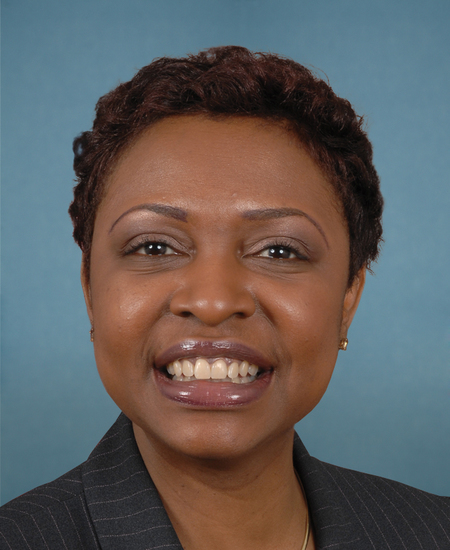
Photo of Yvette D. Clarke
D United States House · District 9 · New York On the 2026 ballot

Rep. Yvette D. Clarke

Compare
Total votes
2,837
all sessions
Attendance
99%
40 missed
Near the chamber average
With party
97%
of cast votes
Near the chamber average
Bipartisan score
2%
crosses aisle rarely
Near the chamber average
Sponsored
2,018
bills & resolutions
Higher than 91% of chamber peers
Committees
4
assignments
2,018 bills and resolutions

Sponsored bills

Total
2,018
Primary
83
Co-sponsor
1,935
This page
2,018
matching current filters
Co-sponsor HR 3224
In committee · United States House · Co-sponsor
I am Vanessa Guillén Act of 2021

I am Vanessa Guillén Act of 2021 This bill addresses the policies and procedures of the Department of Defense (DOD) for cases or allegations of sex-related offenses.

In committee May 13, 2021 1 co-sponsor
Co-sponsor HR 3216
In committee · United States House · Co-sponsor
To amend the Internal Revenue Code of 1986 to create parity for unmarried individuals and heads of household with respect to the temporary 2021 income phaseouts in the child tax credit.

This bill increases the applicable threshold amount for heads of household in 2021 to $150,000 for purposes of the income phaseout in the child tax credit (thus making it equal to the threshold amount for married individuals filing joint tax returns).

In committee May 13, 2021 1 co-sponsor
Primary HR 3139
In committee · United States House · Lead sponsor
PEAKER Act of 2021

Promoting Energy Alternatives is Key to Emission Reductions Act of 2021 or the PEAKER Act of 2021 This bill addresses the emissions from peaker plants and provides financial incentives for renewable energy to reduce the need for peaker plants. Peaker plants are defined as fossil fuel-fired power plants or units of power plants that are run primarily to meet peak electricity demand. In other words, peaker plants are run where there is above average energy demand, such as during extremely hot or cold weather. The bill establishes an additional investment tax credit for renewable energy generation and battery storage to replace the need for peaker plants in disadvantaged communities. In addition, the Department of Energy (DOE) must establish a grant program to provide up to $1 billion annually through FY2032 to eligible entities for clean energy projects. Specifically, grants must be awarded to assist eligible entities in carrying out (1) projects associated with the construction, installation, or acquisition of qualifying renewable energy facilities and qualifying energy storage facilities; or (2) community energy proposals or community energy studies to reduce or replace the need for peaker plants. Entities that are eligible to receive grants include state or local governments, nonprofit organizations, community-owned energy generation facilities or energy storage facilities located in disadvantaged communities, community-based energy cooperatives, or certain partnerships. DOE must also assess and report on the location of each peaker plant, the quantity and type of pollution each plant is producing, and related data as specified by the bill.


In committee May 13, 2021 0 co-sponsors
Co-sponsor HR 3149
In committee · United States House · Co-sponsor
HEAL for Immigrant Families Act of 2021

Health Equity and Access under the Law for Immigrant Women and Families Act of 2021 or the HEAL Immigrant Women and Families Act of 20 21 This bill extends Medicaid and Children's Health Insurance Program coverage to individuals lawfully present in the United States who otherwise meet eligibility requirements. Individuals granted federally authorized presence also are required to maintain minimum essential health insurance coverage and are eligible for health insurance exchanges, reduced cost sharing, premium subsidies, and premium tax credits.

In committee May 13, 2021 1 co-sponsor
Co-sponsor HR 1753
In committee · United States House · Co-sponsor
Improving Access to Nutrition Act of 2021

Improving Access to Nutrition Act of 20 21 This bill repeals certain work requirements for the Supplemental Nutrition Assistance Program (SNAP, formerly known as the food stamp program). The requirements apply to able-bodied adults who are ages 18-49 and have no dependent children. Individuals who do not meet certain work requirements are generally prohibited from receiving more than 3 months of SNAP benefits over a 36-month period. Under current law, some of the work requirements under SNAP are temporarily suspended due to COVID-19 (i.e., coronavirus disease 2019).

In committee May 13, 2021 1 co-sponsor
Co-sponsor HR 1475
Passed · United States House · Co-sponsor
Pursuing Equity in Mental Health Act

Pursuing Equity in Mental Health Act This bill establishes and expands programs to address racial and ethnic disparities in mental health. Specifically, the Department of Health and Human Services (HHS) must award grants to establish interprofessional behavioral health care teams in areas with a high proportion of racial and ethnic minority groups. In addition, HHS may award grants to incorporate best practices and competencies to address mental health disparities in curricula for training social workers, psychologists, and other behavioral health professionals. HHS must also promote behavioral and mental health and reduce stigma associated with mental health conditions and substance use disorder through outreach to racial and ethnic minority groups. HHS must consult with appropriate advocacy groups and behavioral health organizations to develop a strategy for this outreach. The bill also (1) reauthorizes the minority fellowship program to support the education of mental health professionals who provide services to racial and ethnic minorities, and (2) requires studies on mental health disparities and the effects of social media use on adolescents.

Passed May 13, 2021 1 co-sponsor
Co-sponsor HR 958
Passed · United States House · Co-sponsor
Protecting Moms Who Served Act

Protecting Moms Who Served Act This bill requires the Department of Veterans Affairs (VA) to implement the maternity care coordination program. The VA must provide community maternity care providers (i.e., non-VA maternity care providers) with training and support with respect to the unique needs of pregnant and postpartum veterans, particularly regarding mental and behavioral health conditions in relation to the service of the veterans in the Armed Forces. Additionally, the Government Accountability Office must report on maternal mortality and severe maternal morbidity among pregnant and postpartum veterans, with a focus on racial and ethnic disparities in maternal health outcomes for veterans.

Passed May 13, 2021 1 co-sponsor
Co-sponsor HR 721
Passed · United States House · Co-sponsor
Mental Health Services for Students Act of 2021

Mental Health Services for Students Act of 2021 This bill provides specific statutory authority for the Project AWARE (Advancing Wellness and Resiliency in Education) State Educational Agency Grant Program that is administered by the Substance Abuse and Mental Health Services Administration. The program supports school-based mental health services, including screening, treatment, and outreach programs.

Passed May 13, 2021 1 co-sponsor
Co-sponsor HR 3159
In committee · United States House · Co-sponsor
Safer Neighborhoods Gun Buyback Act of 2021

Safer Neighborhoods Gun Buyback Act of 2021 This bill authorizes the Department of Justice's Bureau of Justice Assistance (BJA) to make grants to states, local governments, or gun dealers to conduct gun buyback programs. The BJA may distribute smart prepaid cards for use by a state, local government, or gun dealer to compensate individuals who dispose of firearms. Additionally, the bill establishes a new criminal offense for using or accepting a smart prepaid card in the acquisition or transfer of a firearm or ammunition. A violator is subject to a fine, up to two years in prison, or both.

In committee May 12, 2021 1 co-sponsor
Co-sponsor HR 3126
In committee · United States House · Co-sponsor
Healthy MOM Act

Healthy Maternity and Obstetric Medicine Act or the Healthy MOM Act This bill expands health insurance coverage availability for pregnant individuals. It requires health insurers, health insurance exchanges, and group health plans to offer a special enrollment period to pregnant individuals. The special enrollment period offered by an insurer or exchange must begin when the pregnancy is reported to the insurer or exchange. The special enrollment period offered by a group health plan must begin when the pregnancy is reported to the plan or is confirmed by a health care provider. The bill also makes pregnancy a qualifying life event for the purpose of enrolling in a federal employee health benefit plan. Additionally, a group health plan or health insurer that covers dependents must provide coverage for maternity care to all covered individuals. Any individual who is eligible for Medicaid and is, or becomes, pregnant maintains such eligibility for one year after the end of the pregnancy. The bill revises the range in which a state must establish a maximum level of family income for pregnant women and infants to be eligible for Medicaid. The upper limit of the range is eliminated and the lower limit is set to the level in place on January 1, 2014.

In committee May 12, 2021 1 co-sponsor
Showing 1,791 to 1,800 of 2,018 bills