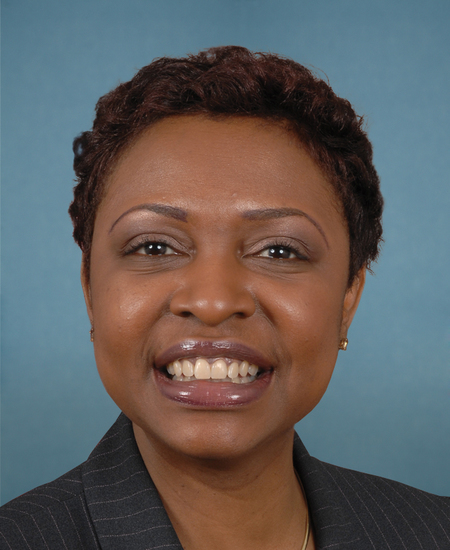
Photo of Yvette D. Clarke
D United States House · District 9 · New York On the 2026 ballot

Rep. Yvette D. Clarke

Compare
Total votes
2,837
all sessions
Attendance
99%
40 missed
Near the chamber average
With party
97%
of cast votes
Near the chamber average
Bipartisan score
2%
crosses aisle rarely
Near the chamber average
Sponsored
2,018
bills & resolutions
Higher than 91% of chamber peers
Committees
4
assignments
2,018 bills and resolutions

Sponsored bills

Total
2,018
Primary
83
Co-sponsor
1,935
This page
2,018
matching current filters
Co-sponsor HR 3517
In committee · United States House · Co-sponsor
Increasing Access to Osteoporosis Testing for Medicare Beneficiaries Act of 2021

Increasing Access to Osteoporosis Testing for Medicare Beneficiaries Act of 2021 This bill specifies that certain Medicare payment rules applicable to imaging services shall apply to dual-energy x-ray absorptiometry services used in bone mass scans beginning in 2022. The Centers for Medicare & Medicaid Services must establish national minimum payment amounts for such services.

In committee May 26, 2021 1 co-sponsor
Co-sponsor HR 2102
In committee · United States House · Co-sponsor
End Polluter Welfare Act of 2021

End Polluter Welfare Act of 2021 This bill limits or eliminates certain fossil fuel oil and gas subsidies for oil companies, including by (1) eliminating the limit on liability for offshore facilities and pipeline operators; (2) eliminating the authority of the Department of Energy to carry out the Fossil Energy Research and Development Program and prohibiting funds made available to the Advanced Research Project Agency from being used to carry out any project that supports fossil fuels; (3) terminating certain provisions relating to enhanced oil recovery, producing oil and natural gas from marginal wells, and limitations on percentage depletion for oil and natural gas wells; (4) terminating other deductions and accounting methods supporting oil, natural gas, and coal companies; (5) increasing the Oil Spill Liability Trust Fund financing rate; (6) denying a tax deduction for removal costs and damages relating to oil spills; (7) imposing an excise tax on the removal price of any taxable crude oil or natural gas; (8) increasing amortization periods for tertiary injectant expenses, development expenditures of a mine or other natural deposit, mining exploration expenditures, and intangible drilling and development costs for oil and gas wells and geothermal wells; (9) repealing the tax credits for the production of electricity from refined coal and for carbon oxide sequestration; and (10) requiring a study and elimination of certain other fossil fuel subsidies.

In committee May 26, 2021 1 co-sponsor
Co-sponsor HRES 438
In committee · United States House · Co-sponsor
Third Reconstruction: Fully addressing poverty and low wages from the bottom up.

This resolution expresses the sense of Congress that legislation and policies that address poverty, low wages, and related issues should be prioritized. Among other priorities, the resolution commits to updating the poverty measure; raising the minimum wage; expanding unemployment insurance; ensuring that all workers receive paid family and medical leave; implementing a federal jobs guarantee; guaranteeing safe and quality housing, a right to water, high-quality public education, and quality health care for all; enacting relief from household and personal debt that cannot be paid; ensuring that state, local, and tribal governments are adequately funded; expanding and protecting the right to vote; eliminating persistent racial inequities; protecting the constitutional rights of assembly and free speech; enacting comprehensive and just immigration reform; ensuring all the rights of Native and Indigenous peoples and tribal nations; transforming the economy into a green renewable energy economy; demilitarizing U.S. foreign policy, borders, and policing; enacting fair taxes on corporations and the wealthy; using deficit spending to meet pressing needs; and encouraging states and cities to enact policies that follow the direction provided by this resolution.

In committee May 25, 2021 1 co-sponsor
Co-sponsor HR 3474
In committee · United States House · Co-sponsor
Keeping All Students Safe Act

Keeping All Students Safe Act This bill prohibits the use of seclusion and limits the use of physical restraint in schools and Head Start programs that receive federal funding. Specifically, the bill prohibits the use of seclusion, which is the involuntary confinement of a student alone in a room or area from which the student is physically prevented from leaving. The term does not include a time out, which may involve separating the student from others in a non-locked setting. The bill prohibits the use of mechanical or chemical restraints or physical restraints that restrict breathing or are life threatening. The bill outlines the requirements for the use of physical restraint, including that the student's behavior must pose an imminent danger of serious physical injury to the student or other individual. Each state must ensure that a sufficient number of program personnel are trained and certified by a state-approved crisis intervention training program. Additionally, each program must establish procedures to follow after an incident involving physical restraint. Further, the bill establishes enforcement provisions, including a private right of action for a student who has been subjected to unlawful seclusion or restraint. The Department of Education and the Department of Health and Human Services must withhold payments from a program for unlawful seclusion or restraint. Finally, the bill requires each state educational agency (SEA) to establish, implement, and enforce policies and procedures required by the bill. It also creates a grant program to assist SEAs with these activities.

In committee May 25, 2021 1 co-sponsor
Co-sponsor HR 3519
In committee · United States House · Co-sponsor
Stop Child Hunger Act of 2021

Stop Child Hunger Act of 2021 This bill establishes a permanent program and provides funds for electronic benefit transfer (EBT) cards to cover meals for children during extended school closures. Specifically, the Department of Agriculture must establish a program to provide EBT cards to cover meals for children who are enrolled in the National School Lunch Program or School Breakfast Program when a school is closed, operating remotely, or a combination of both for a period of five days or more. Cards may be used to purchase food from approved retailers under the Supplemental Nutrition Assistance Program.

In committee May 25, 2021 1 co-sponsor
Primary HR 3461
In committee · United States House · Lead sponsor
DOC Access Act of 2021

Dentist and Optometric Care Access Act of 2021 or the DOC Access Act of 20 21 This bill prohibits private health insurance plans from setting rates for items and services, except for dental cleanings, provided by a doctor of optometry, of dental surgery, or of dental medicine for which the plan does not pay a substantial amount. Additionally, an agreement between a plan and such a doctor for limited scope dental or vision benefits may last longer than two years only with the prior acceptance of the doctor for each term extension. Plans also may not restrict such a doctor's choice of laboratories or suppliers. Such doctors may elect to waive the application of the payment amount and choice of laboratories provisions of this bill. The bill establishes a private right of action for a person adversely affected by a violation of this bill. The bill does not supersede state laws regarding health insurers and dental or vision benefit plans.

In committee May 24, 2021 0 co-sponsors
Co-sponsor HR 3407
In committee · United States House · Co-sponsor
MOM­MA’s Act

Mothers and Offspring Mortality and Morbidity Awareness Act or the MOMMA's Act This bill establishes various programs and requirements to reduce maternal mortality. It also increases federal tobacco taxes and equalizes the tax treatment of different tobacco products. Specifically, the Centers for Disease Control and Prevention (CDC) must provide technical assistance and best practices for collecting data, standardizing reporting, and preventing maternal mortality. The CDC must consult with the Health Resources and Services Administration (HRSA) on this assistance. The bill also provides statutory authority for CDC grants for state-based collaboratives to improve care immediately before and after birth and to improve maternal and infant health outcomes, and a HRSA program to improve the quality and safety of maternity care. Furthermore, the Department of Health and Human Services (HHS) must establish regional centers through health professional schools and training programs to educate health care providers about implicit bias and culturally competent care. In addition, the bill expands eligibility for Medicaid, the Children's Health Insurance Program (CHIP), and other benefits for pregnant and postpartum individuals. Specifically, it extends postpartum eligibility for Medicaid and CHIP for one year; provides coverage for oral health services for pregnant and postpartum individuals under Medicaid and CHIP; and extends postpartum eligibility for the Special Supplemental Nutrition Program for Women, Infants, and Children for two years. HHS must also take steps to publicize the benefits available to pregnant and postpartum individuals under Medicaid and CHIP, and the Centers for Medicare & Medicaid Services must provide guidance on Medicaid coverage for doula services.


In committee May 21, 2021 1 co-sponsor
Co-sponsor HR 3423
In committee · United States House · Co-sponsor
Safe Drinking Water in Public Playgrounds, Parks, and Libraries Act

Safe Drinking Water in Public Playgrounds, Parks, and Libraries Act This bill requires the Environmental Protection Agency to establish a grant program to provide assistance to states and municipalities for the replacement of drinking water fountains that were manufactured prior to 2014 and are located in certain playgrounds, parks, or libraries.

In committee May 21, 2021 1 co-sponsor
Co-sponsor HR 3386
In committee · United States House · Co-sponsor
Smart Cities and Communities Act of 2021

Smart Cities and Communities Act of 2021 This bill establishes programs for the implementation and use of smart technologies and systems in communities of various sizes. A smart city or community is one in which innovative, advanced, and trustworthy information, communication, and energy technologies are applied to (1) improve the health and quality of life of residents; (2) increase efficiency of operations and services; (3) promote economic growth; and (4) create a community that is safer and more secure, equitable, sustainable, resilient, livable, and workable. The Department of Commerce shall establish a regional demonstration grant program focused on facilitating adoption, and allowing measurement and validation of performance, of advanced smart city or community technologies and systems in a variety of communities, including small- and medium-sized cities and rural and tribal communities. Commerce shall also convene a Cybersecurity Working Group to develop tools for evaluating the cybersecurity of smart city or community technologies. The Department of Labor shall establish the TechHire Workforce Training and Development Pilot Program to furnish competitive grants for technology-based job training and education programs that provide an industry-recognized certificate or certification. The Department of Energy (DOE) shall implement a pilot program to improve the access of cities and communities to the expertise and infrastructure of the national laboratories to promote smart city technologies. DOE shall also expand its Technologist in Residence pilot program to include partnerships between national laboratories and cities or communities respecting research and development related to smart cities or communities. The bill requires strong federal encouragement and support for private sector-led standards-related activities. The bill requires the establishment of a strategic international smart cities and communities trade program.

In committee May 21, 2021 1 co-sponsor
Co-sponsor HR 3441
In committee · United States House · Co-sponsor
Substance Use Disorder Workforce Act

Substance Use Disorder Workforce Act This bill increases the number of residency positions eligible for graduate medical education payments under Medicare for hospitals that have addiction or pain medicine programs, with an aggregate increase of 1,000 positions over a five-year period.

In committee May 21, 2021 1 co-sponsor
Showing 1,751 to 1,760 of 2,018 bills