

Mental Health Workforce and Language Access Act of 2021 This bill establishes within the Department of Health and Human Services (HHS) two demonstration programs to increase access to mental health services provided in languages other than English at federally qualified health centers (FQHCs). In carrying out the programs, HHS must give preference to FQHCs at which at least 20% of the patients are best served in a language other than English. First, HHS must provide National Health Service Corps (NHSC) loan repayments to mental health care providers who agree to serve their period of obligated service in an FQHC. HHS may provide enhanced payments to those who serve in an FQHC with non-English language needs. (The NHSC is a scholarship and student loan repayment program for eligible health care providers who agree to work in areas with a shortage of primary care, dental care, and mental health care providers.) Second, HHS must award grants to FQHCs for recruiting and retaining mental health care providers who are fluent in a language other than English.
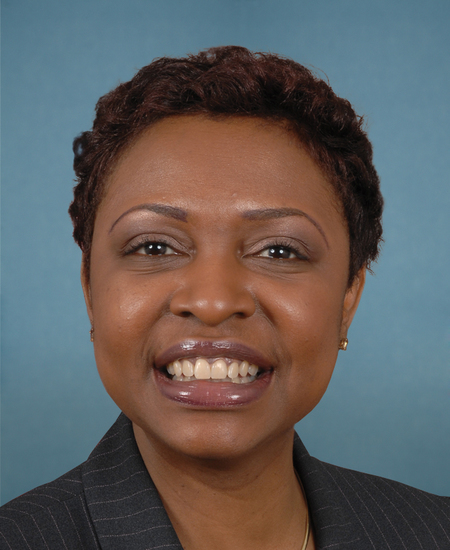
Rep. Yvette D. Clarke
Sponsored bills
This resolution expresses support for the goals and values of the 53rd anniversary of the Fair Housing Act and for efforts to strengthen housing protections, particularly during the COVID-19 public health emergency.
FHA Fairness Act This bill increases the mortgage limit for federal mortgage insurance eligibility for homes in certain cities and counties. Specifically, this increase applies to metropolitan cities and urban counties with higher housing costs that have experienced a decrease in home values over a specified time period.
Raise the Age Act This bill establishes new restrictions on the sale or transfer of certain semiautomatic firearms to individuals under 21 years of age. Specifically, this bill makes it unlawful for a licensed gun dealer, importer, manufacturer, or collector to sell or deliver a semiautomatic center-fire rifle that has (or has the capacity to accept) an ammunition feeding device with a capacity of more than five rounds to an individual who the licensee knows or has reasonable cause to believe is under age 21. The prohibition does not apply if the individual under age 21 is a full-time law enforcement officer or active-duty member of the Armed Forces. The bill also requires the Federal Bureau of Investigation to report on the operation of its public access line, including a description of information sharing protocols and recommendations for improving such protocols.
Fair and Clear Campaign Transparency Act This bill directs the Federal Communications Commission to require certain online public inspection files to be made available to the public in a machine-readable format that supports automated searching, bulk downloading, aggregation, manipulation, sorting, and analysis. Online public inspection files (including political files that contain records of requests to purchase broadcast time by or on behalf of candidates for public office or to communicate a message relating to a political matter of national importance) are files that must be uploaded to the internet by certain television broadcast stations and television systems, AM or FM radio broadcast stations, cable operators, direct broadcast satellite service providers, or satellite digital audio radio service providers.
American Energy Efficiency Act This bill requires electric utilities and natural gas utilities to meet performance standards for 2021 through 2035 with respect to cumulative electricity savings and cumulative natural gas savings.
Enhancing Diversity and Inclusion by Verifying and Ensuring the Reporting required by Statute Is Transpiring and Yielding Data Act or the Enhancing DIVERSITY Data Act This bill requires the Federal Communications Commission (FCC) to carry out rulemaking, data collection, and reporting about the demographic composition of the broadcast industry workforce. Specifically, the FCC must complete a specified rulemaking process related to equal employment opportunity rules and policies that apply to broadcast stations and multichannel video programming distributors (e.g., cable operators). Part of this rulemaking addresses reporting of workforce demographics by broadcast license holders. Within one year of completing the rulemaking, the FCC must begin collecting demographic data pertaining to the broadcast industry workforce. The FCC may not use the collected data in its reviews of broadcast license applications or renewals or to assess compliance with applicable equal employment opportunity rules. Further, the FCC must (1) include analyses of the demographic composition of the broadcast industry workforce in certain reports, and (2) maintain a database that includes publicly available ownership data of broadcast licensees.
Ending the Monopoly of Power Over Workplace Harassment through Education and Reporting Act or the EMPOWER Act This bill makes it an unlawful labor practice for an employer to enter into, or attempt to enforce, a contract with an employee or job applicant that contains a nondisparagement or nondisclosure clause that covers workplace or sexual harassment, including retaliation for participating in a workplace harassment proceeding. The bill exempts certain settlement or separation agreements from such prohibition. The bill also requires the Securities and Exchange Commission to promulgate a regulation that requires any issuer of securities to submit a report for the most recent five-year period with respect to workplace and sexual harassment. The commission must provide for the development and dissemination of training programs and information regarding workplace and sexual harassment. The bill denies a tax deduction for amounts related to judgments and expenses in connection with litigation related to workplace or sexual harassment. It also excludes from gross income, for income tax purposes, any amount received in connection with a claim or settlement related to workplace or sexual harassment, or other unlawful discrimination.
Help Ensure Lower Patient Copays Act or the HELP Copays Act This bill requires health insurance plans to apply certain payments made by, or on behalf of, a plan enrollee toward a plan's cost-sharing requirements. Specifically, plans must apply third-party payments, financial assistance, discounts, product vouchers, and other reductions in out-of-pocket expenses toward the requirements.
Behavioral Health Crisis Services Expansion Act This bill establishes requirements, expands health insurance coverage, and directs other activities to support the provision of behavioral health crisis services along a continuum of care. Specifically, the Department of Health and Human Services (HHS) must establish standards for a behavioral health crisis continuum of care that health care providers and communities may use in responding to individuals experiencing a behavioral health crisis. This continuum of care must include 24-7 crisis hotlines, emergency treatment, stabilization services, and other specified components. In addition, the bill expands health insurance coverage for behavioral health crisis services. It also expands the Community Mental Health Services Block Grant to assist states and territories with developing the infrastructure to provide crisis response services. Furthermore, HHS, in consultation with the Department of Justice, must convene an expert panel to make recommendations concerning training for emergency services dispatchers and crisis call center personnel to respond appropriately to individuals experiencing a behavioral health crisis.