

Introduced Jan 6, 2023
0 co-sponsors
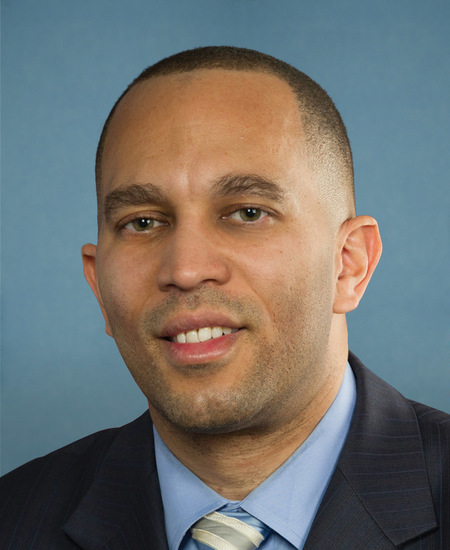
Rep. Hakeem S. Jeffries
Total votes
2,837
all sessions
Attendance
100%
13 missed
Higher than 89% of chamber peers
With party
98%
of cast votes
Higher than 91% of chamber peers
Bipartisan score
1%
crosses aisle rarely
Lower than 92% of chamber peers
Sponsored
347
bills & resolutions
Lower than 99% of chamber peers
Committees
0
assignments
347 bills and resolutions
Sponsored bills
Total
347
Primary
40
Co-sponsor
307
This page
347
matching current filters
Introduced Jan 6, 2023
0 co-sponsors
Human Trafficking Prevention Act of 2022
Human Trafficking Prevention Act of 2022 This act requires the posting of contact information of the national human trafficking hotline in specific places. Specifically, the information must be posted in a visible place in all federal buildings; in the restrooms of each U.S. aircraft, airport, over-the-road bus, bus station, passenger train, and passenger railroad station; and at each port of entry.
Signed into law Dec 27, 2022
0 co-sponsors
To designate the facility of the United States Postal Service located at 15 Chestnut Street in Suffern, New York, as the "Sergeant Gerald T. 'Jerry' Donnellan Post Office".
This act designates the facility of the United States Postal Service located at 15 Chestnut Street in Suffern, New York, as the Sergeant Gerald T. "Jerry" Donnellan Post Office.
Signed into law Dec 27, 2022
1 co-sponsor
Condemning the atrocities that occurred in Atlanta, Georgia, in 1906, in which White supremacist mobs brutalized, terrorized, and killed dozens of Black Americans, and reaffirming the commitment of the House of Representatives to combating hatred, injustice, and White supremacy.
This resolution condemns the actions of a White supremacist mob that drove Black residents out of Atlanta, Georgia in 1906 and supports the designation of a national day of remembrance for the victims of forced migrations of Black Americans.
Passed Dec 23, 2022
1 co-sponsor
Authorizing the printing of a revised and updated version of the House document entitled "Black Americans in Congress, 1870-1989".
This concurrent resolution requires the printing of a revised and updated version of House Document 101-117, titled Black Americans in Congress, 1870-1989 .
Passed Dec 22, 2022
1 co-sponsor
Uyghur Forced Labor Prevention Act
Uyghur Forced Labor Prevention Act This bill imposes various restrictions related to China's Xinjiang Uyghur Autonomous Region, including by prohibiting certain imports from Xinjiang and imposing sanctions on those responsible for human rights violations there. Goods manufactured or produced in Xinjiang shall not be entitled to entry into the United States unless U.S. Customs and Border Protection (1) determines that the goods were not manufactured by convict labor, forced labor, or indentured labor under penal sanctions; and (2) reports such a determination to Congress and to the public. The President shall periodically report to Congress a list of foreign entities and individuals knowingly facilitating (1) the forced labor of Uyghurs, Kazakhs, Kyrgyz, and members of other Muslim minority groups in Xinjiang; and (2) efforts to contravene U.S. laws regarding the importation of forced labor goods from Xinjiang. The President shall impose property-blocking sanctions on the listed individuals and entities and impose visa-blocking sanctions on the listed individuals. Securities issuers required to file annual or quarterly reports with the Securities Exchange Commission shall disclose in such reports instances in which the issuer knowingly engaged in certain activities related to Xinjiang, such as working with an entity building detention facilities or surveillance systems there. After such a disclosure, the President shall determine whether to investigate if sanctions or criminal charges are warranted. The Forced Labor Enforcement Task Force and the Department of State shall report to Congress strategies to address forced labor in Xinjiang or any other part of China. The State Department shall also report to Congress a determination of whether the treatment of Muslim groups in Xinjiang constitutes crimes against humanity or genocide under U.S. law.
Passed Dec 22, 2022
1 co-sponsor
Expanding the VOTE Act
Expanding the Voluntary Opportunities for Translations in Elections Act or the Expanding the VOTE Act This bill expands access to voting materials for individuals with limited proficiency in the English language, including by establishing incentive grants for states and political subdivisions to provide translated voting materials. Additionally, the bill directs the Government Accountability Office to study the impact of (1) reducing the threshold requirement under Section 203 of the Voting Rights Act of 1965, and (2) expanding the definition of language minorities to include native speakers of additional languages.
In committee Dec 21, 2022
1 co-sponsor
American Innovation and Choice Online Act
American Choice and Innovation Online Act This bill prohibits certain large online platforms from engaging in specified acts, including giving preference to their own products on the platform, excluding or disadvantaging competing products from another business on the platform, or discriminating among similarly situated users. Further, a platform may not materially restrict or impede the capacity of a competing business user to access or interoperate with the same platform, operating system, or hardware or software features. The bill also restricts the platform's use of nonpublic data obtained from or generated on the platform and prohibits the platform from restricting access to platform data generated by the activity of a competing business user. The bill also provides additional restrictions related to installing or uninstalling software, search or ranking functionality, and retaliation for contact with law enforcement regarding actual or potential violations of law. The bill establishes affirmative defenses for the prohibited conduct. The Federal Trade Commission or the Department of Justice must designate whether an entity is a platform covered by the bill, and both must carry out enforcement activities. The bill also provides for civil penalties, injunctions, conflicts of interest, a private right of action, and the forfeit of profits for repeat offenders.
In committee Dec 21, 2022
1 co-sponsor
Empowering the U.S. Fire Administration Act
Empowering the U.S. Fire Administration Act This act authorizes the U.S. Fire Administration (USFA) to conduct on-site fire safety investigations of major fires and other fires under other specified circumstances. In the case of a major fire, the USFA may send incident investigators (e.g., safety specialists, fire protection engineers, codes and standards experts, researchers, and fire training specialists) to the site. Any such investigation shall (1) be conducted in coordination and cooperation with appropriate federal, state, local, tribal, and territorial authorities; and (2) examine the previously determined cause and origin of the fire and assess broader systematic matters. Upon concluding any such investigation, the USFA must issue a public report to federal, state, local, tribal, and territorial authorities on the findings of such investigation or collaborate with another investigating federal, state, local, tribal, or territorial agency on that agency's report. The act makes an exception where issuing a report would have a negative impact on a potential or ongoing criminal investigation. Additionally, the USFA may send fire investigators to conduct fire safety investigations at the site of any fire with unusual or remarkable context that results in losses less severe than those occurring as a result of a major fire, in coordination and cooperation with the appropriate federal, state, local, tribal, and territorial authorities.
Signed into law Dec 20, 2022
1 co-sponsor
Ask Maddy
·
AI policy assistant
Ask Maddy about Hakeem S. Jeffries
Scope: united-states
Hi! I can help you understand Hakeem S. Jeffries's legislative record. What would you like to know?
Try one of these
i
Maddy answers using official bill text and legislative records. Always verify before sharing.
Sources cited inline