

Residential Substance Use Disorder Treatment Act of 2021 This bill revises and reauthorizes through FY2026 grants for residential substance use disorder treatment programs at state and local correctional and detention facilities. Among the revisions, the bill replaces statutory references to substance abuse with substance use disorder , specifies that the term residential substance use disorder treatment program includes a medication-assisted treatment program, requires the chief medical officer or other staff overseeing a program to complete training on the science of addiction and the latest research and clinical guidance on treating substance use disorders in criminal justice settings, and allows people who are awaiting trial or in pretrial detention to participate in the programs.
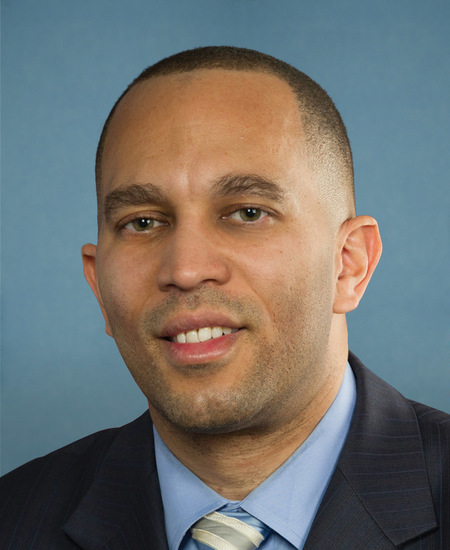
Rep. Hakeem S. Jeffries
Sponsored bills
Disarm Hate Act The bill expands the categories of persons who are prohibited from receiving or possessing a firearm. Specifically, it prohibits firearm sale or transfer to and receipt, possession, shipment, or transport by a person (1) who has been convicted of a misdemeanor hate crime, or (2) who has received an enhanced hate crime misdemeanor sentence.
COVID-19 Safer Detention Act of 2021 This bill expands statutory authority for federal prisoners to be released before completing their sentences or to be placed in the community to serve the final portion of their sentences. First, the bill makes changes to the early release pilot program. The early release pilot program authorizes the Bureau of Prisons to release early and place on home confinement elderly offenders and terminally ill offenders who meet eligibility criteria. This bill expands eligibility to offenders serving time for an offense under the laws of the District of Columbia, expands eligibility to offenders who have served at least one-half (currently, two-thirds) of their prison term, reduces the amount of time an offender must serve by the good time credits earned by the offender, and creates a judicial review process for prisoners and shortens the waiting period for judicial review during the COVID-19 pandemic. Second, the bill modifies the compassionate release process. The compassionate release process authorizes federal courts to reduce a prisoner's sentence and impose a term of probation or supervised released in certain circumstances. This bill expands eligibility to prisoners sentenced before November 1, 1987, specifies that vulnerability to COVID-19 is a basis for compassionate release, and shortens the waiting period for judicial review during the COVID-19 pandemic.
Keeping Our Promise Act This bill authorizes issuing visas to certain individuals who were previously refused a diversity immigrant visa or admission into the United States because of certain executive orders or the COVID-19 public health emergency. (Diversity immigrant visas are available to eligible immigrants from countries with relatively low rates of immigration to the United States.) Specifically, this bill applies to individuals who were refused such a visa solely due to certain executive orders from 2017 to 2020, including orders which suspended the entry of individuals from certain countries. The bill also applies to diversity visa applicants who, because of the COVID-19 emergency, were (1) unable to receive a visa interview despite requesting one, or (2) unable to be admitted into the United States despite being approved for a visa. The Department of State must notify each individual covered under this bill of the individual's visa eligibility. To retain eligibility, an individual must respond to the State Department's notice within one year of the notice. An individual may also lose eligibility if the State Department determines that the applicant fails to meet certain requirements. The bill also relaxes certain annual numerical limits for individuals obtaining a visa under this bill. An individual who was a child when initially selected for a visa shall be treated as a child for the purposes of a visa application under this bill.
First Step Implementation Act of 2021 This bill makes various changes related to federal sentencing law and requires the Department of Justice (DOJ) to establish procedures to ensure the prompt release and accuracy of employment-related background check records. The bill allows certain reduced mandatory minimum sentences for drug offenses to be applied retroactively to offenders who committed their offenses on or before December 21, 2018; permits a court, in certain circumstances, to grant safety valve relief (i.e., impose a sentence without regard to the statutory mandatory minimum penalty for certain drug offenses) for an otherwise eligible defendant who does not meet the requirement pertaining to criminal history; permits a court to reduce a sentence imposed on a defendant convicted as an adult for an offense committed as a juvenile if the defendant has served at least 20 years of the sentence; establishes a process to seal and expunge certain records of juvenile nonviolent offenses; and requires DOJ to establish and enforce procedures to ensure that records exchanged for employment-related background checks are promptly released and accurate.
Extreme Risk Protection Order Act of 2021 This bill establishes grants to support the implementation of extreme risk protection order laws at the state and local levels, extends federal firearms restrictions to individuals who are subject to extreme risk protection orders, and expands related data collection. Extreme risk protection order laws, or red flag laws, generally allow certain individuals (e.g., law enforcement officers or family members) to petition a court for a temporary order that prohibits an at-risk individual from purchasing and possessing firearms. Among its provisions, the bill directs the Office of Community Oriented Policing Services within the Department of Justice to establish a grant program to help states, local governments, Indian tribes, and other entities implement extreme risk protection order laws; extends federal restrictions on the receipt, possession, shipment, and transportation of firearms and ammunition to individuals who are subject to extreme risk protection orders; and requires the Federal Bureau of Investigation to compile (and later destroy) records from federal, tribal, and state courts and other agencies that identify individuals who are subject to extreme risk protection orders.
Major Richard Star Act This bill provides that combat-disabled uniformed services retirees with fewer than 20 years of creditable service may concurrently receive, without reduction, veterans' disability compensation and retired pay or combat-related special compensation.
Merger Filing Fee Modernization Act of 202 2 This bill modifies and expands the schedule for graduated merger filing fees and requires that such fees be adjusted each year based on the Consumer Price Index. It also (1) requires parties to disclose in their premerger notification filings any subsidy received from a foreign entity of concern, (2) modifies the venue rules for multi-district antitrust litigation, and (3) establishes various reporting requirements.
This bill designates the facility of the United States Postal Service located at 39 West Main Street, in Honeoye Falls, New York, as the CW4 Christian J. Koch Memorial Post Office.
This bill designates the facility of the United States Postal Service located at 170 Manhattan Avenue in Buffalo, New York, as the Indiana Hunt-Martin Post Office Building.