

Global Amphibian Protection Act of 2021 This bill establishes a Highly Endangered Amphibian Species Conservation Fund and requires the Department of the Interior to use the fund to carry out a grant program for the conservation of highly endangered amphibian species. Highly endangered amphibian species means any amphibian species categorized on the International Union for Conservation of Nature (IUCN) Red List of Threatened Species as endangered, critically endangered, or extinct in the wild. The term also means any other amphibian species categorized on such list as data deficient or under a threat category lower than endangered if Interior determines that (1) the most recent IUCN Red List assessment indicates that the population is decreasing, or (2) such species is facing new or emerging threats. The bill establishes the fund as a separate account in the Multinational Species Conservation Fund.
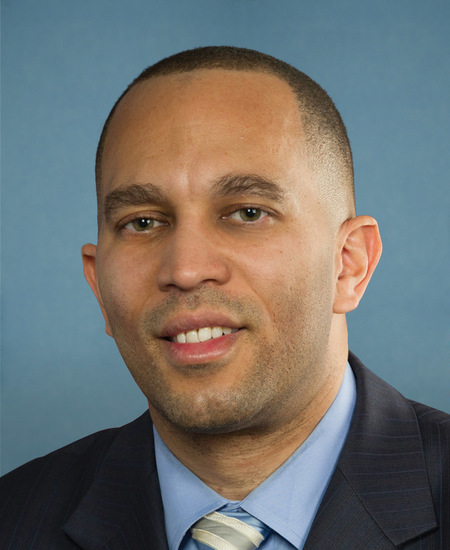
Rep. Hakeem S. Jeffries
Sponsored bills
Maddy summaryHRES 1471 is a procedural resolution that elects Congresswoman Sheila Cherfilus-McCormick to the House Committee on Foreign Affairs, placing her in the committee's ranking immediately after Congresswoman Manning. This resolution adjusts committee membership rankings without altering the committee's duties, responsibilities, or creating new policy. It serves as a routine administrative step to formalize a member's position on a standing committee.
Prevent All Soring Tactics Act of 2022 or the PAST Act of 2022 This bill addresses the practice of soring horses. The soring of horses includes various actions taken on horses' limbs to produce higher gaits that may cause pain, distress, inflammation, or lameness. Specifically, the bill expands soring regulation and enforcement at horse shows, exhibitions, sales, and auctions, including by establishing a new system for inspecting horses for soring. In addition, the bill increases penalties for violations.
Maddy summaryHJRES 53 proposes a constitutional amendment to ban slavery and involuntary servitude as a criminal punishment. Currently, the 13th Amendment to the U.S. Constitution permits such punishments for crimes, creating a legal loophole. If ratified by 3/4 of state legislatures, this amendment would eliminate that exception nationwide, making it unconstitutional to impose forced labor or slavery as part of criminal sentences. The change would directly affect all states' criminal justice systems, particularly prison labor practices, by prohibiting these punishments for any offense.
Competitive Prices Act This bill makes a consciously parallel pricing coordination (i.e., a tacit agreement among two or more persons to raise, lower, change, maintain, or manipulate pricing for the purchase or sale of reasonably interchangeable products or services) a prohibited form of price fixing.
Afghan Adjustment Act This bill expands eligibility for special immigrant visas to certain Afghan nationals (and accompanying spouse and children) and addresses related issues. The Department of Homeland Security may provide such visas to Afghan nationals who provided qualifying service as a member of the Afghan Air Force or other specified entities and meet eligibility requirements, such as passing a background check. Currently, special immigrant visas for Afghan nationals are generally only available to those who were employed by or on behalf of the U.S. government in Afghanistan. Such visas shall also be available to an Afghan national who is a qualifying relative of a veteran or member of the U.S. Armed Forces. The bill also modifies procedures for providing lawful permanent resident status to certain classes of Afghan nationals, such as by (1) providing a streamlined process with specified vetting requirements for certain individuals, including those who provided support to the U.S. government in Afghanistan; and (2) preserving the eligibility of certain battered spouses whose eligibility for such status stemmed from a marriage that has terminated. Furthermore, the Department of State (1) must respond to inquiries from Members of Congress about specific applications from Afghan nationals seeking special immigrant or refugee status; and (2) establish an office in Afghanistan to perform certain tasks, such as issuing visas, if no U.S. embassies are operational in Afghanistan. The President must establish a task force to develop and implement a strategy to assist Afghan nationals who qualify for admission to the United States.
Trafficking Survivors Relief Act of 2022 This bill establishes a process to vacate convictions and expunge arrest records for certain criminal offenses committed by victims of human trafficking that directly result from or relate to having been a trafficking victim. It defines the offenses eligible to be vacated or expunged and sets forth procedures for filing a motion. The bill directs the Government Accountability Office to assess the impact of this process, including the number of human trafficking survivors who file motions to vacate convictions or expunge records. The bill permits certain grants for legal representation to be used to seek post-conviction relief. Finally, the bill establishes a rebuttable presumption that certain offenses were induced by duress if the defendant establishes by clear and convincing evidence that he or she was a victim of human trafficking at the time of the offense.
Restoring Artistic Protection Act of 2022 This bill limits the admissibility of evidence of a defendant's creative or artistic expression against the defendant in a federal criminal case. The term creative or artistic expression means the expression or application of creativity or imagination in the production or arrangement of forms, sounds, words, movements, or symbols, including music, dance, performance art, visual art, poetry, literature, film, and other such objects or media.
Renewing Immigration Provisions of the Immigration Act of 1929 This bill expands eligibility for a program that authorizes the Department of Homeland Security to, at its discretion, provide lawful permanent resident status to certain long-term residents of the United States, including individuals who are unlawfully present. Currently, this program, sometimes referred to as the Registry program, is only available to eligible non-U.S. nationals ( aliens under federal law) who entered the United States before January 1, 1972. The bill removes this entry cutoff date and opens up the program to eligible individuals who have resided in the United States for at least seven years. Existing requirements (e.g., the individual must not be inadmissible or deportable due to certain grounds related to crime or terrorism) continue to apply.
Right to Trial Act This bill addresses the constitutional right to a jury trial, including by (1) outlining additional factors that a court shall consider when imposing a sentence, and (2) authorizing a court to impose a sentence below the mandatory minimum.