

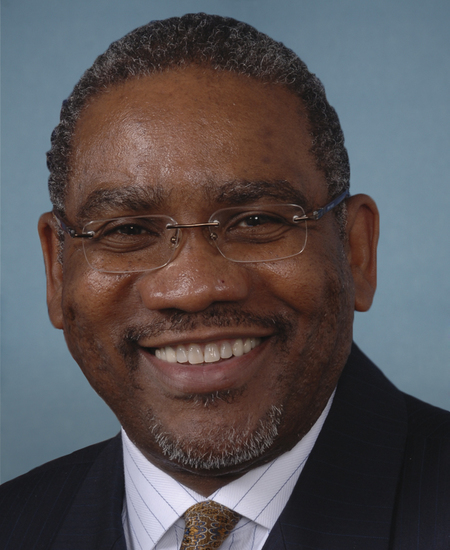
Photo of Gregory W. Meeks
D United States House · District 5 · New York On the 2026 ballot

Rep. Gregory W. Meeks

Compare
Total votes
2,837
all sessions
Attendance
98%
69 missed
Near the chamber average
With party
98%
of cast votes
Higher than 81% of chamber peers
Bipartisan score
1%
crosses aisle rarely
Lower than 81% of chamber peers
Sponsored
1,055
bills & resolutions
Near the chamber average
Committees
4
assignments
1,055 bills and resolutions

Sponsored bills

Total
1,055
Primary
96
Co-sponsor
959
This page
1,055
matching current filters
Co-sponsor HR 2656
In committee · United States House · Co-sponsor
To amend title 31, United States Code, to provide for the issuance of Green Bonds and to establish the United States Green Bank, and for other purposes.

This bill establishes a U.S. Green Bank to finance climate change mitigation and adaptation projects at the state and local level by capitalizing regional, state, and municipal green banks. The Department of the Treasury must issue green bonds to provide the bank with (1) an initial capitalization of $10 billion; and (2) additional capitalization, upon the bank's request, of no more than $50 billion in aggregate at any one time. The bill also establishes in the Treasury a revolving Green Bank Establishment Fund.

In committee Apr 20, 2021 1 co-sponsor
Co-sponsor HR 1996
Passed · United States House · Co-sponsor
SAFE Banking Act of 2021

Secure and Fair Enforcement Banking Act of 2021 or the SAFE Banking Act of 2021 This bill generally prohibits a federal banking regulator from penalizing a depository institution for providing banking services to a legitimate cannabis-related business. Prohibited penalties include terminating or limiting the deposit insurance or share insurance of a depository institution solely because the institution provides financial services to a legitimate cannabis-related business and prohibiting or otherwise discouraging a depository institution from offering financial services to such a business. Additionally, proceeds from a transaction involving activities of a legitimate cannabis-related business are not considered proceeds from unlawful activity. Proceeds from unlawful activity are subject to anti-money laundering laws. Furthermore, a depository institution is not, under federal law, liable or subject to asset forfeiture for providing a loan or other financial services to a legitimate cannabis-related business. The bill also provides that a federal banking agency may not request or order a depository institution to terminate a customer account unless (1) the agency has a valid reason for doing so, and (2) that reason is not based solely on reputation risk. Valid reasons for terminating an account include threats to national security and involvement in terrorist financing, including state sponsorship of terrorism. Finally, the bill decreases the cap on the surplus funds of the Federal Reserve banks. (Amounts exceeding this cap are deposited in the general fund of the Treasury.)

Passed Apr 20, 2021 1 co-sponsor
Primary HRES 130
Passed · United States House · Lead sponsor
Condemning the continued violation of rights and freedoms of the people of Hong Kong by the People’s Republic of China and the Government of the Hong Kong Special Administrative Region.

This resolution condemns the actions taken by the governments of China and Hong Kong to put in place national security legislation that violates the freedoms and rights guaranteed to the people of Hong Kong. (Hong Kong is a part of China but, by agreement, has operated a legal and economic system largely separate from China's.)

Passed Apr 19, 2021 0 co-sponsors
Primary HR 2628
In committee · United States House · Lead sponsor
Debt Collection Practices Harmonization Act

Debt Collection Practices Harmonization Act This bill applies certain consumer protections regarding debt collection to debt owed to a state. It also specifies that existing limits on civil damages awarded for abusive practices by a debt collector must be adjusted for inflation. A court may award injunctive relief for certain debt collection violations. The Department of the Treasury may not contract with any debt collector or other private party to recoup overpayments of certain disaster assistance made to an individual or household by the Federal Emergency Management Agency (FEMA), except in cases of fraud or deceit.

In committee Apr 16, 2021 0 co-sponsors
Co-sponsor HR 2599
In committee · United States House · Co-sponsor
Sandy Duplication of Benefits Fairness Act

Sandy Duplication of Benefits Fairness Act This bill expands the applicability of the waiver of the prohibition against duplication of benefits for disaster relief recipients following Superstorm Sandy. Under current law, the waiver period extends from January 1, 2016, through December 31, 2021. This bill begins that period on October 1, 2012, through December 31, 2021. This change would permit individuals who suffered losses resulting from Superstorm Sandy and who initially applied for and received federal benefits, including Small Business Administration disaster relief loans, to receive additional federal benefits, including funds under the Department of Housing and Urban Development Block Grant for Disaster Relief (CDBG-DR), without having to repay such additional benefits.

In committee Apr 16, 2021 1 co-sponsor
Co-sponsor HR 2573
In committee · United States House · Co-sponsor
Affordable Housing Credit Improvement Act of 2021

Affordable Housing Credit Improvement Act of 2021 This bill revises provisions of the low-income housing tax credit and renames it as the affordable housing credit . The bill increases the per capita dollar amount of the credit and its minimum ceiling amount beginning in 2021 and extends the inflation adjustment for such amounts. The bill modifies tenant income eligibility requirements and the average income formula for determining such income. It also revises rules for student occupancy of rental units and tenant voucher payments, and prohibits any refusal to rent to victims of domestic abuse. The bill further modifies the credit to increase state allocations of the credit; repeal the qualified census tract population cap; prohibit local approval and contribution requirements; increase the credit for certain projects designated to serve extremely low-income households; increase the credit for certain bond-financed projects designated by state agencies; eliminate the basis reduction for properties that receive certain energy-related tax benefits; and increase the population cap for difficult development areas (i.e., areas with high construction, land, and utility costs relative to area median gross income). The bill also includes Indian and rural areas as difficult development areas and modifies other requirements relating to casualty losses, acquisition credits, and foreclosures.

In committee Apr 15, 2021 1 co-sponsor
Co-sponsor HR 40
In committee · United States House · Co-sponsor
Commission to Study and Develop Reparation Proposals for African Americans Act

Commission to Study and Develop Reparation Proposals for African Americans Act This bill establishes the Commission to Study and Develop Reparation Proposals for African Americans. The commission shall examine slavery and discrimination in the colonies and the United States from 1619 to the present and recommend appropriate remedies. The commission shall identify (1) the role of the federal and state governments in supporting the institution of slavery, (2) forms of discrimination in the public and private sectors against freed slaves and their descendants, and (3) lingering negative effects of slavery on living African Americans and society.

In committee Apr 14, 2021 1 co-sponsor
Co-sponsor HR 2465
In committee · United States House · Co-sponsor
Healthy Families Act

Healthy Families Act This bill provides for paid and unpaid sick leave for employees to meet their own medical needs and those of their families. It requires employers with 15 or more employees to provide their employees with at least one hour of earned paid sick leave for every 30 hours worked, up to a maximum of 56 hours of paid sick leave in a year. An employer with fewer than 15 employees may also provide the same amount of paid sick leave, but may opt out of such requirement, in which case such employer must provide its employees at least 56 hours of unpaid leave in a year. An employee may use sick leave for absences (1) resulting from a physical or mental illness, injury or medical condition; (2) resulting from obtaining professional medical diagnosis or care, or preventive medical care; (3) to care for a child, parent, spouse, a domestic partner, or other blood or close relative; and (4) resulting from domestic violence, sexual assault, or stalking. The bill makes it unlawful for any employer to interfere with, restrain, or deny the exercise of an employee's right to accrue sick leave as provided by this bill. An employee may take legal action to enforce the right to sick leave granted by this bill and the Department of Labor must investigate complaints of violations of the requirements of this bill. Labor is authorized to conduct a public awareness campaign to educate and inform the public of the requirements for paid sick leave provided by this bill.

In committee Apr 13, 2021 1 co-sponsor
Co-sponsor HR 1442
In committee · United States House · Co-sponsor
PREPARED Act

Providing Responsible Emergency Plans for Animals at Risk of E merging Disasters Act or the PREPARED Act This bill establishes requirements governing the care of animals by entities, such as zoos, in emergencies or disasters. Specifically, the bill requires each research facility, dealer, exhibitor, intermediate handler, and carrier to develop and follow a contingency plan to provide for the humane handling, treatment, transportation, housing, and care of their animals in the event of an emergency or disaster.

In committee Apr 8, 2021 1 co-sponsor
Showing 921 to 930 of 1,055 bills
Previous 1 … 92 93 94 … 106 Next