

Maddy summaryHR 6055, the Schools Want Accountability for Threats Act (SWAT Act), increases penalties for threats targeting schools. It amends federal laws to add specific provisions making it a crime to threaten or spread false information about public, private, or religious schools offering early childhood through career education (as defined by state law), with penalties of up to 20 years in prison or fines. The bill applies to threats involving fire/explosives (18 U.S.C. §844), mail/interstate communications (§§875, 876), and false information (§1038). This creates a clear federal criminal penalty for individuals making such threats against qualifying schools, without changing existing school safety protocols.
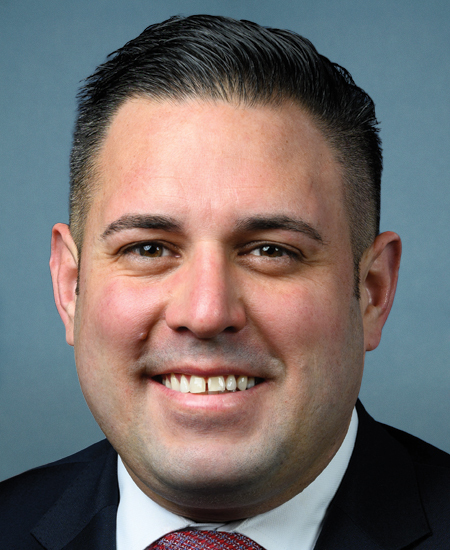
Rep. Anthony D’Esposito
Sponsored bills
Maddy summaryThis bill removes a previous exclusion that prevented temporary federal employees (including U.S. Postal Service staff and Members of Congress) from counting service after January 1, 1988, toward their retirement benefits. It allows these workers to have their post-1988 temporary service counted toward retirement eligibility if they pay a deposit to the retirement system. The change applies to anyone employed by the federal government on or after the bill's enactment date. The Office of Personnel Management must notify affected employees and create rules to implement this change.
Keeping Drugs Out of Schools Act of 2023 This bill allows the Office of National Drug Control Policy to award grants for eligible entities to implement school-community partnerships for preventing and reducing substance use and misuse among youth. Eligible entity refers to a coalition that (1) is a Drug-Free Communities funded coalition on or before the date on which the coalition submits a grant application, and (2) has a memorandum of understanding in effect with not less than one local school to establish a school-community partnership.
Maddy summaryHR 5954 designates the Finger Lakes region in 14 New York counties (Cayuga, Chemung, Cortland, Livingston, Monroe, Onondaga, Ontario, Schuyler, Seneca, Steuben, Tioga, Tompkins, Wayne, and Yates) as a National Heritage Area. It establishes the Finger Lakes Tourism Alliance as the local managing entity and requires a management plan for the area within three years. Federal funding for the area would end 15 years after the bill's enactment, as specified in the National Heritage Area System.
'Operation Swords of Iron' Iron Dome Supplemental Appropriations Act This bill provides $2 billion in appropriations for the Department of Defense to provide to the government of Israel for the procurement of the Iron Dome defense system to counter short-range rocket threats. The funds must be provided to address emergent requirements in support of Operation Swords of Iron.
Maddy summaryThis bill ensures Coast Guard personnel continue receiving pay during budget gaps specific to the Coast Guard. It mandates automatic funding for military members (including reserves), qualified civilian employees, and contract workers providing essential support during a "Coast Guard-specific funding lapse" - defined as when no Coast Guard funding bill passes before the fiscal year begins. The bill covers pay and benefits for these groups until a formal funding bill is enacted or a budget resolution without Coast Guard funding passes. It does not apply to general government shutdowns but targets only Coast Guard operations. The measure aims to prevent disruptions to critical Coast Guard missions during funding delays.
Maddy summaryHR 5653, the "No Budget, No Pay Act," requires Congress to pass a budget plan by April 15 and all annual funding bills by September 30 each year, or members lose pay for the period starting the day after each deadline until the bills are approved. It directly affects all voting Members of Congress (including delegates) during the specified penalty periods, excluding the Vice President. The bill imposes a financial consequence for missing these budget deadlines, aiming to incentivize timely fiscal planning by withholding compensation for the duration of the delay. This is a procedural mechanism focused on budget process deadlines, not on substantive policy changes.
Maddy summaryThis resolution designates the week of September 25-29, 2023, as "National Clean Energy Week" to recognize the growing role of clean energy in the U.S. economy. It expresses support for clean energy jobs and innovation, noting the sector employed about 8.1 million people in 2022. The resolution encourages federal, state, and local investment in affordable clean energy technologies and promotes "commonsense solutions" for energy needs. As a symbolic gesture, it has no legal force or funding implications - it simply urges recognition of clean energy's economic and environmental contributions.
Maddy summaryHR 5838, the SAFER Act, changes how asylum claims are assessed for migrants apprehended at the U.S. border during large-scale migration events. It revises the "credible fear" interview standard to require officers to determine if an asylum seeker is "more likely than not" eligible for asylum and if their claims are "more likely than not" true. The bill also mandates prioritizing removal cases for these migrants, requires scheduling hearings to allow fair access to legal counsel, and directs the hiring of at least 150 additional immigration judges to speed up court processing. It includes reporting requirements on processing times, legal representation rates, and in-absentia removal orders for migrants in these prioritized cases.
Maddy summaryHJRES 11 proposes a constitutional amendment that would limit Members of Congress to serving a maximum of three terms in the House of Representatives and two terms in the Senate. If passed and ratified, it would prevent any member who has already served the maximum terms from running for re-election, including time spent filling vacancies (for more than one year in the House or three years in the Senate). This amendment directly affects current and future members of Congress by changing eligibility rules for re-election. The proposal is currently a joint resolution in the House, requiring ratification by three-fourths of state legislatures to become part of the Constitution.