

Maddy summaryThe QUIET Act requires businesses and organizations to disclose at the start of any robocall or text message that uses artificial intelligence to mimic a human voice or writing. This applies to automated communications generated by AI, excluding calls or texts requiring substantial human involvement. The bill also doubles the maximum civil and criminal penalties for violations where AI impersonation is used to defraud, cause harm, or obtain property. It directly affects entities that send AI-powered automated calls or texts to consumers.
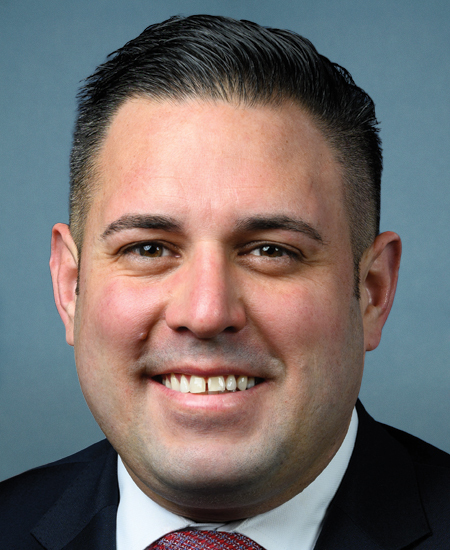
Rep. Anthony D’Esposito
Sponsored bills
Maddy summaryThis bill amends the McKinney-Vento Homeless Assistance Act to integrate behavioral health, mental health, and substance use disorder treatment into housing support for homeless individuals. It requires housing programs receiving federal funds to partner with nearby Certified Community Behavioral Health Clinics for eligible participants, defined as those in supportive housing, receiving Supplemental Security Income (SSI), Social Security Disability Insurance (SSDI), or classified as homeless with a disability. The bill sets aside 2% of annual funding for this integration and provides incentives of up to $500,000 per 1,000 homeless individuals in high-need areas, capped at $2 million per project. It also mandates annual reports on implementation progress to Congress.
Maddy summaryHR 7202 requires the U.S. Secretary of State to report to Congress within 90 days on all U.S. funding provided to UNRWA (the UN agency supporting Palestinian refugees) from fiscal years 2020 through 2024, including monthly spending details. The bill also prohibits U.S. federal funds from being used to support UNRWA, either directly or indirectly, starting upon its enactment. This bill affects U.S. government funding decisions for UNRWA and mandates transparency about past financial support. The legislation focuses on requiring a spending report and blocking future U.S. financial assistance to the agency.
Maddy summaryHR 7185 reauthorizes the High Intensity Drug Trafficking Areas (HIDTA) program through 2030, with specific focus on fentanyl. It allocates $302 million annually for HIDTA operations and adds $14.2 million yearly for grants to enhance fentanyl seizure efforts through competitive grants. The bill requires annual reports detailing fentanyl seizures and trafficking data, and directs the Attorney General to assign at least 16 assistant U.S. attorneys to prioritize fentanyl trafficking cases. This directly affects federal drug task forces, law enforcement agencies, and prosecutors working on fentanyl-related investigations.
Maddy summaryHR 5585, the Agent Raul Gonzalez Officer Safety Act, creates new criminal penalties for individuals fleeing U.S. Border Patrol officers or assisting officers while operating a motor vehicle within 100 miles of the U.S. border. It imposes prison terms of up to 2 years for basic offenses, 5-20 years if serious injury occurs, and 10 years to life if death results. People unlawfully in the U.S. who commit this offense become permanently ineligible for any legal status, including asylum. The bill also requires the Attorney General to submit annual reports to Congress on prosecutions and penalties related to this new offense.
Maddy summaryThis House resolution (HRES 986) condemns New York Governor Hochul's 2025 budget proposal, which the resolution claims reduces school funding for hundreds of schools while allocating billions for migrant services like housing, health care, and transportation. The resolution has no legal effect and serves only as a symbolic statement by House members urging the governor to reverse the budget changes. It does not alter funding or policy but expresses disapproval of the budget's priorities as described in the resolution.
Maddy summaryThis ceremonial resolution (HRES 985) expresses the U.S. House of Representatives' support for Catholic schools during the 50th anniversary of National Catholic Schools Week. It acknowledges Catholic schools' contributions to education, diversity, and community values - highlighting their 1.7 million students, 98.9% high school graduation rate, and role in serving diverse communities - while applauding the National Catholic Educational Association and the United States Conference of Catholic Bishops for organizing the event. The resolution has no binding effect or policy changes; it solely serves as a symbolic gesture of recognition.
Maddy summaryHRES 978 is a non-binding resolution encouraging all U.S. schools (K-12 and colleges) to integrate digital literacy education with age-appropriate lessons on Holocaust history, World War II, and antisemitism. It specifically urges schools to teach Jewish identity, primary-source-based Holocaust history (including antisemitism's historical roots), and critical thinking skills for navigating digital information. The resolution also recommends federal funding for teacher training to support these educational efforts. While not requiring legal changes, it aims to promote historical understanding and digital literacy as tools for preventing hatred and fostering inclusive citizenship. Introduced January 25, 2024, by Representatives Khanna and Fitzpatrick.
Maddy summaryHR 7083, the RAZOR Act, prohibits federal agencies from removing or altering barriers (like fences or fences) built by states along the U.S. border to prevent unlawful crossings. It directly affects federal departments and agencies, such as the Department of Homeland Security, by restricting their ability to modify state-constructed border infrastructure. The key provision is a clear ban on any federal action that would change or remove these state-built barriers. This bill makes a specific policy change regarding federal-state border infrastructure authority without altering broader immigration law.
Maddy summaryHR 7056, the Access to Family Building Act, establishes federal rights for individuals to access assisted reproductive technology (ART) like IVF without unreasonable restrictions, directly affecting patients seeking fertility treatments and health care providers offering ART services. The bill prohibits states from imposing limitations on ART that are more burdensome than those for comparable medical procedures, fail to advance safety, or unduly restrict access, while allowing health and safety regulations that are necessary and least restrictive. It creates federal enforcement mechanisms, including lawsuits by the Attorney General or affected individuals to challenge violating state laws, and preempts conflicting state regulations. The bill explicitly preserves state authority over health/safety regulations and does not alter existing state insurance coverage laws for ART.