

Maddy summaryHR 8005, the Child Exploitation and Artificial Intelligence Expert Commission Act of 2024, establishes a 13-member commission to investigate how artificial intelligence is used in child exploitation crimes and recommend solutions to improve law enforcement's ability to prevent, detect, and prosecute such crimes. The commission, appointed by congressional leaders with expertise in law enforcement, AI, or child welfare, must submit a final report to Congress within two years detailing findings and recommendations for legal or technical improvements. This bill does not create new laws but focuses on identifying legal barriers and developing actionable solutions for law enforcement agencies. The commission will operate independently without federal government employees serving as members.
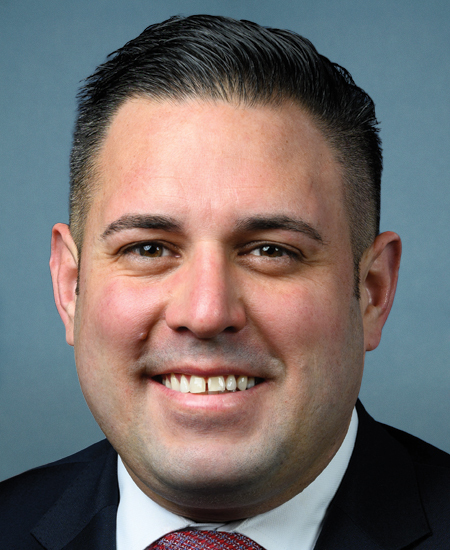
Rep. Anthony D’Esposito
Sponsored bills
Maddy summaryHR 8011, the Iranian Terror Prevention Act, requires the U.S. Secretary of State to designate 12 Iranian-affiliated military groups and any entity controlled by Iran's Revolutionary Guard Corps as Foreign Terrorist Organizations within 90 days. It mandates the President to decide within 60 days whether to impose sanctions under existing law (Executive Order 13224) on these groups, which would block their U.S. assets and restrict transactions. The bill also requires the Secretary of State to submit regular reports to Congress on new entities meeting designation criteria and the President to explain any decisions not to impose sanctions. This law directly affects the listed Iranian military groups and any new entities linked to Iran's Revolutionary Guard Corps.
Maddy summaryHRES 1138, titled "Upholding the Integrity of Our Institution Resolution," amends House rules to deny specific privileges to former members, delegates, or resident commissioners expelled from the House. The bill prohibits expelled individuals from accessing the House floor, dining facilities, parking, document room, Legislative Resource Center, franking privileges, and other House services. It also requires expelled members to surrender their Member pins and removes all benefits previously available to them. This change directly affects any former House member who has been formally expelled, altering their post-expulsion access to House resources.
Maddy summaryHRES 1139 is a non-binding House resolution that formally acknowledges April 17, 2024, as the 500th anniversary of Giovanni da Verrazzano’s 1524 discovery of New York Bay. It recognizes Verrazzano’s role as the first European to map the East Coast of North America, which contributed to the later establishment of New York City and its development as a major economic hub. The resolution highlights historical connections, including Verrazzano’s influence on New York Bay’s exploration and existing commemorations like the Verrazzano-Narrows Bridge. It does not create new laws, allocate funds, or affect any specific group or policy. This is purely a ceremonial acknowledgment by the U.S. House of Representatives.
Maddy summaryThis resolution (HRES 1117) is a formal statement by the U.S. House of Representatives opposing efforts to pressure Israel regarding Gaza. It specifically criticizes calls for an immediate ceasefire, including President Biden's April 4, 2024, statement and UN Security Council Resolution 2728, which the resolution claims was adopted due to the U.S. not vetoing it. The resolution affirms Israel’s right to self-defense following the October 7 Hamas attacks and emphasizes the U.S.-Israel relationship as a major strategic partnership. As a non-binding resolution, it does not change laws or policies but expresses the House’s position on diplomatic pressure related to Gaza.
Maddy summaryThis bill bans airlines from transporting non-citizens using three specific documents: the CBP One mobile app, DHS Form I-385 (Notice to Report), and DHS Form I-862 (Notice to Appear). It also prohibits the Department of Homeland Security from accepting these documents as valid ID for domestic air travel. The law directly affects airlines that might facilitate travel for individuals relying on these documents and travelers using them for flight boarding. Key provisions explicitly list the banned documents in federal law, removing them as acceptable identification for air travel under U.S. Code.
Maddy summaryThis bill requires U.S. federal agencies and courts to use the International Holocaust Remembrance Alliance (IHRA) definition of antisemitism in specific contexts. It mandates that federal departments include this definition in anti-discrimination training (Section 3), directs courts to provide it in jury instructions for cases involving antisemitism (Section 4), and requires agencies to consider antisemitism as a motivating factor in civil rights investigations involving Jewish identity (Section 5). The law applies to existing civil rights enforcement under laws like the Civil Rights Act of 1964 and the Voting Rights Act. It does not create new penalties or alter existing protections but standardizes how antisemitism is recognized in federal processes.
Maddy summaryHR 7959, the SHIELD Act, adds trespass convictions to grounds for denying immigration entry or ordering deportation. It directly affects immigrants convicted of trespass under any state, local, tribal, or federal law, regardless of whether the trespass is classified as a misdemeanor or felony. The bill amends existing immigration law to make anyone convicted of trespass (or who admits to acts constituting trespass) inadmissible upon entry or deportable after entry. These provisions apply based on the jurisdiction where the trespass occurred, without considering the offense's classification under local law.
Maddy summaryHR 7921, the Countering Antisemitism Act, establishes a National Coordinator to Counter Antisemitism within the Executive Office of the President and creates an Interagency Task Force to coordinate federal efforts against antisemitism across multiple agencies. The bill requires federal agencies to report on implementing the U.S. National Strategy to Counter Antisemitism, mandates annual threat assessments of antisemitic violent extremism from the FBI, DHS, and National Counterterrorism Center, and addresses antisemitic discrimination in higher education through a designated Office for Civil Rights Designee. It also includes provisions for a study on Holocaust education by the U.S. Holocaust Memorial Museum, a study on online antisemitism with recommendations for Congress, and amendments to the Nonprofit Security Grant Program to require public reporting on grant applications and awards.
Maddy summaryThis bill establishes a new Transnational Repression Office within Homeland Security Investigations to analyze and monitor threats where foreign governments or their agents target U.S. people through harassment, threats, coercion, or intimidation - such as stalking, surveillance, or efforts to silence dissent. The office must issue annual reports to Congress detailing incidents, perpetrators, and U.S. government responses, while sharing threat information with state and local law enforcement. It directly affects U.S. citizens and residents targeted by foreign actors engaging in transnational repression, including those facing threats to their First Amendment rights or physical safety. The office will operate for 10 years before sunset, with no new funding or personnel required beyond existing DHS resources.