

Maddy summaryHR 277 would require Congress to approve major federal regulations before they take effect. Major rules are defined as those with significant economic impact ($100 million+ annually), major cost increases for consumers or industries, or significant adverse effects on competition, employment, or innovation. Agencies must submit detailed information about these rules to Congress, including cost-benefit analyses, before they can take effect. Congress would have 70 session days to approve the rule with a joint resolution; if they don't act within that timeframe, the rule would not take effect. This would increase congressional oversight of federal regulations and require more detailed information about proposed rules before they become law.
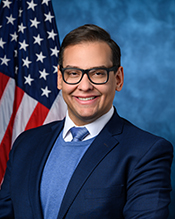
Rep. George Santos
Sponsored bills
Maddy summaryThis bill requires all U.S. flags displayed on federal property or purchased by federal agencies to be 100% made in the United States, meaning all materials and manufacturing must occur domestically. It directly affects federal agencies (including military departments, legislative/judicial branches, and U.S.-owned corporations) and their procurement of flags for display on government property. Key provisions include a 90-day implementation for new flag purchases and a 2-year phase-in for display requirements, with a separate mandate for the FTC to study and report on country-of-origin labeling enforcement for flags within one year. The bill does not apply to private entities or flags displayed off federal property.
This concurrent resolution condemns Cuba and China for discussing and implementing an agreement to build a Chinese intelligence base on the island of Cuba, 90 miles from the United States.
Maddy summaryHCONRES 51 is a non-binding concurrent resolution expressing Congress's opinion that the Chinese Communist Party poses the greatest threat to freedom and the free world. As a symbolic statement, it does not create new laws, alter policies, or directly affect any individuals or entities. The resolution serves solely as a formal expression of congressional sentiment without legal force. It was introduced in the House of Representatives on June 12, 2023, and referred to the Committee on Foreign Affairs.
This concurrent resolution condemns the Chinese Communist Party for the Wuhan lab leak causing the COVID-19 pandemic and the resulting death of over 1,000,000 Americans.
This resolution condemns the Chinese Communist Party (CCP) for knowingly and intentionally manipulating its currency. The resolution also (1) supports the actions by former Treasury Secretary Steven Mnuchin to engage with the International Monetary Fund to eliminate the unfair competitive advantage created by China in 2019, and (2) calls on the Biden administration to take similar action to hold the CCP accountable for their present-day efforts to manipulate their currency.
CCP Wrongful Death Accountability Act of 2023 This bill authorizes certain private lawsuits against the Chinese government for harm resulting from the COVID-19 pandemic. Specifically, the bill authorizes a case to be brought by (1) a U.S. national if their immediate relative died of COVID-19 (i.e., wrongful death), or (2) a U.S. citizen for harm suffered by the citizen. The harms for which a citizen may seek damages include, but are not limited to, expenditures for overtime wages paid to frontline workers, vaccine or medical equipment purchases, and research and development costs. Such a case must be brought in a U.S. district court. If the Chinese government fails to pay a judgment under one of these provisions within one year, the plaintiff may obtain a court order directing the federal government to pay the amount owed. If the federal government is ordered to pay the judgment, the federal government must deduct an equivalent amount from (1) any interest or debt owed by the United States to China, or (2) any amounts made available to provide U.S. assistance to China.
Pre-Pilot Pathway Act This bill directs the Department of Transportation (DOT) to establish an apprenticeship program with flight schools in order to establish a commercial pilot pipeline; DOT must issue any necessary regulations to implement the program within one year of the bill's enactment. Each flight school participating in the program may select up to eight applicants per academic year to serve as apprentices. DOT must take appropriate actions to develop methods to incentivize pilots, including retired pilots, to become flight school instructors. This includes developing pathway programs for pilots to gain initial qualification or concurrent qualification as certified flight instructors.
Maddy summaryHR 4001 prohibits the U.S. government and any person using U.S. government funds from selling arms, cybersecurity services, or military equipment to the People's Republic of China or the Chinese Communist Party. The bill directly affects U.S. agencies, contractors, and businesses that receive federal funding, banning these specific sales as a matter of policy. Key provisions require all such transactions to cease immediately, applying to both direct government contracts and any agreements funded by U.S. government money. This is a clear policy restriction targeting defense-related exports to China, with no exemptions specified in the text.
CCP Virus Reimbursement For States Act of 2023 This bill authorizes states to sue the Chinese government for harm suffered as a result of the COVID-19 pandemic. The bill specifies that the actionable harms for which a state may seek damages include, but are not limited to, expenditures such as overtime wages paid to frontline workers, vaccine or medical equipment purchases, and research and development costs. Such a case must be brought in a U.S. district court. If the Chinese government fails to pay a judgment to a state within one year, the state may obtain a court order directing the federal government to pay the amount owed. If the federal government is ordered to pay the judgment, the federal government must deduct an equivalent amount from (1) any interest or debt owed by the United States to China, or (2) any amounts made available to provide U.S. assistance to China.