

Equal Access to Therapeutics Act This bill prohibits using race or ethnicity as a factor in decisions about an individual's access to COVID-19 treatments (e.g., monoclonal antibody therapies). Specifically, the Department of Health and Human Services (HHS) may not adopt any policy or guidance that allows race or ethnicity to be factored into such decisions. Furthermore, the Secretary of HHS shall be personally liable for the death of any individual who is denied access to COVID-19 treatments pursuant to a prohibited policy or guidance. The bill also prohibits hospitals or other health care providers that have policies restricting access to COVID-19 treatments based on race or ethnicity from receiving federal funds.
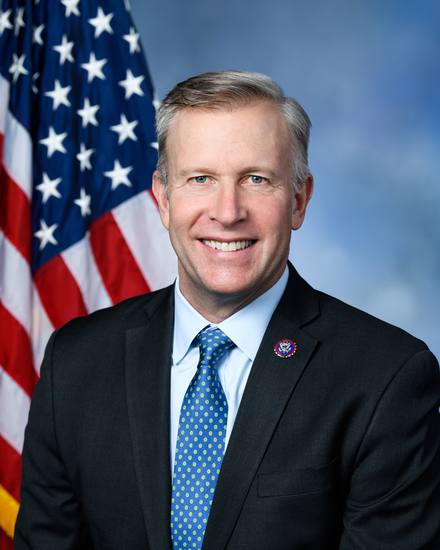
Rep. Chris Jacobs
Sponsored bills
Unmask Our Kids Act This bill prohibits a local educational agency (LEA) from receiving federal funds unless (1) in-person instruction is available to all students at each public elementary and secondary school under the jurisdiction of the LEA, and (2) a parent of a student at any school may opt out of a student face covering requirement.
Kids in Classes Act This bill prohibits a state educational agency from receiving specified federal education funds unless funds are provided directly to a parent or guardian of an eligible child for certain qualified educational expenses (e.g., educational materials, tutoring, or private school tuition). Eligible child refers to a child who attends a public elementary or secondary school and such school (1) receives specified federal education funds; and (2) does not provide, for more than three days during a school year and for reasons related to a public health emergency or collective bargaining action, in-person instruction for all students who wish to attend.
Crime Doesn't Fly Act of 2022 This bill prohibits the use of warrants for the arrest, removal, or deportation of an alien as proof of identity at an airport security checkpoint unless the alien is being removed from the United States pursuant to immigration laws.
Maddy summaryThis resolution (HRES 883) is a symbolic gesture designating January 22 as "National Sanctity of Human Life Day" to recognize the value of human life at all stages. It contains statements opposing abortion and citing fetal development milestones, but the resolution itself has no legal effect or policy changes. It does not alter laws, allocate funding, or directly affect any individuals or groups. The bill solely encourages Americans to reflect on "the value of life" through a non-binding designation. As a procedural resolution, it has no binding provisions or concrete policy impact.
Maddy summaryThis resolution expresses the U.S. House of Representatives' support for designating January 23-29, 2022, as "National School Choice Week." It encourages parents to learn about K-12 education options (including public, charter, private, and online schools) and promotes public awareness of educational choice benefits during that week. The resolution does not create new laws or policies but serves as a symbolic gesture to highlight parental choice in education. It was introduced by multiple representatives and referred to the Education and Labor Committee.
Irresponsible Olympic Collaboration Act or the IOC Act This bill eliminates the tax exemption for any organization or entity whose primary purpose is the promotion of international, multi-sport, athletic competitions, and that has gross receipts in in excess of $100 million for any of the 3 preceding taxable years (e.g., the International Olympic Committee).
SNAP Provisions to Lower Undue Struggle Act of 2021 or the SNAP PLUS Act of 2021 This bill expands the Supplemental Nutrition Assistance Program (SNAP) to permit the use of SNAP benefits to purchase prepared foods fit for immediate consumption and hot foods.
Emergency SNAP Staffing Flexibility Act of 2021 This bill authorizes a state agency to hire contractors to administer parts of the Supplemental Nutrition Assistance Program (SNAP) if the state experiences an increase in SNAP applications or an inability to timely process the applications because of workforce shortages, emergencies, or disasters.
Accelerating Access to Critical Therapies for ALS Act This bill establishes grant programs to address neurodegenerative diseases, such as amyotrophic lateral sclerosis (also known as ALS or Lou Gehrig's disease), and contains other related provisions. The Department of Health and Human Services (HHS) shall award grants to eligible entities for scientific research utilizing data from expanded access to investigational ALS treatments for individuals who are not otherwise eligible for clinical trials. The Food and Drug Administration (FDA) shall award grants to public and private entities to cover the costs of research and development of drugs that diagnose or treat ALS and other rare neurodegenerative diseases. HHS shall also establish the Public-Private Partnership for Neurodegenerative Diseases between the National Institutes of Health, the FDA, and at least one eligible entity (generally, an institution of higher education or a nonprofit organization). The partnership shall support the development and regulatory review of drugs that address ALS and other rare neurodegenerative diseases. The FDA shall publish on its website a five-year action plan for fostering the development of drugs that improve or extend the lives of people living with rare neurodegenerative diseases. The Government Accountability Office must report to Congress about the grants provided under this bill, including an analysis of the impact of such grants on research and development of treatments for ALS.