

Maddy summaryHR 1619 requires schools participating in the National School Lunch Program to provide fluid milk substitutes (like soy or almond milk) upon request by a student or their parent/guardian. The bill removes the previous requirement that substitutions needed a medical authority's written statement for most dietary needs, instead allowing requests based on the student's or parent's request alone. It aligns the definition of acceptable substitutes with current Dietary Guidelines for Americans. This change directly affects students with dietary restrictions, making it simpler for schools to accommodate their needs without extra medical documentation.
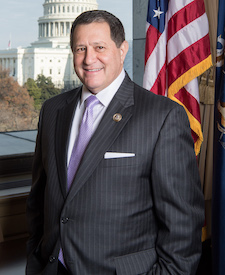
Rep. Joseph D. Morelle
Sponsored bills
Strengthening Medicaid Incentives for Licensees Enrolled in Dental Act or the SMILED Act This bill requires state Medicaid programs to implement certain measures to improve the participation of dentists and the processing of related claims under Medicaid. Specifically, states must assure the Centers for Medicare & Medicaid Services that they will address dentist participation by improving eligibility verification and simplifying participation requirements and claims administration. States must also (1) use an electronic, integrated data collection system to credential participating dentists within 90 days of application receipt; and (2) develop procedures for conducting audits that are consistent with practice standards and that allow for improper claims to be rectified through claims adjustments.
Maddy summaryHR 1595 establishes a federal grant program to help states improve their licensing systems for firearms dealers. It authorizes annual competitive grants (up to $2.5 million per state per year) for states to develop, implement, or evaluate their dealer licensing programs, provided they already meet minimum standards like requiring 3-year licenses, conducting inspections, and imposing penalties for violations. States receiving grants must report annually on inspections, violations, license status, and other metrics, with the Attorney General also submitting annual reports to Congress. This bill directly affects state governments that operate firearms dealer licensing programs, providing funding to strengthen oversight without changing existing state laws.
Maddy summaryThis bill authorizes a Congressional Gold Medal to honor the "Hello Girls" - female telephone operators who served in the Army Signal Corps during World War I. They provided critical battlefield communications in France (connecting 26 million calls), wore military uniforms, and faced combat risks, but were denied veteran benefits for 60 years due to being classified as civilian contractors. The medal recognizes their pioneering service, devotion, and the decades-long struggle to gain military recognition. The award follows similar recognition for other WWII women veterans and aims to correct the historical injustice they faced.
Maddy summaryHRES 197 is a procedural resolution that sets annual funding limits for 20 House committees during the 118th Congress (2023-2025). It specifies exact dollar amounts for each committee's expenses (e.g., $27,696,649 for Energy and Commerce, $29,923,636 for Oversight and Accountability) and divides these into first-session (2023-2024) and second-session (2024-2025) allocations. The resolution also establishes a $4 million reserve fund for unanticipated committee expenses, split between the two sessions. This bill directly affects House committees by authorizing their operational budgets under administrative rules.
Maddy summaryHR 1540 creates a new assistance program to make National Flood Insurance Program (NFIP) premiums more affordable for low-income households and small entities. It provides graduated discounts so eligible policyholders pay no more than 1% of their area median income for flood insurance on primary residences or related personal property. The program, funded by $250 million annually, targets households earning ≤120% of local median income, small businesses (≤100 employees), and nonprofits meeting hardship criteria. FEMA must also implement monthly premium payment options by 180 days after enactment. This directly affects NFIP policyholders in flood-prone areas facing high insurance costs relative to their income.
Maddy summaryThis bill requires Medicaid to cover dental and oral health services for adults beginning in 2025, directly affecting low-income adults enrolled in Medicaid. It defines covered services to include preventive care, restorative treatments, dentures, implants, and emergency dental care. The bill increases federal funding for these services (100% FMAP for a 12-quarter period starting in 2025) and requires states to implement new quality measures tracking oral health outcomes and disparities. It also mandates reports on access barriers and creates outreach programs to improve culturally competent dental care for underserved populations.
Maddy summaryThis bill amends the World Trade Center Health Program to expand eligibility to include certain Department of Defense and Federal agency workers who responded to the September 11 attacks at the Pentagon and Shanksville, Pennsylvania. It establishes a 500-person enrollment cap for these responders, allows a broader range of licensed health care providers to conduct program evaluations, and creates two new funding mechanisms totaling $2.04 billion for the program through 2033. The bill also clarifies enrollment counts by excluding deceased individuals from program statistics and adjusts funding calculations to ensure continued support for affected responders and survivors. These changes directly affect 9/11 responders who worked at the Pentagon and Shanksville sites and their families participating in the health program.
Maddy summaryHR 1328, the Medical Device Nonvisual Accessibility Act of 2023, requires certain home-use medical devices (like blood pressure monitors and sleep apnea machines) to include nonvisual accessibility features - such as voice commands or audio feedback - by 2025. It directly affects blind or low-vision users who rely on these devices for independent, safe, and private care at home. The bill mandates that devices classified as Class II or III (and cleared via FDA processes) must meet accessibility standards ensuring equal usability for blind or low-vision individuals, with limited waivers allowed for manufacturers facing undue hardship. The FDA will develop and enforce these standards within two years, consulting with accessibility experts and blind users.
Maddy summaryThe Paycheck Fairness Act (HR 17) strengthens equal pay protections by amending the Fair Labor Standards Act. It prohibits pay discrimination based on sex, pregnancy, childbirth, sexual orientation, gender identity, and sex characteristics. The bill modifies employer defenses for pay differences to require demonstration that any disparity is job-related, consistent with business necessity, and accounts for the entire pay differential. It also prohibits employers from relying on wage history when making hiring decisions or setting pay, enhances penalties for violations, and requires the EEOC to collect compensation data disaggregated by sex, race, and national origin.