This resolution urges the U.S. Postal Service to take steps to ensure the continuation of its six-day mail delivery service.
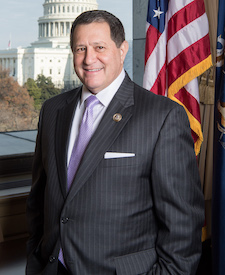
Rep. Joseph D. Morelle
Sponsored bills
This resolution expresses the sense of the House of Representatives that the U.S. Postal Service should restore mail delivery service standards to those of July 1, 2012.
Law Enforcement Officers Equity Act This bill expands the definition of law enforcement officer under provisions of the Federal Employees Retirement System (FERS) and the Civil Service Retirement System (CSRS). Specifically, the bill expands the definition to include (1) federal employees whose duties encompass the investigation or apprehension of suspected or convicted criminals and who are authorized to carry a firearm; (2) Internal Revenue Service employees whose duties are primarily the collection of delinquent taxes and the securing of delinquent returns; (3) U.S. Postal Inspection Service employees; (4) Department of Veterans Affairs police officers; and (5) certain U.S. Customs and Border Protection employees who are seized-property specialists with duties relating to custody, management, and disposition of seized and forfeited property. The bill deems service performed by an incumbent law enforcement officer on or after the enactment date of this bill to be service performed as a law enforcement officer for retirement purposes. The past service of such incumbents shall be treated as service performed by a law enforcement officer for retirement purposes only if a written election is submitted to the Office of Personnel Management within five years after the enactment of this bill or before separation from government service, whichever is earlier. An incumbent who makes an election before the enactment of this bill may pay a deposit into the Civil Service Retirement and Disability Fund to cover prior service. A law enforcement officer shall not be subject to mandatory separation during the three-year period beginning on the enactment of this bill.

"Six Triple Eight" Congressional Gold Medal Act of 2021 This bill directs the Speaker of the House of Representatives and the President pro tempore of the Senate to arrange for the award of a Congressional Gold Medal in honor of the women of the 6888th Central Postal Directory Battalion (commonly known as the Six Triple Eight) in recognition of their pioneering military service, devotion to duty, and contributions to increase the morale of personnel stationed in the European theater of operations during World War II. The medal shall be given to the Smithsonian Institution and made available for display and research.
Moms Matter Act This bill establishes two grant programs to address maternal mental health conditions and substance use disorders, with a focus on racial and ethnic minority groups. First, the Substance Abuse and Mental Health Services Administration must award grants for maternal behavioral health services. Eligible grantees include state, tribal, and local governments; health care providers; and organizations that serve pregnant and postpartum individuals. Second, the Department of Health and Human Services may award grants to grow and diversify the maternal mental and behavioral health workforce by establishing or expanding schools and training programs.
American Family Act of 2021 This bill modifies the child tax credit to (1) make the credit fully refundable, (2) increase the amount of the credit and allow an additional credit for children who are under six years of age, (3) require the amount of the credit to be adjusted annually for inflation, and (4) require the Department of the Treasury to establish a program for making advance payments of the credit on a monthly basis.
High Speed Rail Corridor Development Act of 2021 This bill revises and reauthorizes through FY2025 the high-speed rail corridor development competitive grant program of the Department of Transportation (DOT). In awarding grants, the bill requires DOT to prioritize (1) projects that involve the purchase of electrified next generation passenger rail equipment, and (2) applications for projects that provide for a greater non-federal share of the cost of such projects. DOT must also for each fiscal year set aside 50% of funds for projects with a federal share that does not exceed 50% of the project net capital cost.
This resolution adopts a concurrent resolution (S.Con.Res. 5) that establishes the congressional budget for the federal government for FY2021, sets forth budgetary levels for FY2022-FY2030, and provides reconciliation instructions for legislation that increases the deficit.
This resolution expresses the sense of the House of Representatives that the U.S. Postal Service should continue door delivery for all customers.
Small Business PPE Tax Credit Act This bill allows certain small businesses a tax credit for qualified personal protective equipment expenses, up to $25,000 in a taxable year. The entities eligible for such credit include farms, veterans organizations, and tribal business concerns. The bill defines qualified personal protective equipment expenses to include the cost of equipment for reducing the risk of coronavirus (i.e., the virus that causes COVID-19) transmission, including gloves, medical masks and protective gear, and cleaning supplies.