

Medicare Demonstration of Coverage for Low Vision Devices Act of 2022 This bill requires the Centers for Medicare & Medicaid Services (CMS) to carry out a demonstration project to evaluate the fiscal impact of covering low-vision devices under Medicare in the same manner as Medicare coverage is provided for durable medical equipment. The bill defines low-vision device to mean a physician-prescribed device that magnifies, enhances, or otherwise augments or interprets visual images; the term does not include ordinary eyeglasses or contact lenses. The bill appropriates $2.5 million for FY2022 and each of the next four fiscal years for the CMS to carry out the project.
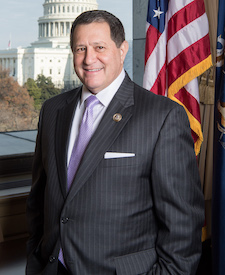
Rep. Joseph D. Morelle
Sponsored bills
Regional Innovation Act of 2021 This bill establishes a Regional Technology and Innovation Hub Program and a Regional Clean Energy Innovation Program. The bill directs the Department of Commerce to establish the Regional Technology and Innovation Hub Program to encourage collaboration among local, state, and federal government entities, institutions of higher education, the private sector, nonprofit organizations, and others to promote inclusive regional innovation initiatives; designate eligible consortia as hubs and facilitate activities by such consortia in implementing their regional innovation strategies; and develop best practices for regional development and competitiveness in technology and innovation. Additionally, the Department of Energy shall establish the Regional Clean Energy Innovation Program to enhance the economic, environmental, and energy security of the United States; accelerate the pace of innovation of clean energy technologies through regional clean energy innovation partnerships; improve the competitiveness of U.S. clean energy technology research, development, demonstration, and commercial application; and support the development of tools and technologies best suited for use in diverse regions of the United States, including in rural, tribal, and low-income communities. Commerce shall carry out a program of data collection and analysis of technology and innovation sectors critical to realizing national objectives, including national security, economic prosperity, and social welfare.
Women's Health Protection Act of 2021 This bill prohibits governmental restrictions on the provision of, and access to, abortion services. Specifically, governments may not limit a provider's ability to prescribe certain drugs, offer abortion services via telemedicine, or immediately provide abortion services when the provider determines a delay risks the patient's health. Furthermore, governments may not require a provider to perform unnecessary medical procedures, provide medically inaccurate information, comply with credentialing or other conditions that do not apply to providers whose services are medically comparable to abortions, or carry out all services connected to an abortion. In addition, governments may not (1) require patients to make medically unnecessary in-person visits before receiving abortion services or disclose their reasons for obtaining such services, or (2) prohibit abortion services before fetal viability or after fetal viability when a provider determines the pregnancy risks the patient's life or health. The bill also prohibits other governmental measures that are similar to the bill's specified restrictions or that otherwise single out and impede access to abortion services, unless a government demonstrates that the measure significantly advances the safety of abortion services or health of patients and cannot be achieved through less restrictive means. The Department of Justice, individuals, or providers may bring a lawsuit to enforce this bill, and states are not immune from suits for violations. The bill applies to restrictions imposed both prior and subsequent to the bill's enactment.
Original Black History Month Resolution of 2022 This resolution recognizes the importance of commemorating Black History Month to acknowledge the achievements of Black Americans throughout history.
Maddy summaryHRES 939 is a symbolic House resolution expressing support for designating February 21-25, 2022, as "Public Schools Week." It does not create new policies, allocate funding, or impose requirements on schools or students. The resolution uses supportive language to acknowledge public education's role in democracy but has no legal effect. It was introduced by multiple representatives as a non-binding gesture of appreciation for public schools.
Small Business Cybersecurity Assistance Pilot Program Act This bill reauthorizes through FY2025 the Cybersecurity Assistance Pilot Program that provides grants to states to assist small businesses in developing their cybersecurity infrastructure.
Congressional Tribute to Constance Baker Motley Act of 2022 This bill provides for the award of a Congressional Gold Medal posthumously to Constance Baker Motley in recognition of her contributions and service to the United States in advancing civil rights as an attorney, elected official, and judge.
Gas Prices Relief Act of 2022 This bill provides for a temporary exemption through 2022 from the excise tax on gasoline (other than aviation gasoline) and from the Leaking Underground Storage Tank Trust Fund financing rate. The Department of the Treasury must transfer from the general fund to the Highway Trust Fund and the Leaking Underground Storage Tank Trust Fund amounts resulting from the exemption provided by this bill. The bill also expresses congressional policy that consumers immediately receive the benefit of this exemption.
Made in America Manufacturing Communities Act of 2022 This bill establishes the Manufacturing Communities Support Program to provide financial and technical assistance to support investments in U.S. manufacturing.
This concurrent resolution directs the Joint Committee on the Library to modify the statue, known as the Portrait Monument, commemorating women's suffrage and located in the rotunda of the U.S. Capitol by placing an inscription on it that is based on its original inscription from when it was delivered to the U.S. Capitol on February 10, 1921. The concurrent resolution also authorizes the use of the rotunda of the U.S. Capitol for a ceremony to unveil the revised Portrait Monument.