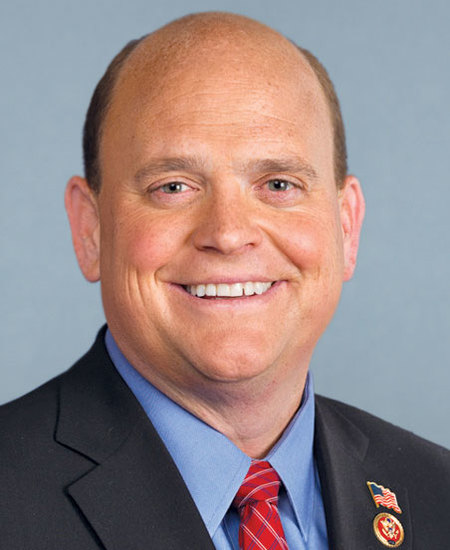
Improving Social Security's Service to Victims of Identity Theft Act This bill requires the Social Security Administration to provide a single point of contact for any individual whose Social Security account number has been misused. The single point of contact must track the individual's case to completion and coordinate with other specialized units to resolve case issues as quickly as possible.
Sponsored bills
Honoring Harriet Tubman Act This bill requires the Joint Committee on the Library to obtain a statue of Harriet Tubman and place the statue in a suitable permanent location in National Statuary Hall.
This bill designates the facility of the United States Postal Service located at 66 Meserole Avenue in Brooklyn, New York, as the Joseph R. Lentol Post Office.
Suspending Normal Trade Relations with Russia and Belarus Act This bill suspends normal trade relations with Russia and Belarus. It also prohibits the importation of energy products from Russia. Specifically, the bill authorizes the President to proclaim increases in the rates of duty applicable to products of Russia or Belarus. This authority terminates on January 1, 2024. The President may restore normal trade relations with Russia and Belarus, subject to congressional disapproval. Additionally, the bill prohibits the importation of Russian products that are classified under chapter 27 of the Harmonized Tariff Schedule (which includes mineral fuels, mineral oils and products of their distillation, bituminous substances, and mineral waxes). The bill directs the U.S. Trade Representative to take certain actions, including to consider steps to suspend Russia's participation in the World Trade Organization and seek to halt the accession process of Belarus.
Ban Russian Energy Imports Act This bill declares that a national emergency exists with respect to the aggression of Russia against Ukraine. During this emergency, the President must prohibit the importation of crude oil, petroleum, petroleum products, liquefied natural gas, and coal in which Russia or a Russian national has any interest. The bill exempts products that are already loaded or in transit at the time of this bill's enactment.
Building Civic Bridges Act This bill establishes an office and pilot grant program within the Corporation for National and Community Service to support civic bridge building, which aims to address local issues and polarization within communities.
Protecting Family and Small Business Tax Cuts Act of 2022 This bill makes permanent provisions affecting individual and business taxpayers that were enacted in 2017 by the Tax Cuts and Jobs Act and are scheduled to expire at the end of 2025. The bill makes permanent provisions that reduce individual and capital gain tax rates. The bill increases the standard tax deduction for individual taxpayers. It also increases and modifies the child tax credit and raises the contribution base for the tax deduction of charitable contributions. The bill allows additional contributions to ABLE accounts (tax-exempt accounts designed to enable individuals with disabilities to save and pay for disability-related expenses). It exempts from taxation combat zone benefits of members of the Armed Forces serving in the Sinai Peninsula of Egypt and the moving expenses of servicemembers. Additionally, the bill lowers to $750,000 the amount of mortgage debt eligible for an interest expense tax deduction; excludes from the gross income of student borrowers income attributable to the discharge after 2025 of loan debt due to death or disability; makes permanent the limitation on the tax deduction for state and local taxes and denies a deduction for foreign real property taxes; makes permanent the tax deduction of the income of certain pass-through business entities; repeals the tax deduction for personal tax exemptions and the exclusion of employer-provided bicycle commuter fringe benefits; terminates certain miscellaneous itemized tax deductions; doubles the estate and gift tax exemption amount; and makes permanent the increase of the alternative minimum tax exemption amount for individual taxpayers.
DMEPOS Relief Act of 2022 or the DRA of 2022 This bill increases payment adjustments for certain items that were included in Round 2021 of the Medicare Durable Medical Equipment, Prosthetics, Orthotics, and Supplies (DMEPOS) Competitive Bidding Program but for which contracts were not executed. The bill applies to items that are furnished between January 1, 2022, and December 31, 2023, and that were not subject to the unadjusted fee schedule amount as of January 1, 2021. Under the DMEPOS Competitive Bidding Program, the Centers for Medicare & Medicaid Services (CMS) sets payment for certain durable medical equipment under Medicare based on a competitive bidding process with suppliers, rather than the fee schedule amount. The CMS included 16 product categories in Round 2021 of the program but ultimately did not award contracts for 13 of these categories (that were also in previous rounds) as the resulting payment amounts did not achieve expected savings.
Accelerating Charitable Efforts Act or the ACE Act This bill modifies tax rules relating to donor advised funds (DAFs) (separately identified funds maintained and operated by a tax-exempt charitable organization for which a donor retains advisory privileges with respect to the distribution of funds and the investment of assets). Specifically, the bill places certain restrictions on charitable contribution deductions for gifts made to a nonqualified DAF. It also sets forth rules for the treatment of private foundation administrative expenses paid to disqualified persons and for the treatment of distributions to DAFs from private foundations. The bill imposes a 50% penalty on contributions held in a DAF that are not timely distributed. The bill also sets forth special rules for the treatment of contributions from DAFs for purposes of meeting the public support test (the requirement that charitable organizations receive a certain percentage of their support from public sources). The bill exempts from the tax on the investment income of a private foundation (1) distributions to a DAF of not less than 7% of the foundation's assets, and (2) for foundations that have a duration, specified in their governing documents, of not more than 25 years.
Right to Equitable and Professional Auto Industry Repair Act or the REPAIR Act This bill requires a motor vehicle manufacturer to provide to a vehicle's owner certain direct, real-time, in-vehicle data generated by the operation of the vehicle that is related to diagnostics, repair, service, wear, and calibration or recalibration of parts and systems of the vehicle. Specifically, a vehicle manufacturer may not impair an owner's access to such vehicle-generated data or impair an aftermarket parts manufacturer from producing or offering compatible aftermarket parts. A manufacturer also must make available to the vehicle's owner, and designees, vehicle-generated data through a standardized access platform. Outside of a recall, a manufacturer may not mandate or recommend the use of a particular brand or manufacturer of parts, tools, or equipment. The National Highway Traffic Safety Administration must issue standards for access to vehicle data through the standardized access platform. The Federal Trade Commission must establish an advisory committee to assess and report on existing and emerging barriers to vehicle repair and vehicle owners' control over their vehicle-generated data. This bill provides authority for the commission to enforce these requirements.