

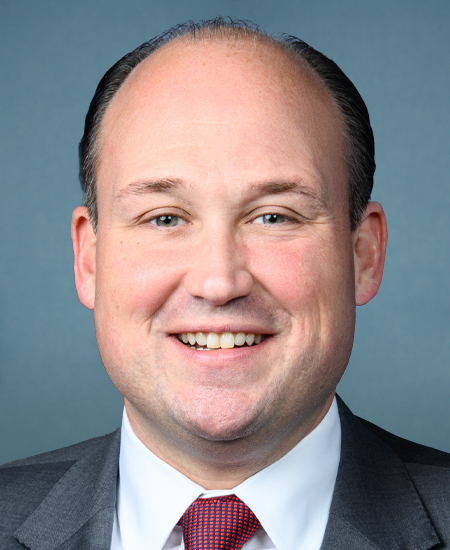
Photo of Nicholas A. Langworthy
R United States House · District 23 · New York On the 2026 ballot

Rep. Nicholas A. Langworthy

Compare
Total votes
1,879
all sessions
Attendance
96%
66 missed
Near the chamber average
With party
95%
of cast votes
Near the chamber average
Bipartisan score
3%
crosses aisle rarely
Near the chamber average
Sponsored
772
bills & resolutions
Near the chamber average
Committees
7
assignments
772 bills and resolutions

Sponsored bills

Total
772
Primary
81
Co-sponsor
691
This page
772
matching current filters
Co-sponsor HR 9337
In committee · United States House · Co-sponsor
Hydropower Licensing Affordability Act

Maddy summaryThe Hydropower Licensing Affordability Act amends the Federal Power Act to modify how federal licenses for hydropower projects are issued. Specifically, it requires that license conditions include measures to reasonably mitigate direct adverse effects on federal reservations and fish populations within applicable river systems. These changes aim to ensure that new or existing hydropower projects address environmental impacts on protected lands and aquatic species before a license is granted. The bill directly affects hydropower project developers and federal agencies responsible for licensing and environmental oversight.

In committee Jun 18, 2026 1 co-sponsor
Co-sponsor HR 425
In committee · United States House · Co-sponsor
Repealing Big Brother Overreach Act

Repealing Big Brother Overreach Act This bill repeals the Corporate Transparency Act. The act requires existing companies and newly created companies to report beneficial ownership information to the Department of the Treasury’s Financial Crimes Enforcement Network for purposes of addressing the financing of terrorism and money laundering.

In committee Jun 18, 2026 1 co-sponsor
Co-sponsor HR 9305
In committee · United States House · Co-sponsor
Juice for Healthy Families Act of 2026

Maddy summaryThe Juice for Healthy Families Act of 2026 amends the Child Nutrition Act to increase the maximum monthly allowance of single-strength juice for participants in the Special Supplemental Nutrition Program for Women, Infants, and Children (WIC). Under this change, families receiving Food Packages IV, V, VI, or VII would be authorized to receive up to 128 fluid ounces of juice per month instead of the current limit. This policy adjustment directly affects WIC participants by expanding their access to juice as part of their nutritional support. The bill does not alter eligibility requirements or the overall structure of the program, focusing solely on the specific quantity of juice permitted.

In committee Jun 11, 2026 1 co-sponsor
Co-sponsor HR 9304
In committee · United States House · Co-sponsor
Juice Access Improvement Act

Maddy summaryThe Juice Access Improvement Act modifies the Special Supplemental Nutrition Program for Women, Infants, and Children (WIC) to make juice the standard food benefit for specific participant groups, including young children, pregnant women, and breastfeeding mothers. Under this bill, the Secretary of Agriculture must require state agencies to set juice as the default option while still allowing participants to request a cash-value voucher instead if they prefer other food items. The law defines eligible juice based on existing federal nutritional standards and ensures that the value of any cash vouchers used for substitutions is adjusted annually for inflation. This change directly affects families enrolled in WIC food packages designed for children, pregnant women, and postpartum or breastfeeding individuals.

In committee Jun 11, 2026 1 co-sponsor
Co-sponsor HR 9298
In committee · United States House · Co-sponsor
Stopping Harmful and Outrageous Torts Act

Maddy summaryThis bill, known as the Stopping Harmful and Outrageous Torts Act, expands legal protections for firearm manufacturers and sellers by strengthening their immunity from civil lawsuits. It requires courts to immediately dismiss any pending cases against these companies that are based on the criminal or unlawful misuse of a gun by a third party, while also clarifying that sellers are not liable for negligence in entrusting products to others. The legislation further restricts who can file such suits by prohibiting foreign governments from bringing these claims and adding a specific exception for victims under the age of 17, though it maintains immunity for cases involving design or manufacturing defects. Additionally, the bill allows companies to move these cases to federal court and grants them the right to appeal dismissal orders immediately, along with the ability to recover legal fees if they win. Finally, it preempts state and local laws that attempt to impose liability on these entities for the same types of misuse-related harms.

In committee Jun 11, 2026 1 co-sponsor
Co-sponsor HR 5408
Passed · United States House · Co-sponsor
Faster Labor Contracts Act

Maddy summaryHR 5408, the Faster Labor Contracts Act, requires employers to begin negotiating a first contract with a newly certified union within 10 days of written request. If no agreement is reached within 90 days, the parties must seek mediation, and if unresolved after 30 days of mediation, the dispute moves to binding arbitration by a three-member panel. The arbitration decision, based on factors like employer finances, industry standards, and cost of living, becomes binding for two years. This bill directly affects newly certified unions and their employers during initial contract negotiations, aiming to reduce delays that currently average 465 days.

Passed Jun 10, 2026 1 co-sponsor
Primary HRES 1345
Passed · United States House · Lead sponsor
Providing for consideration of the bill (H.R. 8312) to establish fraud prevention and program integrity functions and data sharing authorities within the Department of Treasury and a permanent governmentwide Inspector General for Fraud, Accountability, and Recovery, and for other purposes; providing for consideration of the bill (H.R. 8464) to amend title 31, United States Code, to authorize pausing and segmenting payments, and for other purposes; providing for consideration of the resolution (H. Res. 1335) condemning actors seeking to defraud the United States Government, and expressing the sense of the House of Representatives that governmentwide fraud and improper payment prevention reforms will meaningfully improve the financial prosperity of the United States, and that Federal program eligibility should be verified before payment; and providing for consideration of the bill (S. 2) to provide for reconciliation pursuant to title II of S. Con. Res. 33.

Maddy summaryThis resolution is a procedural measure that sets the rules for debating and voting on four separate pieces of legislation related to government oversight and budgeting. It allows the House to consider bills that would create new fraud prevention units within the Treasury, establish a permanent inspector general for fraud, and authorize pausing government payments to verify eligibility. Additionally, it facilitates the consideration of a resolution condemning fraud and a bill to enable budget reconciliation. By waiving certain procedural objections, the resolution streamlines the legislative process for these specific items.

Passed Jun 9, 2026 0 co-sponsors
Primary HR 9117
In committee · United States House · Lead sponsor
CHECK Act of 2026

Maddy summaryThe CHECK Act of 2026 requires healthcare intermediaries, such as pharmacy benefit managers and third-party administrators, to provide group health plans with quarterly, detailed reports on their pricing formulas, rebates, and fees without charge. This legislation also mandates that these providers supply specific data on alternative payment models and prohibits contract clauses that delay or restrict access to this financial information. Additionally, the bill expands transparency for patients by requiring health plans to send itemized explanations of benefits within 45 days of a payment request and obligating healthcare providers to issue itemized bills that include plain language descriptions, billing codes, and charity care information. These new reporting and billing requirements are designed to help plans verify costs and enable patients to better understand their medical expenses. Non-compliance with these disclosure rules could result in civil penalties of up to $100,000 per day for service providers and up to $10,000 per instance for healthcare facilities.

In committee Jun 3, 2026 0 co-sponsors
Co-sponsor HR 1041
Passed · United States House · Co-sponsor
Veterans 2nd Amendment Protection Act

Maddy summaryHR 1041, the Veterans 2nd Amendment Protection Act, prevents the Department of Veterans Affairs (VA) from automatically sending veterans' personal information to the national background check system (NICS) solely because a court has appointed a fiduciary (like a guardian) to manage their benefits. This directly affects veterans who have a fiduciary appointed due to mental health or cognitive challenges but are not deemed a danger to themselves or others. The bill requires a court order finding the veteran poses a danger before any such information can be shared with the NICS. It changes VA procedures to block unnecessary barriers to firearm ownership for veterans who qualify for fiduciary support without a judicial determination of danger.

Passed Jun 2, 2026 1 co-sponsor
Co-sponsor HR 8990
In committee · United States House · Co-sponsor
Protect Domestic Oil and Gas Small Business Act of 2026

Maddy summaryThis bill, titled the Protect Domestic Oil and Gas Small Business Act of 2026, exempts small oil and gas wells from specific environmental regulations under the Clean Air Act. It directly affects owners and operators of marginal wells, defined as sites producing 15 barrels of oil or less per day, or 90,000 cubic feet of natural gas or less per day. The legislation removes requirements for monitoring, reporting, and leak detection for these smaller operations, while also mandating that the EPA approve any state plan revisions granting this exemption within 180 days. Additionally, the bill requires the EPA to update its regulations to reflect these changes and to terminate any ongoing enforcement actions against marginal wells that were initiated before the law takes effect.

In committee May 21, 2026 1 co-sponsor
Showing 51 to 60 of 772 bills
Previous 1 … 5 6 7 … 78 Next