Maddy summaryHR 53 (FIND Act) requires federal contractors to certify they do not refuse to work with firearm manufacturers, dealers, ammunition sellers, or related safety device companies based on bias. It prohibits main contractors from awarding subcontracts exceeding 10% of a contract’s value to entities that fail to make this certification, and bans efforts to circumvent the rule through complex subcontract tiers. The law applies to all federal procurement contracts, directly affecting businesses bidding on government work. Violations risk contract termination and suspension from future government contracts.
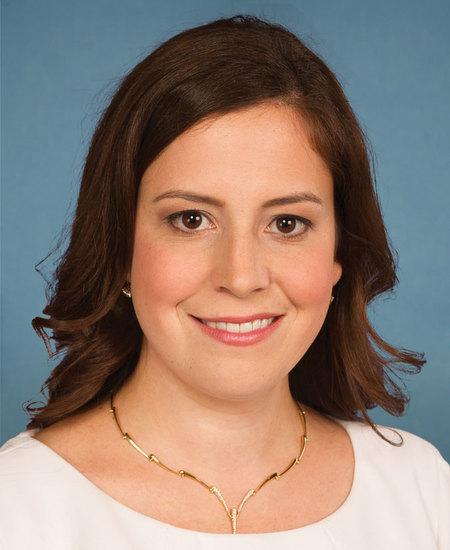
Rep. Elise M. Stefanik
Sponsored bills
Maddy summaryThis bill requires large district attorney offices (serving jurisdictions of 380,000+ people) that receive federal Byrne grant funds to submit annual reports to the Attorney General. The reports must detail prosecution decisions for 10 specific violent crimes and gun offenses (including murder, rape, robbery, aggravated assault, burglary, and firearm violations), such as cases declined, plea agreements, and defendant histories. The Attorney General must establish uniform reporting standards and share all collected data publicly with Congress and on a government website. This policy change directly affects major prosecutors' offices receiving federal crime-fighting funds, aiming to increase transparency in how they handle serious offenses.
This resolution elects the following officers of the House of Representatives: (1) Cheryl L. Johnson as Clerk, (2) Catherine Szpindor as Chief Administrative Officer, and (3) Rev. Dr. Margaret Grun Kibben as Chaplain.
Sami's Law This act addresses safety requirements for passengers and drivers of ride-sharing companies (e.g., Uber, Lyft, or taxicabs). The act requires the Government Accountability Office to submit to Congress a biennial report that includes the results of a study regarding (1) the incidence of fatal and non-fatal physical assault and sexual assault in the preceding two calendar years on drivers by passengers of ride-sharing vehicles and on passengers by drivers of such vehicles, (2) the nature and specifics of any background checks conducted on prospective drivers of ride-sharing vehicles, and (3) the safety steps taken by ride-sharing companies related to rider and driver safety.
This act designates the facility of the United States Postal Service located at 15 Chestnut Street in Suffern, New York, as the Sergeant Gerald T. "Jerry" Donnellan Post Office.
This act directs the Speaker of the House of Representatives and the President pro tempore of the Senate to arrange for the posthumous award of a Congressional Gold Medal to commemorate Glen Doherty, Tyrone Woods, J. Christopher Stevens, and Sean Smith, four Americans killed in the September 11, 2012, attack on the U.S. consulate in Benghazi, Libya. (Stevens was the U.S. Ambassador to Libya at the time, Smith was an officer in the Foreign Service, and Doherty and Woods were both government contractors and former Navy SEALs.) After the medal has been awarded, it shall be given to the Central Intelligence Agency Museum.
Fair and Open Skies Act This bill prohibits the Department of Transportation (DOT) from issuing a foreign air carrier permit or an exemption from certain air carrier certificate requirements under the United States-European Union Air Transport Agreement of April 2007, unless DOT finds that issuing the permit or exemption would be consistent with Article 17 bis of the agreement, which provides that opportunities created by the agreement do not undermine labor standards or the labor-related rights and principles contained in the laws of the respective parties to the agreement; and imposes conditions on the permit or exemption necessary to ensure compliance with Article 17 bis . The bill modifies policy considerations relating to air carrier certificates to require DOT to consider preventing entry into U.S. markets by flag of convenience carriers (i.e., foreign air carriers established in a country other the home country of their majority owner in order to avoid regulations of the home country) and preventing the undermining of labor standards. In carrying out such air carrier certificate requirements, DOT must consider preventing entry of flag of convenience carriers into U.S. markets as being in the public interest and consistent with public convenience and necessity for safety in air transportation and air commerce. In formulating U.S. international air transportation policy relating to the elimination of discrimination and unfair competition, the Department of State and DOT must include in their considerations the undermining of labor standards.
Cardiovascular Advances in Research and Opportunities Legacy Act This act addresses research, education, and awareness concerning valvular heart disease and its treatment. This disease is caused by damage to or disease affecting any valve that controls blood flow in the heart. The National Institutes of Health may conduct or support research on the disease in consultation with the National Heart, Lung, and Blood Institute (NHLBI). The NHLBI must also conduct a workshop on mitral valve prolapse, which occurs when the valve between the chambers of the left side of the heart seals improperly. The Department of Health and Human Services (HHS) must develop best practices to treat valvular heart disease. HHS may also carry out other projects to increase education and awareness of the disease.
Big Cat Public Safety Act This act revises requirements governing the trade of big cats (i.e., species of lion, tiger, leopard, cheetah, jaguar, or cougar or any hybrid of such species) under the Lacey Act to limit the possession, breeding, and exhibition of big cats. The Lacey Act prohibits any person from importing, exporting, buying, selling, transporting, receiving, or acquiring big cats across state lines or the U.S. border. However, some exemptions are provided for certain entities, such as universities and wildlife sanctuaries. (Sec. 3) The act expands the Lacey Act prohibitions to include a prohibition on possessing or breeding big cats. Breeding means facilitating propagation or reproduction (whether intentionally or negligently), or failing to prevent propagation or reproduction. Owners of big cats that were born before this act's enactment may keep their big cats, but the owners must register them with the U.S. Fish and Wildlife Service. The act modifies the list of entities that are exempt from prohibitions to export, buy, sell, transport, receive, acquire, possess, or breed big cats. The modified list includes exemptions for entities or facilities exhibiting animals to the public if they (1) hold a Class C license in good standing under the Animal Welfare Act, and (2) do not allow individuals to come into direct physical contact with big cats. However, direct contact is allowed if the individual is a trained professional, a veterinarian, or directly supporting conservation programs that do not involve commercial activities and meet other specified restrictions. (Sec. 4) A person who knowingly violates the act must be fined not more than $20,000, or imprisoned for no more than five years, or both. The act considers each violation to be a separate offense. The offense must be deemed to have been committed not only in the district where the violation first occurred, but also in any district in which the defendant may have taken or been in possession of the prohibited wildlife species. (Sec. 5) The act extends forfeiture provisions to fish, wildlife, or plants that are bred or possessed; thus, big cats bred or possessed in violation of the act are subject to forfeiture. (Sec. 6) The Department of the Interior must issue regulations to implement this act.

Putting Investors First Act of 2022 This bill requires a proxy advisory firm to register with the Securities and Exchange Commission and prohibits an unregistered proxy advisory firm from using interstate commerce to provide proxy-voting advice, research, analysis, or recommendations to any client. With respect to these firms, the bill (1) establishes procedures for both registration and termination of registration; (2) requires each firm to employ an ombudsman, designate a compliance officer, and publicly disclose conflicts of interest; (3) allows issuers to assess and comment on proxy voting recommendations; and (4) prohibits unfair, coercive, or abusive practices. The bill establishes a private right of action against a proxy advisory firm that endorses an approved proposal that is not supported by the issuer and is found to be illegal.